
I thought I knew how she fit in my life. Until she was gone.
A little over a year ago, I sat in a salon chair, a leopard-print drape tight around my neck. Amelia stood behind me, snipping the dead ends off my blonde highlights, giving me the same haircut she’d given me for the past 20 years.
“Do you want to see where they sawed me open?” she asked, tossing a lock of her own aquamarine hair over her shoulder. She handed me her phone, and I bit back a gasp. The photo showed massive stitches running across her abdomen. It looked like she’d been clutched in the jaws of a lion.
“I just need to get through the rest of this bulls*it,” she said, taking her phone back. “I’m so sick of being sick.”
I glanced in the mirror and met her gaze. Ever since we were kids, her pale blue eyes had always glittered with a hint of defiance. But now they looked flat. Exhausted. When I stood to leave, I reached in for a hug, even though she’d never been much of a hugger. At least, not with me. But I pulled her body, which felt small in its black vintage dress, into my arms anyway.
“I’ll make an appointment in a few months,” I said, stepping through the swirl of hair that littered the floor.
“If I’m still here,” she said, attempting a half-hearted smirk.
I paused at the door. “You will be,” I said.
But she wouldn’t.
The Misfits’ Wall
Amelia and I were never really friends. Or were we? I didn’t know what to call the tangle of our years together. I only knew that when she died, the loss in some ways felt worse for my inability to categorize what we’d meant to each other. What does it mean to grieve someone you aren’t sure even really liked you that much?
Amelia and I had grown up together in the same sleepy Indiana town, attending the same Catholic high school. While Amelia jazzed up her school uniform with ripped stockings and Doc Martens, I jazzed up mine with striped tube socks and a large, fake sunflower pinned to my coat. Amelia was punk rock, while I was a theater kid. Both meant we often ate lunch outside with the misfits. This was the ‘90s, and our little clutch of kids spent those afternoons huddled against a brick wall, passing around Pixies cassettes and cigarettes. A few feet away, a statue of the Blessed Virgin frowned at the illicit smoking. But Amelia and I weren’t really there for the Marlboros. We were there for a boy.
Sam had shiny brown hair that hung to his waist, and on the weekends he strutted sexily across a stage in fishnets and a corset, playing Riff Raff in The Rocky Horror Picture Show. Sam was also in a band, and sometimes after school I’d go watch him practice in his mother’s basement. I’d walk down the carpeted steps in my school uniform, only to find Amelia already there. Together we’d sit in our matching navy skirts, quietly ignoring each other, as we watched Sam swing his hair and thrash at the drums. Neither of us ever managed to win Sam, though of the two of us, Amelia got closer, victoriously making out with him in her hatchback.
After high school, I went on to college, while Amelia went to cosmetology school. We lost track of each other in that blur of years, until we both resurfaced in New York City in our early 20s. I’d heard from friends that she was doing hair, and as I’d just had a disastrous experience at a Queens salon that left my hair the color and texture of a hay bale, I nervously made an appointment with her. The last time I’d seen her, she’d been scowling through the halls of our high school. Now she was wrapping my head in foils, her large skull rings weaving through my hair, while the sounds of Manhattan blasted through the window.
The Appointment
I had a brief, ridiculous worry that she might seek revenge over our old rivalry, that she might swivel my chair to the mirror and reveal she’d bleached my hair banshee white. When she finished, I was thrilled to see it was the best cut and color of my life. I let out an audible “whew!” and she grinned in amusement.
She would go on to do my hair for the next two decades. I always requested the same boring shade of blonde, whereas her hair was always a circus of color—sometimes popsicle purple, sometimes a witchy green. Amelia would do my hair in different salons all over the city, and once, when we were both visiting our hometown at the same time, she did it at my parents’ house, rinsing my hair in the pink porcelain sink of my childhood.
When I was in my 30s, she did my hair for my wedding, which was a big family affair at a formal event space. And though she styled my hair in the loose curls I requested, she declined my invitation to attend the reception.
She got married herself around the same time, though she did so in Vegas, wearing a scarlet dress while standing before a swaggering Elvis impersonator. That marriage wouldn’t last, however, and much of Amelia’s romantic life was as wild as her hair. She was always madly in love, or madly out of love, and I never knew when I plopped into her salon chair what torrid tale of passion she’d be sharing that day. But share she would. Because Amelia loved to talk, and would do so nonstop while swabbing color onto my dark roots.
Perhaps the only thing she was more passionate about than men was politics. A fierce activist, she would deliver lengthy, enraged tirades about the failure to protect the poor and vulnerable. I once joked that she needed her own podcast, and she guffawed at this, taking a deep drag off her vape.
“I don’t know about that,” she said, exhaling cannabis into the back of my neck.
Sometimes she’d hand the vape over to me, and the conversation would devolve from the electoral college into things far sillier, like reminiscing about high school and the name of Sam’s band. (“Incriminator!” we’d shout, sputtering with laughter.)
Eventually, she would leave New York and open a salon in Louisville, Kentucky, across the river from where we’d grown up. It was a tiny shop with a bright red awning, the inside decorated with doll heads and neon stickers denouncing fascism. I would visit the salon whenever I was in town, and when protests exploded, I remember sliding wide-eyed into the swivel chair and asking how she’d been.
“Well, I got pepper sprayed by riot police yesterday,” she said, whipping a spiderweb-print drape over my chest while checking her violet lipstick in the mirror. “And then my friends and I chased some thugs out of a bar.”
Then Everything Changed
Only a few years later, I stumbled across her Instagram post announcing her stage four colon cancer. Stunned, I texted her and asked what I could do. I quickly sent a Seamless card and Venmoed some money, though these gestures felt ridiculous in light of the problem. Like offering a squirt gun to someone engulfed in flames.
How could someone as fierce as Amelia be sick? It seemed to go against the natural order of things. And I fully expected Amelia to treat cancer the same way she would thugs in a bar: smashing it out with a brick. But cancer, of course, cares little about how bright and blazing someone’s personality is.
In the midst of her many treatments, Amelia made plans to remarry, this time to a kindly, longtime boyfriend. I wasn’t invited to the wedding, though I never expected to be. But I regularly checked in for details, as she seemed to relish the planning. It was clear she wasn’t getting better, but we didn’t discuss this. Instead, we texted about her rose-patterned dress. The flowers. Her electric blue manicure.
Then late one night, a text popped up from her, rather shyly asking if I might help her write her wedding vows. I was surprised, but honored, and as I brainstormed some ideas for her, I was struck that we’d first crossed paths as adolescents on the hunt for love. Now, both middle-aged women, I was helping her find words for her final love story.
The Coat
A few months later, I was sitting in my Brooklyn apartment, shopping online for a winter jacket. I was about to click purchase on a preppy gray peacoat, when my phone rang. It was a friend from back home. He wanted to know if I knew. Amelia was gone.
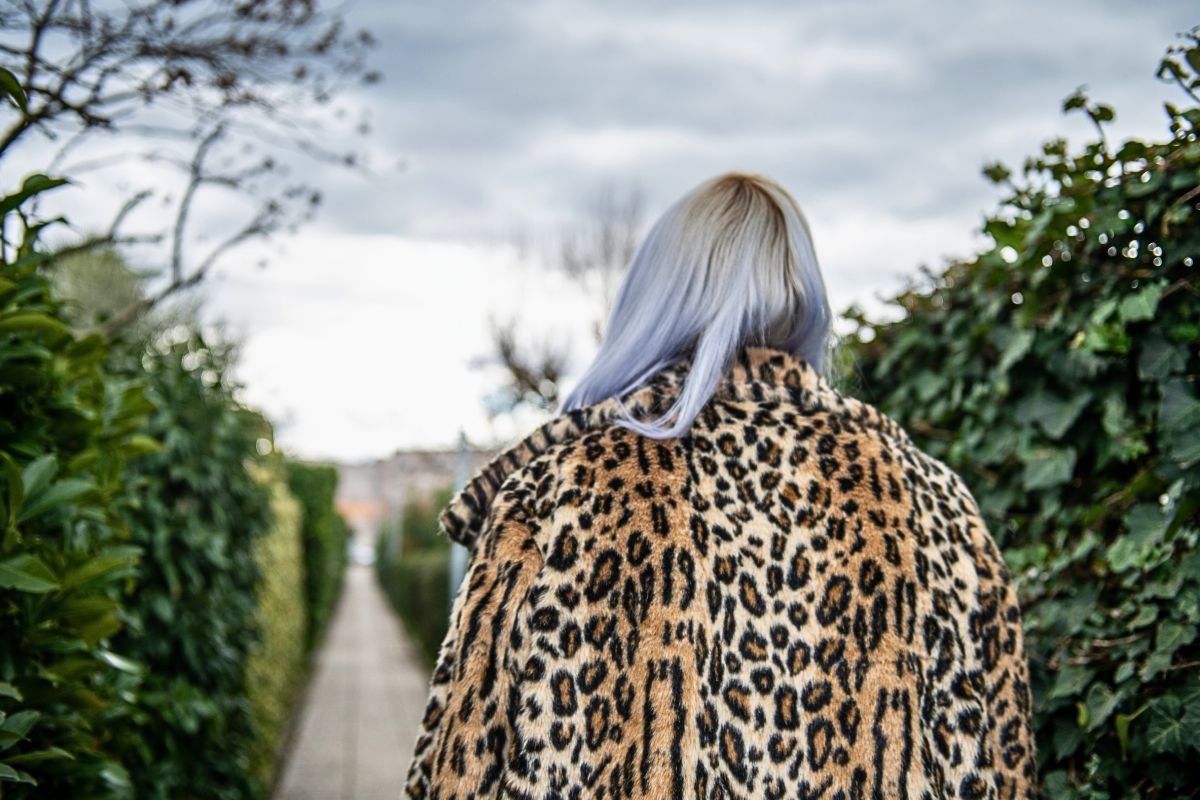
It shouldn’t have been shocking. But even still, I felt blindsided. When we hung up, I stared blankly at my computer. And as if on autopilot, I emptied the peacoat from my cart, and instead, dropped in a faux-fur leopard-print number. It wasn’t my style in the least. It was Amelia’s. But I blearily blinked through tears and clicked purchase.
It felt ridiculous, but I wanted the coat as some sort of evidence. That she was here. That I knew her. That we were … what? I didn’t know. When I tried to conjure something to fit the framework of our relationship, I could think only of Steel Magnolias. Is that what we were? A slightly stoned Truvy and Clairee talking politics, then joking about men’s penis sizes?
Maybe. Or maybe some relationships just refuse to be slotted into easy boxes. Amelia and I were client and stylist. We were acquaintances and confidantes. We were, once upon a time, two teenage girls standing in a basement, waiting for our lives to start.
I can so easily remember how that little room pulsed and crashed with sound, and how the wave of it washed over us, passing through us. I think of it every time I pull on that coat. I’m aware it doesn’t quite suit me, as I look much more like a crackpot lady singing showtunes at the bus stop in it than glam rock. But when I wear it, I like to imagine that long ago drumbeat is still out there somewhere, rumbling through space and time—a radiant force that is never, ever really gone.



28 Responses
This was so beautifully written; brought me to tears.
Thank you so much. I’m so glad you were moved by it. Thank you for reading!
This is a beautiful tribute to a woman who left her mark on your life and a wound in your heart. I bet she’s tickled pink (or maybe purple or turquoise) that you wear the leopard-print coat in her honor.
Love this reply. Thank you so much!
Damn. (Sobbing face.)
Thank you so much for reading!
What a beautiful tribute to your friend and trip down your personal memory lane. Thank you.
And thank YOU for reading! I’m glad you liked it.
This hit me hard, it in a good way. I had very few friends, always on the edge of groups in high school and college. There have been only 4. One passed away 6 years ago. Your description of your friend brought mine back into sharp remembrance. Thank you.
I’m so sorry you also lost someone. But I’m glad I brought back some nice memories for you. Thank you for reading!
Friendship comes in as many shades as hair does. It doesn’t have to be deep to be true. This lovely tribute is testament to your friendship and her colorful impact on your life.
Love this.
Love this comment. Thank you so much!
Thank you for sharing this messy and beautiful relation/friendship. One could only hoped to be honored in such an extraordinary way. Hope you enjoy your coat!
Thank you! And I do love my coat. Thank you for reading.
I’m so sorry for your loss. And I love that you bought that coat.
Thank you, and thank you for reading!
Enchanted by the way you write and this beautiful story of friendship. Yes, of course you were friends! Thank you for a wonderful start to my day.
Well this comment makes MY day! Thanks very much, and thanks for reading!
What a lovely tribute to an old friend.
Thanks so much!
Beautiful story. Thank you for sharing it.
How true that all friends don’t fit the mold but we mold them in anyway, somewhere.
A variety of friends for different reasons makes life interesting.
Thank you for a story everyone should be able to relate to.
Well written.
And thank you for reading! I’m glad you enjoyed it.
I miss her.
And than you for sharing and helping to keep her around.
What a tale, and the way you told it. You two shared a realm of experiences throughout many phases of your lives. Whatever you call your relationship, you shared together, and cared. Amelia’s life mattered. Beautiful.
Thank you so much for this very sweet and thoughtful comment. I’m so glad you enjoyed it. Thanks for reading. ♥️