
You don’t need diabetes to purchase this data-gathering wearable. Learn why the tech trend is taking off and whether the information it shares really moves the needle for women’s health.
It’s 5 p.m. on a Tuesday, and you’ve just downed a fruit salad before a late-afternoon workout. Feeling semi-virtuous for having skipped the Snickers bar, you grab your bag and head for the door, but wait … what’s that? The little pop-up on your continuous glucose monitor phone app alerts you to a rapid rise in your blood sugar. You keep moving out the door, but doubt creeps in: What just happened? Is fruit bad for me? Should I skip it tomorrow?
Like Fitbits or Oura rings, continuous glucose monitors (CGMs) promise users insightful health metrics—in this case, about blood sugar levels. And while it may seem like information overkill to some, there’s a very real reason women—particularly those over 50—want the data: In a world of medical gaslighting and doctors who don’t have time to answer questions about unexplained weight gain, sleepless nights, hair loss, or heart palpitations (we could go on), owning your own health data is a sanity check. There’s a measurable, scientific explanation for what’s going on with your body.
But the use of CGMs for nondiabetics is a topic of increasing debate. “The meaning of fluctuations in blood glucose is uncertain in people without diabetes,” wrote the authors in a 2026 paper in JAMA. “Using CGM to avoid spikes may lead people to unnecessarily restrict healthy foods … or replace them with less healthy options.”
And for women during or after menopause, natural changes in blood sugar call into question the relevance of CGM data. Yet the trend continues to grow, with the U.S. market for over-the-counter CGMs valued at $194 million in 2025 and nondiabetics accounting for the largest share of that revenue.
So, does the hype equal better health?
What Is a Continuous Glucose Monitor, and Who Uses One?
When the first CGM received approval from the Food and Drug Administration (FDA) in 1999, the clunky, pager-sized device was considered an information-gathering tool for doctors. Adoption among patients was slow. But in recent years, better technology, Medicare coverage for eligible users, and a growing interest in DIY wellness have seen its use skyrocket.
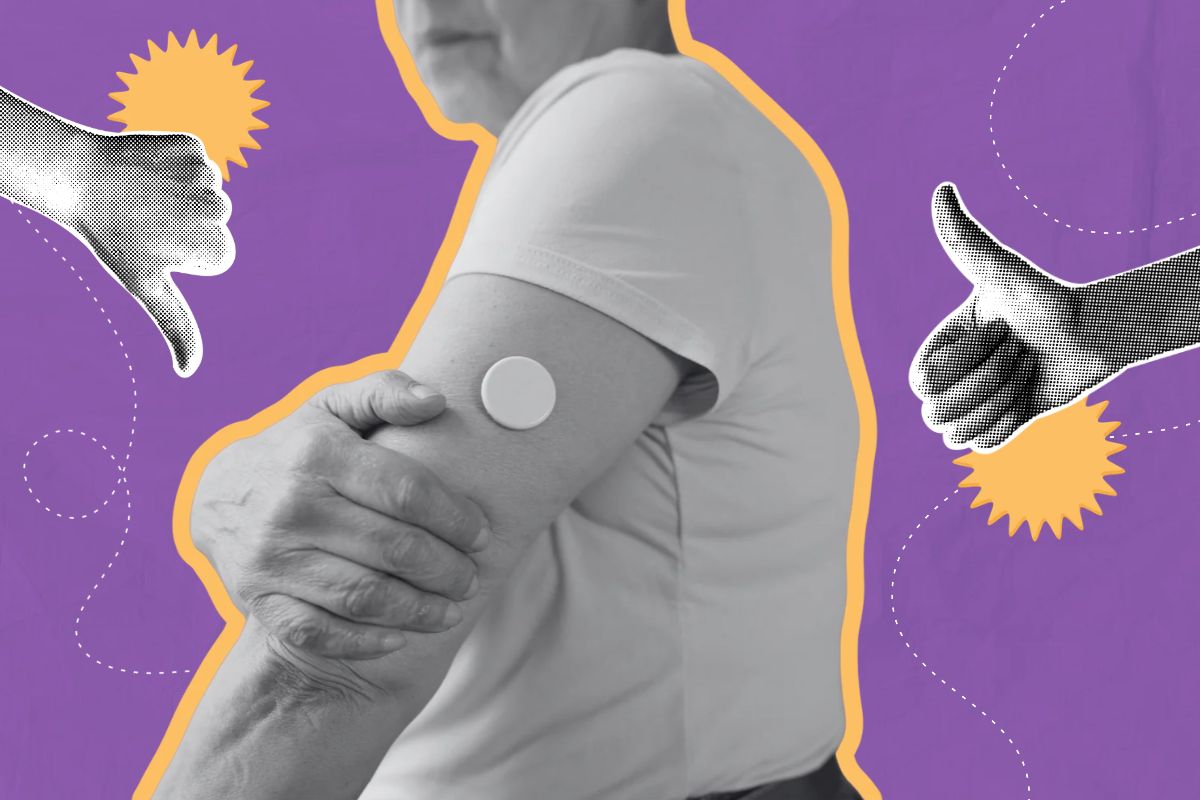
Today’s version features a tiny, flexible filament inserted just under the skin and covered with a small adhesive patch. The sensor transmits data to a smartphone that runs it through a proprietary algorithm, then displays an approximation of real-time glucose readings.
“At this point, CGMs are standard of care for anyone taking insulin,” said endocrinologist Gillian Goddard, M.D., an adjunct assistant professor of medicine at the NYU Grossman School of Medicine in New York City.
The arrival of newer, nimbler, more discreet versions of CGMs corresponded with a growing public interest in health wearables. In 2024, the FDA cleared the first CGM for over-the-counter sales to adults who don’t use insulin, including people without diabetes. Manufacturers quickly found a new audience among people interested in how food, exercise, sleep, and hormonal changes affected their glucose levels and, in turn, overall health.
How Does Menopause Affect Blood Sugar?
As it turns out, there’s another variable that affects blood sugar levels, and it’s not one midlife women have a lot of control over. “When women go through menopause and estrogen levels drop, they’re more likely to form visceral fat in their midsection and around their organs, which can make them insulin resistant,” Goddard explained. “That means it takes more insulin to keep blood sugar normal, and so blood sugar rises.” Some women will develop diabetes; others will be able to control their blood sugar by balancing their diet—which one depends largely on genetics, according to Goddard.
Given that an increased risk for metabolic disease in postmenopausal women is linked to hormonal changes affecting blood sugar levels, it’s understandable why some women see glucose monitoring as beneficial to their health. Yet the out-of-pocket cost isn’t cheap: “A one-month supply of [Dexcom’s CGM] Stelo costs about $100,” said Toni Isabella, R.N., manager of the diabetes program at Hackensack University Medical Center in New Jersey.
While CGMs can reveal high glucose levels, they’re not diagnostic tools for diabetes. “We don’t have validated CGM criteria for that diagnosis,” said endocrinologist Priyanka Majety, M.D., who specializes in diabetes and metabolic disorders at VCU Health in Richmond, Virginia. “It requires a laboratory A1C, fasting plasma glucose, or oral glucose tolerance test. The evidence that wearing a CGM improves long-term health or prevents diabetes remains limited.”
Can a CGM Cause More Worry Than It’s Worth?
Given their limitations, why are CGMs growing in popularity? Isabella said that it may come down to women wanting a seat at the table when it comes to managing their health. “Weight comes on after 50, you’re not sleeping so you’re cranky, which means you’re snacking on more carbs—one thing leads to another with women’s health around menopause, and it feels unfair,” she explained. “Women feel stuck—they have all these challenges and don’t know what to do about them.”
With wearables, the information is there for you to view and act on. “CGMs capture information that you would otherwise not have,” said Isabella.
But accessing that data is just half the equation. “Anytime you collect data, you want to know what to do with it,” said Goddard. “For nondiabetics, the risk is someone deciding they shouldn’t eat an apple at 5 p.m. because their blood sugar spiked. You can’t use a CGM to determine your diet.”
“Glucose naturally fluctuates, and seeing every rise and dip can make a normal response to food feel like a health problem,” Majety agreed. “And for people prone to health anxiety, repeatedly checking the app may make that worry worse.”
There’s also the misconception that a spike in blood sugar is bad. “Your brain and muscles need glucose to operate,” Majety said. “It’s not a metric you can track for consistency and base your daily health decisions off it.” For instance, low-intensity exercise like walking around the block can lower blood glucose levels, said Goddard. But high-intensity exercise like going for a run may raise it. That doesn’t mean running is bad—it’s great for your heart and muscles. It just means context is everything.
What Should You Track Instead?
Despite reservations from the medical community over CGMs’ usefulness, when you consider that more than two in five American adults have prediabetes, a device that encourages mindfulness about sugar intake isn’t all bad. “On the positive side, it could help women make better choices and be more active,” Isabella said.
Majety acknowledged its potential as a carrot for healthier habits. “A CGM can show how glucose responds to meals, activity, sleep, and stress—some people find that immediate feedback motivating,” she said. But the drawbacks outweigh the benefits for her. “For people without diabetes, there are no validated normal ranges for glucose fluctuations, individual readings are less accurate than a lab test, and we don’t know what a single spike means for long-term health.”
So, what should you use if you’re looking for a tool to track your health? “Start with sleep tracking,” said Goddard, adding that when sleep is poor, blood pressure and blood sugar are higher and cognition is affected.
Put another way, you’re better off getting your sleep in good shape than obsessing over eating an apple.
Normal Blood Sugar Ranges With and Without Diabetes
Blood glucose targets are different if you have diabetes or don’t. Blood glucose levels fluctuate throughout the day and can be affected by what you eat, when you exercise, whether you’re stressed, and how much you sleep.
Per the American Diabetes Association, diabetes can be diagnosed using a fasting plasma glucose test (after at least eight hours of consuming nothing but water), a two-hour oral glucose tolerance test (blood sugar measured before and two hours after drinking a standardized glucose solution), or an A1C (a test that checks red blood cells for the percentage of hemoglobin with glucose attached). Results usually need to be confirmed on a second day. Here’s what the numbers mean for nonpregnant adults.
Diabetes:
A1C: 6.5% or greater
Fasting plasma glucose: 126 mg/dL or greater
Two hours after a glucose tolerance drink: 200 mg/dL or greater
Prediabetes:
A1C: 5.7% to 6.4%
Fasting plasma glucose: 100 mg/dL to 125 mg/dL
Two hours after a glucose tolerance drink: 140 mg/dL to 199 mg/dL
No Diabetes:
A1C: Less than 5.7%
Fasting plasma glucose: Less than 100 mg/dL
Two hours after a glucose tolerance drink: Less than 140 mg/dL
Reviewed by Sonya Maynard, health and wellness fact-checker, in November 2026.
**********
MEDICAL ADVICE DISCLAIMER
DISCLAIMER: This website does not provide medical advice. For health or wellness-related content, SFD Media LLC emphasizes that information about medicines, treatments, and therapeutic goods (including text, graphics, and images) is provided for general information only. No material on this site is intended to substitute for professional medical advice, diagnosis, or treatment. Users are advised to independently evaluate and verify the accuracy, reliability, and suitability of the information before relying on it. You should not rely on the content as a substitute for professional medical advice. Consult with a physician or other healthcare professional for any health concerns or questions you may have. SFD Media LLC is not responsible for any action taken based on the information provided on this website. The use of any information provided on this website is solely at your own risk.