
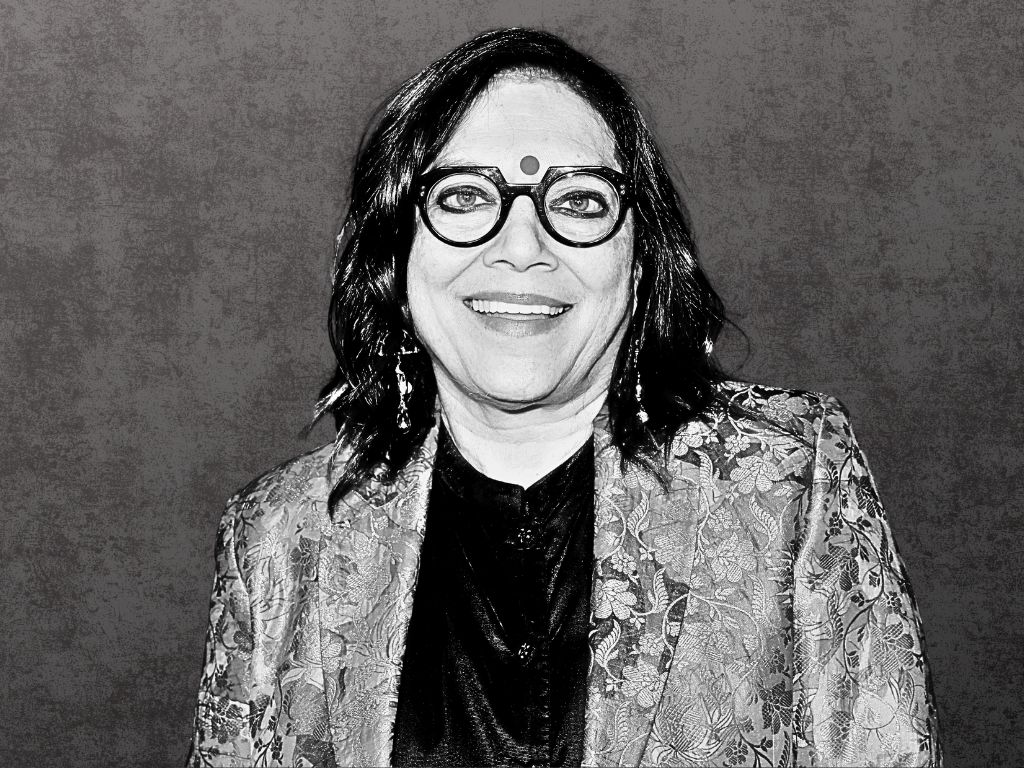
Zohran may be the newly historic mayor, but Mira Nair has spent decades shaping the world through film, storytelling, and a radical belief in visibility.
Her 34-year-old son was inaugurated as New York City’s first Muslim, South Asian, and African-born mayor on New Year’s Day, following an election that shocked the old guard and thrilled a new generation. In mom Mira Nair’s words, Zohran Mamdani “more than won the weekend” with his election.
Leave it to a filmmaker to draw the box office analogy. Nair, aka Momdani, may be trending now because of her son, but the India-born filmmaker, 68, has been blazing trails for decades. “I’m going to be the mother of New York City,” she told reporters after her son’s swearing in.
Mamdani embodies a lot of firsts, but Nair came first. Her films have long tackled complex social issues and captured universal themes in individual stories from around the globe, earning her dozens of glass-ceiling-breaking accolades, including an Oscar nomination.
It’s not hard to divine Nair’s legacy in her progressive son—yet he is just one of her creations. His political messages echo themes seen consistently in her work over the last four decades, not to mention in the tides of her exceptional life, where she has modeled balancing work and motherhood, art and commerce, creativity and public service.
Awareness and Independence
The Times of India went so far as to brand Nair the “true architect” of her son’s politics: “Her decades of cinematic storytelling, championing empathy and visibility, laid the groundwork for his political philosophy of inclusion and justice, proving art can indeed shape reality.” In Nair’s case, reality also shaped art.
Born in India to a Hindu family, Nair has credited her mother for her own social awareness and independence. At 18, she boldly embarked for America alone to study at Harvard. Destined for the arts, Nair explored a few mediums before she found her calling in film—not unlike her son’s slaloming path from the arts to politics (videos of his short-lived rap career are worth googling).
Courage and Commitment
Her early films were short documentaries that took on increasingly weightier topics in her home and adopted countries, like migration, sex work, and forced fetus gender testing in India (inspired by her own mother’s experience). “I have always been drawn to the stories of people who live on the margins of society—on the edge, or outside, always dealing with the question of what and where is home,” she told The New Yorker in 2002. “The point is to plunge into the layers of life in front of you and extricate the humanity that is local to that place, and to do it in a way that is so truthful that it becomes universal,” she told Vogue India—skills Mamdani has extended to politics.
Nair’s social commitment and service to others didn’t fade to black when end credits rolled. After the premiere of her Oscar-nominated debut feature, 1988’s Salaam Bombay!, Nair and her mother helped launch a non-profit to provide essential services to thousands of Mumbai street children. In Kampala, Uganda—where she gave birth to Zohran in 1991 to be near extended family—she created a training initiative for emerging East African filmmakers.
Identity and Integrity
Her son has cited that initiative’s motto—“If we don’t tell our own stories, no one else will”—as a #lifelesson from mom. Her films have long shown her doing just that. The steamy 1991 interracial romance, Mississippi Masala, about the daughter of Ugandan Indian immigrants (Sarita Choudhury) who falls for a local Black man (Denzel Washington), was widely well-received.
Follow-ups didn’t all fare as well. “You have to have the heart of a poet and the skin of an elephant” to be a filmmaker, Nair told Vogue. Even so, she has stayed steadfastly independent—“If they can buy your integrity, you don’t have it,” she’s said of mainstream Hollywood. Her refusal to trade integrity for access was particularly radical in an industry that already offered women—and especially women of color—fewer opportunities.
Balancing Motherhood and Career—With Help
Her biggest successes do seem to come when she sticks closest to her “own story,” like 2001 international hit Monsoon Wedding, which she’s described as “like spending two hours at my family’s dining table.” And Mamdani has always had a seat at the table. He reportedly convinced mom to pass up on a Harry Potter directing gig to make Bengali immigrant assimilation story The Namesake in 2006. On her popular 2016 Disney film Queen of Katwe, about a Ugandan chess prodigy, he’s credited as both music supervisor and third assistant director.
A photo of him as a little boy sitting on his mother’s lap on set recently elicited dozens of comments on Instagram, including this one: “I can totally relate to this! Congrats to all working mothers everywhere.” Nair explained to Harper’s Bazaar, “I never stopped working during my whole motherhood—because everywhere I went, right from babyhood to later, I had a caravan of three parents: my mother, my father-in-law, and my mother-in-law.”
Legacy of Artist and Mom
In interviews, Nair paints a loving portrait of the “deeply political,” globe-trotting, multi-generational Mamdani-Nair household(s) her son was raised in (dad Mahmood, who is Muslim, is a well-known professor and political author). “Of course, the world we live in, and what we write and film and think about, is the world that Zohran has very much absorbed,” she told The New York Times.
Unsurprisingly, mom has no shortage of proud words about her son, on whose mayoral campaign the whole multilingual family chipped in. “I love that he gives us all hope,” she crowed to Vogue India. “There’s a visionary aspect to how he sees the world. And it’s not about power. It’s about equality, justice, and real respect for working people.” Sound familiar?
Only time will tell if Mamdani has the political promise so many are pinning on him, but the traits voters so admired—and which Nair herself highlights in her son—are attributes she has embodied privately and publicly for decades.







2 Responses
Mira Nair is unquestionably a very gifted filmmaker. However, given that she has accepted tens of millions of dollars in funding from Qatar, a country that has an abysmal record on women’s rights and LGBTQ rights, she can hardly be called progressive or a feminist role model. In the summer of 2025, several news outlets, among them the New York Post and the Financial Express, published articles detailing the deep history of Nair’s connections to Qatar and the huge sums of money she has taken from the Qatari government, including the entire $15 million budget of her 2012 film, The Reluctant Fundamentalist. Nair has not denied any of these claims. Per the New York Post: “Qatar’s sharia-inspired social policies, which bar women from marrying or holding government roles without a male guardian’s permission and which can punish homosexuality with torture or even death, are at odds with the progressive images Nair and Mamdani have cultivated.” She is free to take money from whomever she pleases, obviously, but one cannot take millions from a country that is so oppressive toward women and other minorities and be considered a feminist or liberal. I recently discovered Provoked by Susan and I enjoy your website so much, so I was disappointed that your reporter did not raise the issue of Nair’s hypocrisy.
Mia, thank you for raising this. It’s a serious critique, and you’re right that the question of funding—especially from governments with deeply troubling records on women’s and LGBTQ rights—complicates how we evaluate public figures/creatives who are celebrated.
Your point underscores a real and ongoing tension: how artists navigate power, patronage, and compromise in a global system where funding often comes with ethical contradictions.
At PROVOKED, we’re interested in examining influence, achievement, and contradiction—sometimes within the same person; and sometimes, like in this article, that deeper conversation can happen here in the comments. The questions you raise are valid, and they’re part of a larger, harder conversation that often extends beyond the scope of a single article.
We appreciate engaged readers who push us to think more critically, and your comment adds an important dimension to the discussion and our community. —susan