
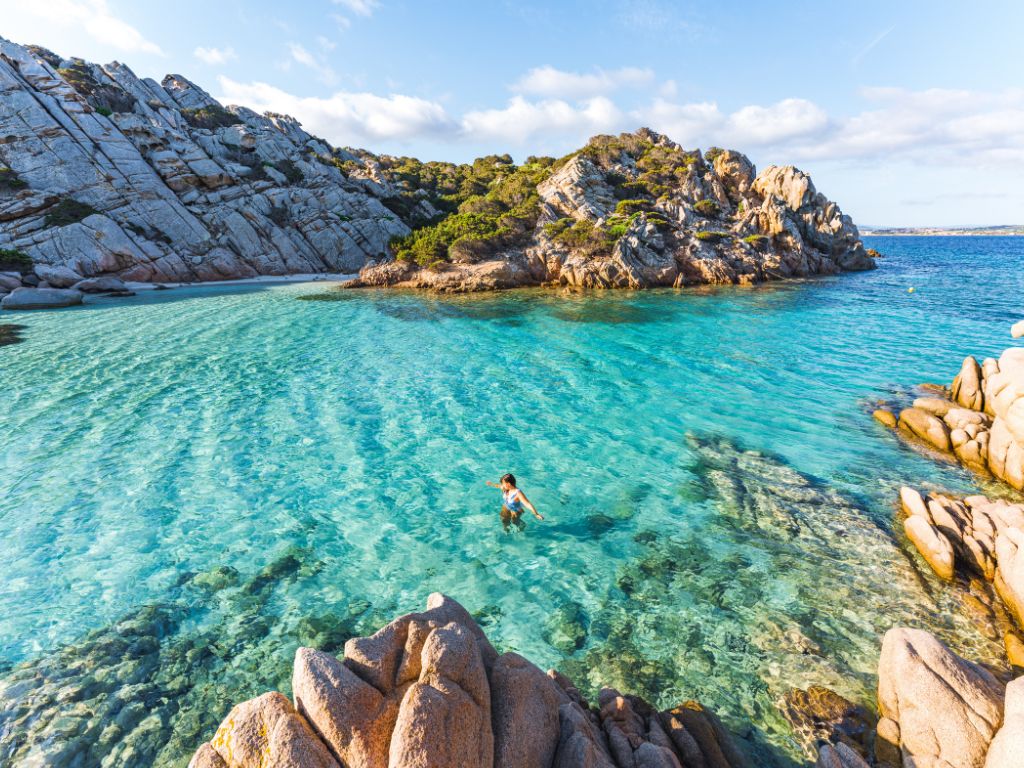
Why I came back after 30 years—and what I saw differently.
When an ex-boyfriend backed out of a trip to Sardinia, I went anyway. The island meant more than a Mediterranean postcard. It was home for two years, three decades ago. Returning wasn’t just a visit; it was an homage.
Back in 1995, my move to Sardinia was met with blank stares. Practically none of my American friends knew where it was on the map. When I’d tell Sards I was from New York, their brows shot up in disbelief. “Why would you leave there for this backwater?” they’d ask. I loved Manhattan, but I needed a break from the fast pace and concrete canyons. An Italian multimedia startup offered me a job.
I went.
Returning solo meant I could follow my own compass. There were old friends to connect with, favorite places to revisit, and new corners to explore. Today, Sardinia is a global destination, but few look past its turquoise fringe.
That’s where I wanted to lean in.
Sardinia Isn’t “Italy” the Way Most People Mean It
Nicknamed l’isola continente, Sardinia packs the complexity of an entire continent into the size of New Hampshire. Mountains rise abruptly from wetlands, shepherds and fishermen maintain parallel worlds, stone and sea exist in constant tension. Sardinia’s history predates Italy itself.
More than 7,000 Bronze-Age Nuragic towers still dot the landscape, stone proof of an indigenous civilization that refused to be conquered. Despite centuries of occupation by Phoenicians, Carthaginians, Romans, and Spaniards, the island’s identity remained untarnished. History isn’t boxed up in museums here. It lives in the food, the architecture, and the stubborn grip of local customs. Sardinia spins on its own cultural axis.
That’s the island I came back for. Not the beach-club version sold in brochures, but the one that reveals itself slowly—if you’re paying attention.
Oristano and the Sinis Peninsula—Beaches with Brain
After a whirlwind 48 hours catching up with friends in Cagliari, sipping aperitivos at Antico Caffe and chasing fiery sunsets over Poetto Beach, it was time to abandon civilization.
First stop, Oristano. It’s only 90 miles northwest, but worlds away. Across the fertile Campidano heartland, the source of the island’s citrus, wheat, and Terralba wine, the Sinis Peninsula unveils an untamed coast. Most travelers flock here for the pristine beaches.
The wiser ones stay for what lies beneath the sand.
Perched on a craggy rise, Tharros is the most badass ruin I’ve ever seen. It wasn’t just built. It was layered. Established by the Carthaginians in the 7th century B.C. upon Nuragic bones, it was later seized by Rome. As I wandered the basalt streets, the Mistral winds whipped at my face, murmuring like phantom echoes of a once-bustling port. From the skeletal Roman baths to temples reduced to grit, every fragment endured.
I clambered up the five-story, 16th-century Spanish Tower of San Giovanni di Sinis. From the top, the coastline dissolved into soft hues. After scanning the sandy coves with binoculars, I traded ancient stones for a late-September swim, history and pleasure sharing the same shoreline.
Its coastal exposure ultimately proved its undoing. By 1070 A.D., sea raids forced Tharros’s abandonment. Power shifted inland to Oristano, where narrow alleyways now host fashionable storefronts and buzzy cafés. Ceramicists flock here for the premium clay, displaying colorful work in open-air piazza exhibitions. Every Carnival the medieval Sa Sartiglia horse race reminds visitors that ritual still animates this city.
Fifteen minutes away at the Cabras Archaeological Museum, the “rock stars” of the Mediterranean—the Giants of Mont’e Prama—stand tall and ageless. These colossal, 3,000-year-old limestone boxers, warriors, and archers, shattered for millennia, have been reassembled and restored from thousands of fragments. Towering up to 7 feet tall, the stony, brooding titans are easily the Mediterranean’s most jaw-dropping archaeological find in the last half-century.
Pro tip: If you skip these, you’ve missed the soul of the island.
Lunch was edible geography, stripped down and served hot. The Cabras Lagoon is home to the source of Sardinia’s bottarga di muggine (mullet caviar). At Trattoria da Giulia, the spaghetti alla bottarga was a brine-soaked, umami bomb, slicked in olive oil and jagged with parsley. With UNESCO recently recognizing Italian cuisine, this hidden masterpiece won’t stay secret for long.
Barbagia and Nuoro—The Interior Most Travelers Miss
Many travelers never venture inland to the remote Barbagia region. Roman colonizers, enraged by fierce Nuragic resistance, branded the island’s core “barbarian.” Even today, the region’s granite spikes discourage the faint of heart, but the payoff is spectacular.
My drive from Oristano into Nuoro tightened into rocky slopes toward Monte Ortobene.
“Sardinian Athens,” as Nuoro is called, is the birthplace of Grazia Deledda, the 1926 Nobel laureate whose writing explored the endurance embedded in this landscape. Her childhood home offers a glimpse into 19th-century life, while the Museo del Costume, the island’s best ethnographic collection, offers a deep dive into the jewelry, masks, and finery of Sardinia’s subregions.
Beyond Nuoro, the road slices through the Supramonte summits toward Oliena. Beneath Monte Corrasi’s limestone cliffs lies Agriturismo Guthiddai. This family-run estate produces Nepente di Oliena DOC, a red wine prized for its spicy, full-bodied structure.
The chef serves a farm-driven menu that’s a master class in Sardinian gastronomy. Dinner featured crispy pane carasau, handmade macarrones de bocciu, and spit-roasted porceddu (suckling pig) slow-cooked over savory herbs. Seadas, a pastry filled with cheese and honey, capped a meal that felt rooted and visceral.
Mount Tiscali—the Hike That Changes the Whole Trip
If Sardinia has a sacred pilgrimage, this is it. Hidden inside a collapsed sinkhole at the summit of Mount Tiscali lies a 3,000-year-old village. This geological wonder served as a sanctuary for Nuragic people hiding from Roman legions.
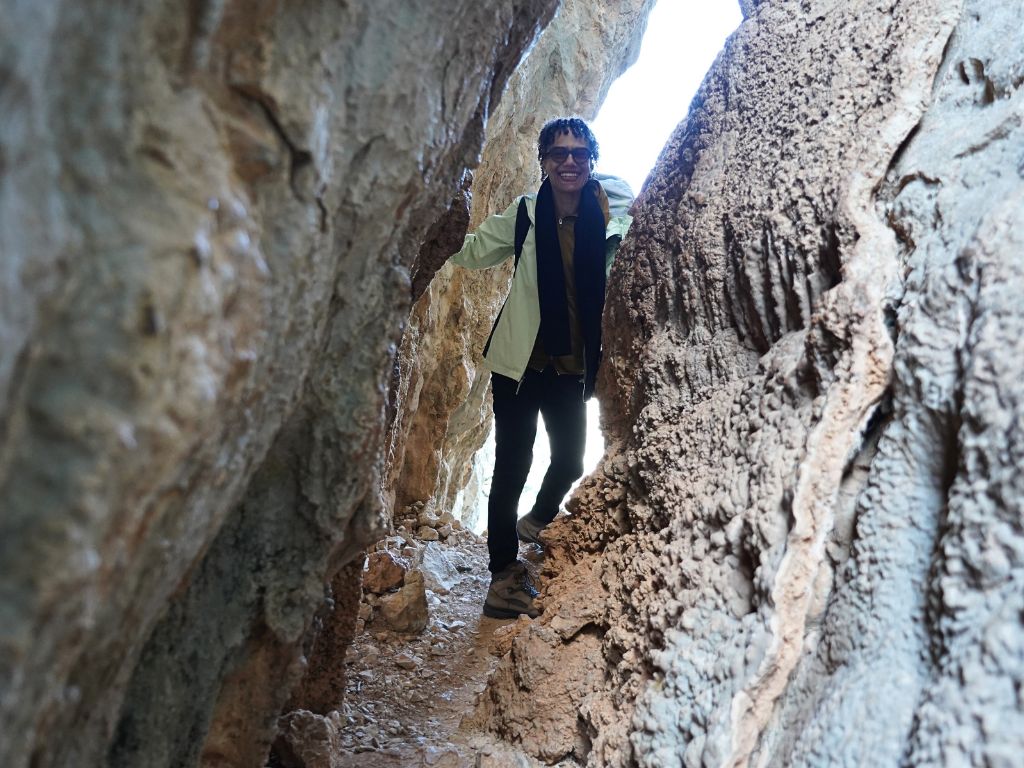
Getting there’s a brutal, two-hour scramble. You’d be a fool to go without a guide, and I tapped a local who knows every stone. Having tracked mountain gorillas in Uganda, I thought I had the lungs for it. Still, the ascent was a punishing zigzag through juniper and scrub. I squeezed through narrow crevices and clawed over slick boulders. At the peak, the Lanaittu Valley explodes beneath you, making every drop of sweat a fair trade.
Descending a rickety ladder into the cave feels like crossing into a parallel world. Inside, the ruins remain eerily intact, sheltered by stone and silence. This is Sardinia at its most elemental and most revealing. I’d lived on the island for two years and returned twice without coming here. Some places require patience and repetition.
Their rewards are earned.
Discernment as a Destination
Returning to Sardinia by myself sharpened my sense of discernment. I moved with greater assurance, ventured beyond my comfort zone, and chose depth over accumulation. Because Sardinia isn’t about seeing everything at once. It’s about choosing well—and having the willingness to return.



One Response
Accompagnare Giannella alla scoperta dei nostri luoghi, è stata un’esperienza a doppio scopo, son tornato anche io grattificato e se le pietre del Supramonte potessero parlare, son sicuro che dopo la lettura di questo articolo, ne sarebbero grate pure loro!
Spero in una prossima occasione tra le meraviglie del nostro territorio.
A medas annos!