
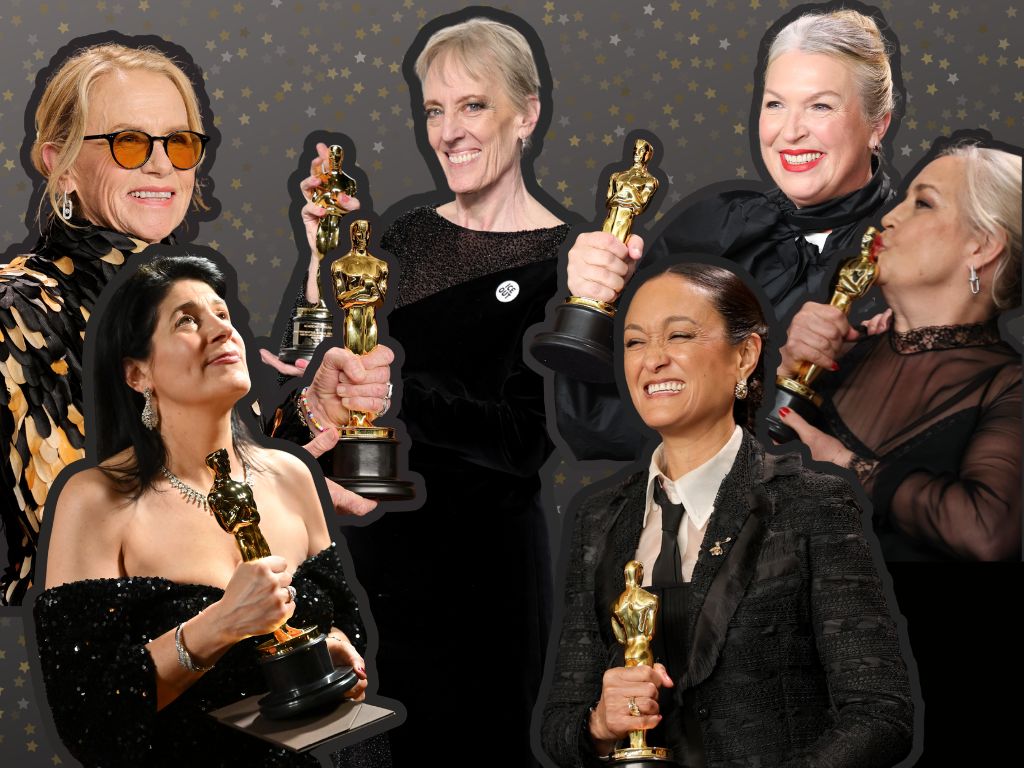
The red carpet judged women’s bodies. The podium revealed the women who actually make the movies.
The first spectacle was the one you expected—opening on the red carpet, the slow pan across celebrity bodies, the annual ritual of evaluating women by how they look and what they’re wearing before anyone has said a word about what they’ve created.
The second show was quieter, more surprising—and far more interesting.
That show happened at the podium, in the voices of women whose names you probably didn’t recognize before Sunday night and absolutely should know now.
Both played out around the same ceremony.
That’s the real story.
The One to Watch
Let’s start with the women who were the true stars Sunday night—from an actress to the technicians whose craft creates the cinematography, the casting, and the visual worlds that make the films work.
Amy Madigan is 75. She started her career as a rock musician in Chicago, making her film debut in 1982. She earned her first Oscar nomination in 1986 for Twice in a Lifetime—playing Gene Hackman’s angry, complicated daughter with the kind of rawness that should’ve launched a very different career than the one she got. Instead, she spent the next four decades grinding through what one journalist in 2010 described as the reality of being an actress over 50 in Hollywood.
Madigan herself put it more directly: “My husband works a lot more than I do. You know what the situation is.” Her husband is Ed Harris.
Think about that for a minute.
Then last year she played Aunt Gladys in Weapons—a weird, terrifying role nobody saw coming. The character went TikTok‑viral and turned into a Halloween costume before awards season even started: ginger wig, thrift‑store polyester, and an older woman who walks into a room like she owns the house and everyone’s nightmare inside it. Madigan’s on screen for about 14 minutes and makes every scene count.
Forty years between nominations. First Oscar. A record‑setting gap in Academy history.
On stage Sunday night her legs were shaking and she called herself “flummoxed,” then thanked the director who finally handed her the dream part she should have been offered decades ago. The lesson—if Hollywood is listening, which it probably isn’t—is painfully simple: The talent was never the problem. The people doing the casting lacked the imagination to use it.
Autumn Durald Arkapaw didn’t stroll into the Dolby Theater as legacy; she got there the long way around.
Raised by a single mother and her mother’s extensive Filipino family in Southern California, she was “the camera kid” in a crowded house who figured her eye would eventually turn on a museum wall, not a movie screen. She studied art history at Loyola Marymount University convinced she was headed for a life as a curator before admitting that what she really obsessed over wasn’t just images but how they moved and breathed. So she pivoted: graduate school at the American Film Institute, and a profession her own parents couldn’t quite picture, entering a pipeline where women made up just 7 percent of cinematographers on the top 250 films in 2025.
She shot Black Panther: Wakanda Forever. She shot The Last Showgirl. She became the first female cinematographer to shoot on large‑format IMAX 65mm for Sinners—a technical leap so significant she had to call the cinematographer of Oppenheimer for advice, because there was literally no woman who had done it before.
Sunday night she became the first woman and first Black cinematographer to win in the category’s 98‑year history. Before her, only three women had ever been nominated.
Three.
In 98 years.
She asked every woman in the Dolby Theatre to stand up.
“A lot of little girls that look like me will sleep really well tonight,” she told reporters backstage.
The Academy will call it history, but from her vantage point it looks more like a slow acknowledgment.
Cassandra Kulukundis graduated from Vassar in 1993 and walked into Hollywood as an intern on Paul Thomas Anderson’s first film, Hard Eight. She assembled the ensemble of The Brutalist and has contributed to six Best Picture nominees. She is not, by any reasonable definition of the word, a nepo baby. She’s a woman who started as an intern in her 20s and spent 30 years doing invisible work that shaped the faces of American cinema.
The Academy didn’t have a casting category until this year, despite having existed since 1929.
Kulukundis won the inaugural award and used the moment to honor every casting director:
“I dedicate this to you and to the casting directors who never got a chance to get nominated, who didn’t even get a chance to get their name on the movie. So this is for you guys.”
Then there is Guillermo del Toro’s Frankenstein, which swept three craft categories. Two of those statues went to women who’ve spent their careers building other people’s visions from the inside out.
Costume designer Kate Hawley pulled the film’s visual language from the natural world—blood- red corsets, jewel-toned gowns layered like insects, archival Tiffany jewelry, and a wedding dress engineered so its organza slowly filled with blood in the final act. First nomination. First win. Onstage she thanked the “artisans, the alchemists, the dream weavers.”
Beside her was production designer Tamara Deverell, who built the brutal fairy tale from the ground up: more than 100 sets, including a full‑scale 18th‑century sailing ship and a lab carved into an abandoned water tower. All constructed by hand because she refuses to let AI design what human emotion has to inhabit.
Second nomination. First win.
Two women who built a monster’s world.
And then there is Gwendolyn Yates Whittle, 64, who’s been a member of Skywalker Sound for decades and has worked on over 120 films—Titanic, Saving Private Ryan, Terminator 2, Avatar, Fight Club, Iron Man. She’s been nominated for Oscars three times before Sunday night.
She won for F1, the Formula One racing film, making the engines scream and the crowd feel the speed as a physical force.
What almost nobody in that room knew, until she said it on the red carpet, is that she had cancer while working on the film. A year ago she had no hair. She showed up anyway.
Her colleagues, she said, made her feel necessary.
“The fact that I’m standing here with hair, holding this, makes the whole thing even more mind-blowingly special.”
Over 120 films. Four Oscar nominations. One win.
And she did it while fighting for her life. Nobody asked her what she was wearing.
The Show We’ve Seen Before
There was no female nominee for Best Director. Again. Paul Thomas Anderson won. But the five nominated directors were all men, in a year when female filmmakers made some of the most discussed work in cinema. This isn’t new. The directing category remains a gentleman’s club that occasionally lets women peek through the window.
And then there was the red carpet.
It would be easy to say nothing about how certain women looked. It would also be dishonest. The ultra-thin emaciation trend that has been building quietly for two years arrived in full force, and it was impossible to watch without noticing—not the choices individual women make about their bodies, but the cultural machinery that produces and rewards a specific kind of smallness. Women whose presence used to fill a room, rendered somehow diminished. The contrast with what was happening at the podium was so stark it felt almost intentional.
Inside: women in their 50s, 60s, and 70s taking up space, holding gold, commanding rooms. Outside: cameras dwelling on bodies that looked like they were working very hard at disappearing. Both things on the same night.
Finally, the Bridesmaids reunion. Fifteen years since the film that made us howl, and five women back together on stage—which should have been purely joyful. The bit they did leaned hard into jokes about looking good for your age, about work done on faces, about the whole familiar arsenal of women-aging-as-punchline.
The audience laughed.
The women laughed.
The joke, as always, was never that men age. Only that women dare to.
Roll Credits
Here is what the 98th Oscars actually told us, if you were watching the right show:
Women in midlife are building the visual and sonic worlds cinema inhabits. They’re doing it after decades of patience and work that went unacknowledged long past any reasonable point. When they finally reach the microphone, they thank the women who came before them and the ones who will come after. They make it about more than themselves.
Hollywood still jokes about our faces.
The women who won Sunday night were considerably more interested in their work.
It shouldn’t have taken this long.
But they got there.
And now we know their names.