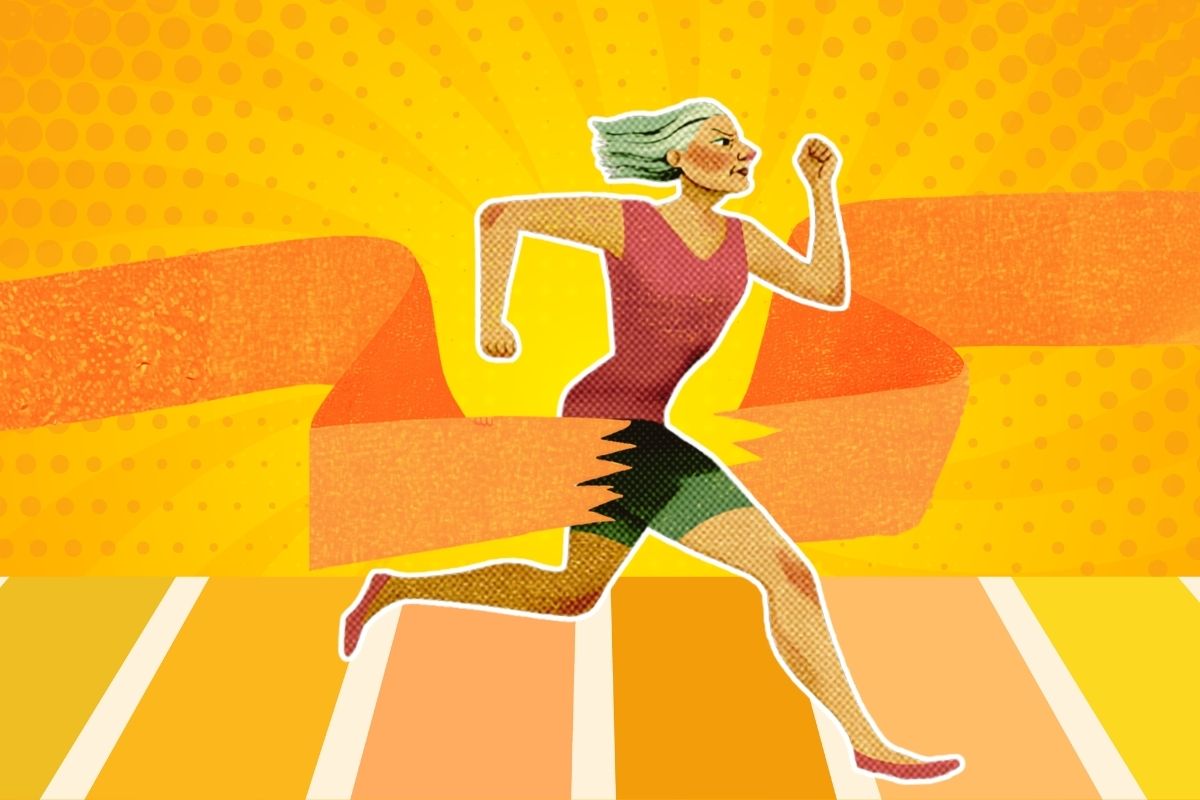
No one was forcing me to disappear at 49. I was cooperating with it. The triathlon was how I changed that.
Women are told to “age gracefully,” but now there’s an entire industry built around managing middle age correctly. Take the GLP-1. Do the strength training. Fix your hormones. Buy the serum. Practice gratitude. Stay relevant at work, but not threatening. I told myself none of that was really getting to me. Then I looked at the life I was settling into.
When I turned 49, I realized no one was forcing me to disappear. I was collaborating with it. I wasn’t ready for that, so I interrupted it.
For my 50th year, I made a rule: every experience had to be something I hadn’t done before—and I couldn’t do it alone. If I was going to build a bigger life, I wanted people there to see it happen.
One of those experiences was a 5K—something I had long ago decided my body couldn’t handle. I trained with my friend Nikki, finished, and then asked, somewhat recklessly, what came next.
She didn’t hesitate. She said, “A triathlon.” I opened my mouth to say, “No, thanks.” But before I could get the words out, she said, “I’ll train with you, and we’ll do the triathlon together.”
Nikki explained what was required: a half-mile swim, a 10-mile bike ride, and a 3.1-mile run. The run didn’t scare me, since I had just proven I could do a 5K. My husband and I also rode bikes regularly. But the open-water swim terrified me. Thanks to Jaws, I imagined myself as the slowest swimmer—and the easiest human chum.
Nikki waved those worries away and said the open-water swim was her favorite part of the race. I didn’t believe her, but I agreed to train anyway.
During training, I peppered Nikki with anxious questions about goggles, energy gels, and whether panic counted as a legitimate triathlon obstacle. Fortunately, she’s an elementary school teacher.
Nikki and I have known each other for decades—long enough to have been through a lot together. Nikki is tall, blonde, athletic, and way more optimistic than I am. She’s also the person who always seems to know exactly what to say when I’m convincing myself not to try something. Over the years, she’s talked me through self-doubt, anxiety, bad moods, resistance, and plenty of excuses. Somehow, I usually end up doing the thing I was absolutely certain I couldn’t do.
When the day came, my husband and friends cheered me on. My daughter was probably asleep—triathlons start offensively early. I finished much later than Nikki did, but I had done it.
We did a few more triathlons and then COVID hit. Other than the occasional, “When are you doing another triathlon?” I didn’t think much about them. Then last year, Nikki said she wanted to do a triathlon with me to celebrate her 60th birthday. Almost nothing about it appealed to me—a four-hour drive, overnight stay, and a later, hotter start time.
This is exactly the kind of moment where “aging gracefully” would’ve sounded sensible—stay home, avoid the inconvenience, stick to your routine. And sometimes that’s genuinely what you need. But sometimes it’s also how you slowly stop asking more from yourself.
And Nikki had done so much for me that saying no felt less honest than admitting I’d simply gotten comfortable. I’d slipped back into a midlife routine built around convenience, repetition, and a lot of binge-watching, and this felt like the kind of disruption I probably needed.
So I said yes.
This time, though, we didn’t follow a standard triathlon training plan—no structured swim-bike-run schedule, no weekly “bricks” (a bike ride followed immediately by a run, so your legs learn the transition).
Instead, we trained the way women in their late 50s actually live, squeezing workouts between pickleball, Pilates, dinner plans, obligations, and the bone-deep exhaustion that comes from managing a full adult life.
I was still anxious, texting Nikki: “Are you practicing transitions? Do you have a packing list? I haven’t done an ocean swim in years and I’m nervous.” Nikki was her usual calm self. After an open-water swim, we got out and she said, “We did it!”
A few days before the race, I was feeling hopeful. “We’re gonna crush it on Sunday!” I texted Nikki. She responded: “Love the positivity! It’s going to be a blast!”
The morning of the race I felt differently. My stomach was in knots. It was the biggest triathlon I had participated in, and there were thousands of people. Many of the participants were young, visibly athletic, and clearly comfortable in their bodies in a way that made me feel very aware of my age. Standing there, I couldn’t help noticing how unusual it still feels to see older women doing things this physically demanding.
By the time the swim began, I was panicking hard enough that I briefly considered turning around and swimming directly back to shore. I didn’t know if I’d make it through the swim, but I finally calmed down enough to finish.
The bike portion was fine, but the run was hard—hot, humid, and exhausting. I kept going anyway. After I crossed the finish line, the first thing I did was look for Nikki. I knew she had finished ahead of me (she always does).
Eventually I found her, and we hugged. “We made it!” Nikki said.
I couldn’t wait to get home and tell everyone about it. A woman in her 50s or 60s doing a triathlon still surprises people. And while my ego likes the kudos, another part of me finds it depressing that women doing hard, ambitious things at this age still feels unusual. It says something about how easily “maturity” for women becomes another word for shrinking.
That’s why doing something difficult like this with another person matters. Someone was there who had seen the whole thing—from the doubt to the panic to the finish—and knew exactly what it took.
What I like even more is not disappearing.
My 60th birthday is coming up next year. I already texted Nikki that I want to do another triathlon with her. The races matter less than what they interrupt—my instinct to retreat into smaller, easier choices.
The triathlon is just the part you can see.


4 Responses
My husband died in 2020 when I was 65. I started walking with friends for the company. One thing led to another and since then I have completed 23 1/2 marathons and numerous shorter races. Over time, I have gotten faster so I am usually alone for most of the race but the friends are at the finish line or I am waiting there to cheer them in. We are all there for each other and it makes the experience so much sweeter. The last couple of years I have taken up trail running (walking). It’s surprising how many people find it exceptional. I don’t, I just keep challenging myself to be better than before.
FYI, I will be 71 in a few weeks. It’s easier to place in this age bracket! 🙂
OMG! Thank you, thank you, thank you! At 70, 3 months post breast cancer surgery at the advice of my surgeon, I have started the most intense workout routine in decades. This morning my constant aches had me considering telling my trainer that I need a break. Then I read your piece and reminded myself how much I need to push through the workouts and all the other obstacles I will encounter along the way.
Proud of you!
For my 50th, (20 yrs. ago) I completed a half marathon alone! Would have made it so much more enjoyable if I had a friend with me.
Love your comment about “every experience has to be something you haven’t done before”and not to do it alone! I am a let’s try it person but usually it is alone.