
Why the songs we loved when we were young can bring back more than a memory.
The other day, my husband read me the Billboard Top 20 for the week ending August 19, 1978—our first week at college, the week we met.
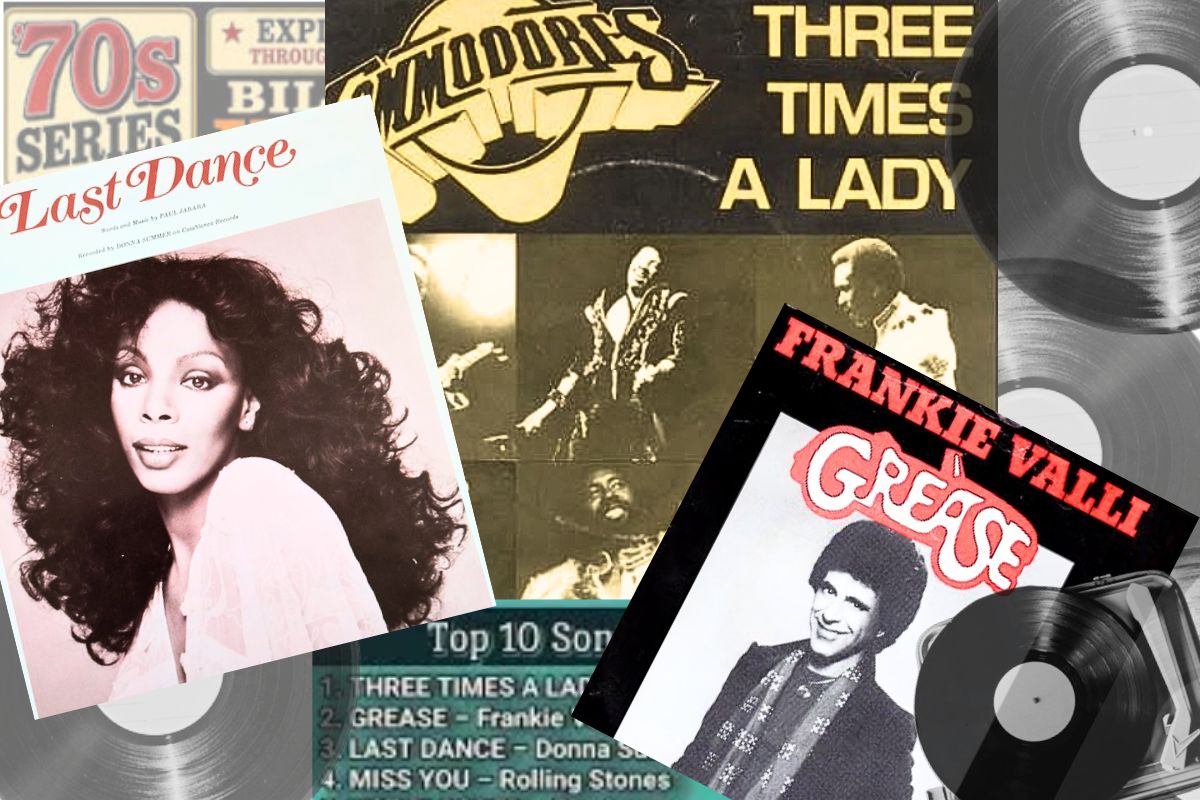
The Commodores were No. 1 with “Three Times a Lady.” Frankie Valli’s “Grease” was No. 2. Donna Summer’s “Last Dance” was right behind it.
Once he got done sharing the list, I felt something hard to describe. Not just, Oh, I remember that song, but a warm rush somewhere deep inside me. Then, for the next few hours, I couldn’t stop thinking about who I was and who I was about to become.
What was that feeling?
An Oprah Daily piece about nostalgia landed in my feed last week. It was written by a Gen Z woman with a wallet full of ticket stubs, which I found charming. But it also made me think: at this point, most of us are moving around stacks of boxes with decades of evidence of a life well-lived. Vinyl records, ornaments passed down from grandma, VHS tapes of movies. My mother’s recipes, scratched out in her elegant but bossy handwriting. There are stories attached to each of these.
I’m not sentimental. But this Billboard list felt like an exception. Nostalgia is one of the ways we connect to the person we were. The warmth I felt when my husband read that chart to me has a scientific explanation, and that’s better news than simply saying “looking back feels nice.”
And for women our age? We have quite an archive.
Why 1978 Still Has Me
We tend to recall autobiographical memories that cluster around ages 15 to 25. This phenomenon is called the reminiscence bump, which makes sense since this is the time when our identities are still being formed.
Music sits right in the middle of all that.
A song is never just a song when it belongs to those years. It’s a shortcut back to a particular version of yourself. When my husband read that list aloud, he was unlocking the feeling of being 18 again, hopeful and at the front end of a big life. That was 48 years ago. We married in 1983, and we’re still here.
Lionel Richie’s delivery of “Three Times a Lady” with that waltz rhythm offered me the kind of grand, grown-up devotion my 18-year-old self could barely imagine. Not simply romance but being seen and chosen. “Grease” felt like becoming bold enough to enter the world, leaving girlhood behind with a whole life waiting beyond college. And Donna Summer’s “Last Dance” delivered an anthem: stay in the dance long enough to claim what you wanted.
Of course, these songs don’t let go. Your brain is built for it. Nostalgic music calls up autobiographical memories and activates brain networks involved in memory and self-reflection. And here’s the part I didn’t expect: In a study of older adults, the songs that produced the strongest emotion created the most personal memories, almost perfectly in step, and that link appears to be more prevalent in us than it is in the young. The archive doesn’t fade. It sharpens.
That Warm Feeling? It’s Real.
When I said those songs gave me a warm feeling inside, I wasn’t speaking metaphorically.
Researchers have found that people report more nostalgia on colder days and in colder rooms. In studies, nostalgic music was associated with feeling physically warmer; people asked to recall a nostalgic event judged a cold room as warmer than people asked to remember an ordinary event. In another experiment, people thinking nostalgically tolerated ice-cold water for longer.
Researchers think that nostalgia can help us mentally recreate a state of comfort we once knew.
I love that.
A song from 1978 can’t actually heat the room, but it can bring you back to an inner place where you feel hopeful and known. For a moment, your body gets the message that you’re safe and have a sense of belonging.
My Father, on a Loop
When I can’t fall asleep, I replay two or three memories from my childhood with my father. One of them is very specific. I’m sitting in his workshop, on a green shiny Naugahyde bar stool, pulled up as close to his raised workbench as I could get. He always had a small radio playing softly in the background, tuned to his favorite—any song Olivia Newton-John was singing that year. God, he loved her. I would sit for hours watching him work on a birdhouse, a dollhouse, whatever he was making that week. The stool, the radio, and the smell of sawdust were what researchers would call retrieval cues—small keys that unlock the memory you don’t want to lose.
I run this scene and other similar ones over like reruns. They’re the last images I want in my head before I fall asleep. I don’t force myself to think of them. They’re simply there, waiting for me when the house is quiet and sleep will not come.
There’s science around this, too, though I almost hesitate to mention it because the experience feels so personal. Nostalgia can create what researchers call self-continuity: a felt connection between who you were and who you are now. It also tends to be social. The memories that stay with us are often memories of being with somebody—being cared for and part of a family’s story. Research links nostalgia to social connectedness, which in turn can strengthen a sense of continuity and meaning.
Maybe that’s why those nighttime memories work for me. I’m not going backward. I’m returning to a place where I felt seen and cared for. Memory isn’t a video recording. It shifts a little every time we replay it. A memory I’ve revisited for decades is partly a memory of the last time I remembered it. That doesn’t make it less true. It makes it mine.
Visit, Don’t Move In
The past is a brilliant editor. We tend not to replay the disappointments or the awkward moments. I find that the trick is to visit the past without asking it to replace the present. Instead, let it warm you and remind you of everything that brought you here.
I welcomed my husband’s interruption. Revisiting the chart wasn’t just a reminder but a map of my coming-of-age story. First: be cherished. Then: be bold enough to enter it. Finally: stay in the dance until you choose otherwise.
And I’m not sorry about a single thing that came after.
Find the chart from the week you met your special person, and tell me your No. 1 song.
Want to go back to August 1978 with me?
I made a Spotify playlist with all 20 songs from the Billboard chart the week we met.



8 Responses
Beautiful. Music is a way to time travel.
I found the science studies revealing music making even a cool room seem warmer fascinating.
How wonderful you and your husband share warm memories connected to those songs.
Hi Michele, the science is interesting. It surprised me to. But we have all felt it right? That warm fuzzy feeling when a song comes on that transports us back somewhere in time…
Susan, I loved this story! So much of it resonated with me. When I catch a song on the radio “in the wild” it can instantly transport me back to the girl with the silk flowers in her hair, big dreams of being a writer, and wondering if she’ll ever fall in love. Also, your reminiscence of your father’s workbench, same!! The smell of turpentine, the scratchy sound of a transistor radio, and my hands busy with some creative task are my Happy Place, too. Brava!
It’s 1969. I’m sharing an apartment in Minneapolis with my two best friends from college as we pursue our first career jobs. Our boyfriends are visiting from Iowa for the weekend. Someone brought the Crosby, Stills, and Nash album. We play it on our cheap stereo and are mesmerized. After listening we discuss this masterpiece of musical genius.
Fifty seven years later “Wooden Ships” comes up daily on my Youtube playlist. I am transported back in time for a few moments…. laughing and loving with my 5 best friends, all of whom are gone now by distance and two by death.
They say that your musical memories are strongest from when you are about 13 years old. I was 13 in 1970, so this soundtrack of my early teens, coming of age, always conjures up the deepest and most vivid memories.
I don’t remember the one song that would remind me of him, but I do know that when I hear songs like “Rock the Boat” or George McRae’s “Rock Your Baby,” and other early disco mainstream hits I’m transported to a warm Friday night at Adventurers Inn, a small amusemement park near LaGuardia Airport where we’d all head for rides and cheesy prizes. I remember those heady evenings filled with teen lust, love and angst—and holding on so tight as we spun and dipped and thinking this was the happiest time of my life. It’s really the only time that I can recall music playing such a huge role in my life and a relationship. If only those magic moments could have lasted. Then we grew up and away, and even though it’s been 50 years, a flood of bittersweet memories still emerges each time a song from that era plays.
Ellen, I can almost see that Friday night at Adventurers Inn from the way you describe it. And that feeling of holding on tight and believing, right then, that this might be the happiest time of your life. Maybe that’s what those songs preserve for us. Not just the people or places, but exactly how it felt to be that version of ourselves. Thank you for sharing this. ❤️—susan
Oh goodness, I can’t possibly remember the year I met but I started getting to know him in 1984. When I just knew we were it and the memories that the time brings is Prince’s Purple Rain album. Not one song, the whole darn album. I’m 18, 19, 20 all over again and it’s an anthem for me that still makes me so alive and full of possibilities.
Hi Ali, The whole darn album! I love that. And maybe that’s exactly it. You don’t just hear Purple Rain and remember being 18 or 19. For a few minutes, you get to feel that sense of your whole self, when you had absolutely no idea what was coming next. What a wonderful soundtrack to have attached to those years. Thanks so much for sharing. —susan