
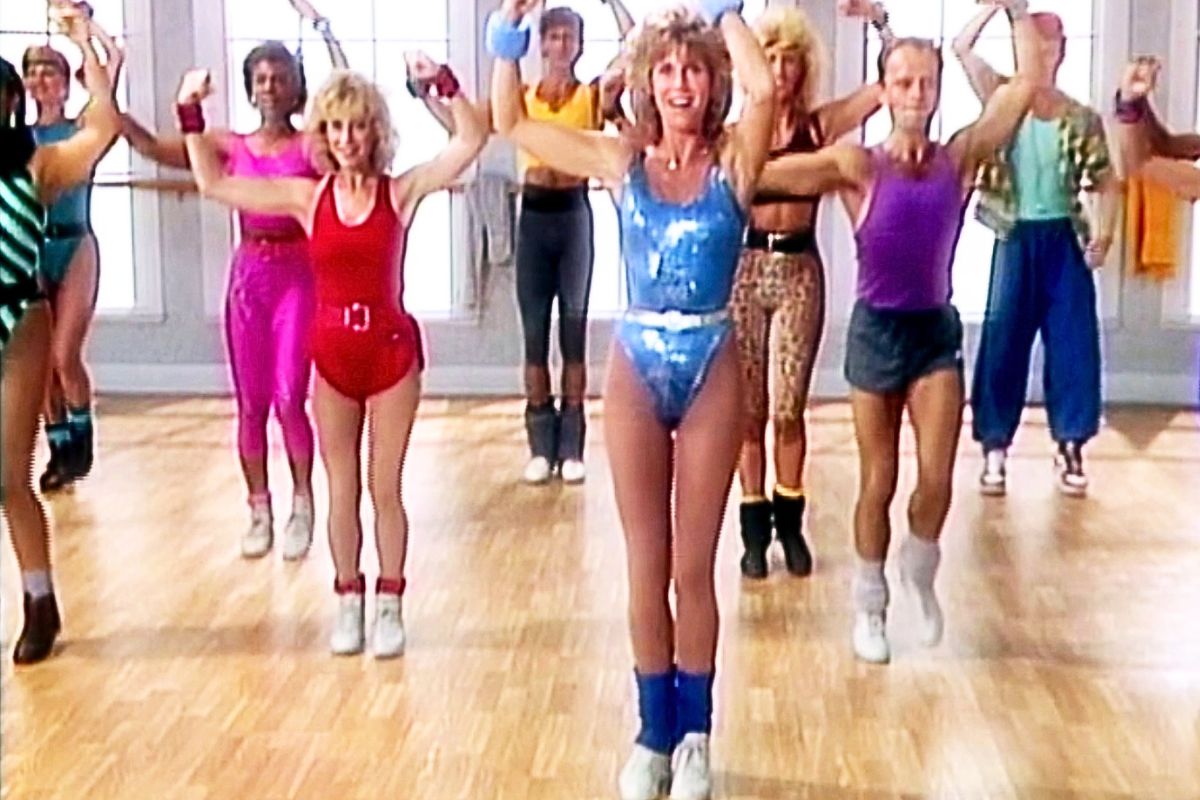
Leg warmers, the ThighMaster, Tae Bo, and now a ring that tells you how you slept. The pitch never changes.
I began my fitness career at age eight, teaching Get in Shape Girl! classes to exactly three neighborhood kids on my front lawn. I had a pink plastic workout kit, a cassette tape, and more confidence than any kid had any business having.
That front lawn was my introduction to the great American fitness promise: somewhere out there was a workout that would finally be the one. I made it through leg warmers, VHS tapes, and enough home exercise equipment to furnish a small gym. Every few years, the industry came up with a new apparatus or a new reason to believe this particular system might finally change everything. We didn’t have smartwatches telling us how well we’d slept. We had a television and an alarming amount of faith in people wearing Lycra.
Jane Fonda Scared Me
Jane Fonda was the first fitness celebrity I remember taking seriously. She had a uniform of leg warmers and leotards, and a voice that made squats sound slightly threatening. I respected her the way you respect a strict aunt: from a distance, without much urge to visit.
So I moved on to Gilad Janklowicz and Bodies in Motion, filmed on the beaches of Hawaii with a cast of tan, cheerful people doing lunges in swimwear. My basement became a much less glamorous version of the same thing. I was doing the workouts on carpet while wearing a decade-old T-shirt and mentally relocating myself to an island.
Gilad ended every episode with the same advice: “Keep your body in motion.”
Richard Simmons came along with a completely different idea about what exercise could look like. Sweatin’ to the Oldies had sequins, a perm that defied physics, and a room full of people who looked like people I actually knew. There were older women, bigger bodies, and people still figuring out the steps. Simmons seemed genuinely delighted to have everyone there. I would sing along while I exercised, and half the time it felt more like a community theater rehearsal than a workout.
The instructors of that era would spend the entire workout asking questions, offering encouragement, and carrying on a conversation without ever waiting for an answer. Simmons was particularly good at making you feel as if he had noticed you’d shown up. For an industry that spent plenty of time making women feel that their bodies needed improvement, that was a welcome change.
Then Every Body Part Became a Project
My basement then became a full-time aerobics studio. I got so familiar with Denise Austin step tapes that I turned the sound off and conducted the class from memory, including the little fake laughs and cheesy encouragement. I knew the V-steps, T-steps, and “around the world” well enough to keep going without her.
That worked fine until I took an actual step class at the gym, taught by a friend’s mom. If I missed a step at home, nobody saw it. At the gym, I had to consider the possibility that the woman watching me trip over the platform would someday end up standing behind me at the grocery store. I went back to exercising where the only witness was the dog.
Around that time, the fitness industry was getting more specific, too. Buns of Steel. Thighs of Steel. Abs of Steel. I owned all three, because apparently my body was now a collection of unrelated problems and each one needed its own VHS tape. Tamilee Webb demonstrated endless leg lifts in high-cut neon leotards while the camera lingered on whatever part of us was currently considered a problem.
Then Suzanne Somers arrived with her own leotard and the ThighMaster. “You just put it between your knees and squeeze!” So I did, for 15 minutes a day while watching television. The spring-loaded contraption that promised to revolutionize my workout occasionally pinched my skin or shot out of position, but at $19.95, it seemed worth the risk. I have no idea whether it changed my thighs. I do remember the sound it made when it flew across the room.
I Decided I Wanted Strength
By the late ’90s, I had moved on to Billy Blanks and Tae Bo. The first time I put one of those tapes in, I assumed it was playing at triple speed. It wasn’t. Blanks really did expect us to throw roundhouse kicks, jabs, and punches at that pace while people in the background occasionally let out sounds that suggested they were fighting for their lives.
I loved it. For a while, I was convinced I was becoming the sort of woman who could handle herself in a dark parking lot. I never got the chance to test that out, but I liked feeling strong enough to imagine I could.
Yoga took that idea further. I started watching Steve Ross’s morning show, Inhale, which paired yoga with R&B music, and eventually moved on to power yoga videos and DVDs. I did them at home because classes were expensive and because my search for inner peace has never involved being around other people.
By then, I was paying attention to flexibility and mobility in a way I hadn’t when I was doing hundreds of squats. I wasn’t worried much about perfect Tree Pose anymore. Bending over to pull weeds in the garden without paying for it for the next two days became a more practical measure of fitness.
The Optimization Olympics
And now we have biohacking. I don’t own an Oura Ring, a smartwatch, or a supplement stack, so I’m mostly watching the biohacking era from the sidelines. But I know people who have embraced the data. One friend told me his Apple Watch once asked if he wanted to log a workout after he sneezed three times in a row. Another friend bragged that she hit her daily step goal while wandering the Target parking lot trying to remember where she parked.
Somewhere along the way, movement became something we needed to document, score, and evaluate. A walk to the mailbox can become a data point. A bad night of sleep can become a number you think about the next morning. Garmin devices and other wearables send so much information to an app that you can spend almost as much time reviewing the workout as doing it.
The technology is more sophisticated than a VHS tape, but the sales pitch is familiar. Now we can subscribe to a service that tells us whether we’re sleeping, recovering, moving, eating, and living as optimally as possible.
I never did any of this because I wanted to spend my life trying to change my body. I exercised because I liked the music and choreography, because I liked feeling strong, and because I was also a shameless showoff who enjoyed pretending I was part of something bigger than my basement.
These days, I still want those things. I want to carry 12 grocery bags from the car in one trip and get off the floor without wondering what muscle group I just managed to aggravate.
I just need to keep this body in motion.


2 Responses
I just took my first hip-hop dance class at the tender age of almost 59. I had no idea what the steps were but just kept moving. Also, I’m with you. I’ll walk miles for exercise, but I’m not making two trips from the car. lol
I loved doing the Jane Fonda workouts..I dropped 20 lbs in a month…