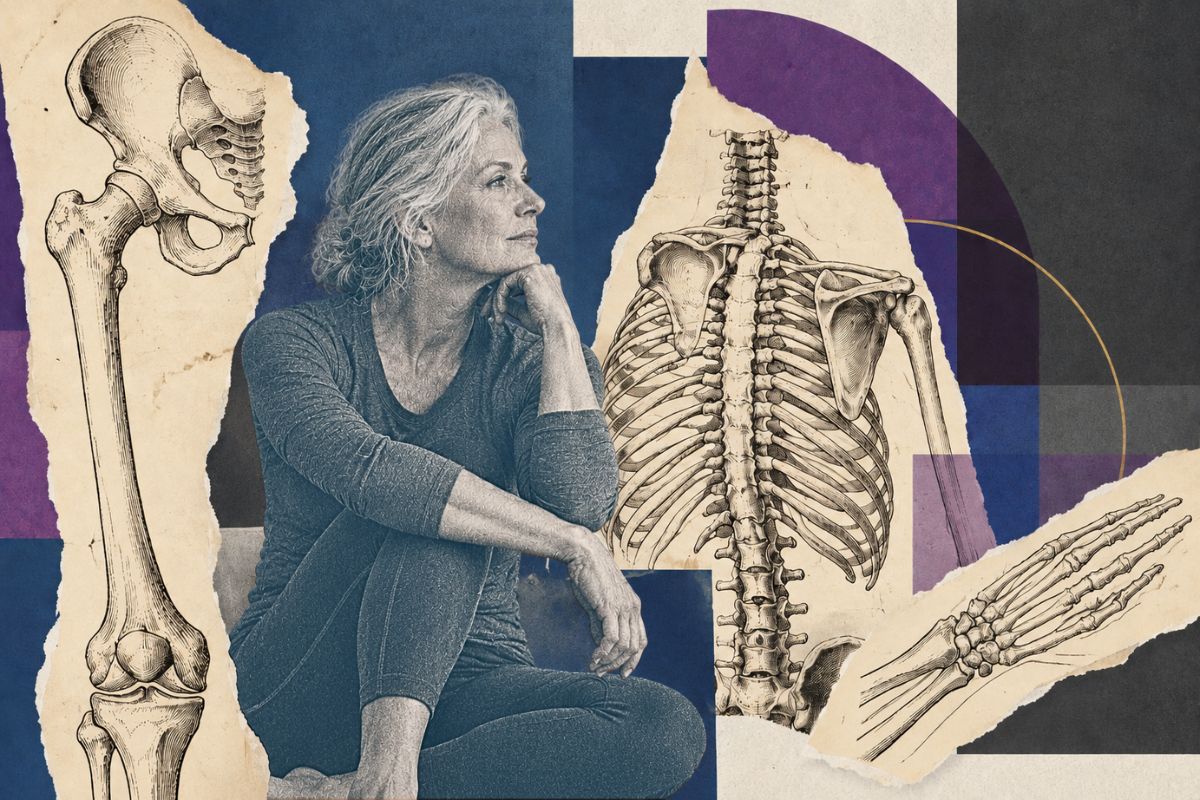
Screening guidelines are built around when fractures become more likely, not when women are losing bone fastest.
Of everything menopause did to you, the real damage was happening somewhere else—in your bones. In the long-running SWAN study, women lost an average of 10.6% of bone mineral density at the lumbar spine and 9.1% at the femoral neck over the 10-year period surrounding the final menstrual period. Bone loss was fastest from roughly one year before to two years after the final period.
Most women experience menopause around age 52, per the National Institutes of Health. Not coincidentally, roughly one in two women over 50 will break a bone because of osteoporosis.
Sounds like a big deal, right? Something health agencies should be sounding the alarm over? But no. Instead, the U.S. Preventive Services Task Force (USPSTF), an independent expert panel, recommends that women with no known risk factors receive their first dual-energy X-ray absorptiometry (DXA) bone scan starting at age 65—a full 13 years after bone loss hits overdrive. Come again?
Let’s look at it this way: A woman’s lifetime risk of fracturing her hip due to low bone density is equal to her risk of developing breast, uterine, and ovarian cancer combined. Yet screening for this risk isn’t recommended until more than a decade after the greatest damage is done. If we were talking about cancer, there’s a chance we’d be dead by then.
In a world of increasingly upside-down priorities, policymakers have once again shown reluctance to provide access to tools that could prevent serious health consequences for 51% of its citizens. The question: What can we do about it?
Who Makes These Guidelines, Anyway?
The USPSTF has 16 volunteer members appointed by the HHS Secretary with expertise in various areas of preventive medicine. In forming their recommendations, “the task force relies on rigorous data, including clear evidence from placebo-controlled studies,” said Natalie Cusano, M.D., who runs the bone metabolism program at Lenox Hill Hospital.
Given the evidence showing accelerated bone loss in women’s early 50s, how does this result in a screening recommendation of 65? “Guidelines are based on fracture risk—not on bone density loss risk,” explained Soma Mandal, M.D., a women’s health specialist in New Jersey. “Menopause is when bone loss accelerates, but 65 is statistically when fractures increase, and the guidelines are based on that.”
Michael R. McClung, M.D., founding director of the Oregon Osteoporosis Center, offered a historical explanation for why preventive bone-loss treatment fell out of favor.
“When studies documenting the ability to prevent bone loss at menopause first came out 30 years ago, there was a lot of pushback because it was too expensive, and it meant we’d have to treat too many women for too many years with expensive medication,” said McClung. As those costs came down, “there was new pushback with negative news about estrogen and breast cancer. Between those two things, the idea of taking a preventive approach evaporated.”
DXA screening guidelines do say that women with a known risk factor, such as low body mass index (BMI), should be considered for screening before age 65. The problem? Menopause alone doesn’t automatically qualify women for earlier screening—even though it’s when bone loss accelerates.
For postmenopausal women under 65, the question isn’t simply age; it’s risk.
If you’re postmenopausal and under 65, one tool clinicians may use to assess whether earlier screening makes sense is the Osteoporosis Risk Assessment Instrument (ORAI). It considers age, weight, and whether you currently use estrogen. A woman aged 55 to 64 who weighs 60 to 69 kilograms and isn’t using estrogen scores 10—above the commonly used threshold for considering a DXA scan. The score isn’t a diagnosis, but it can give you a concrete question to bring to your doctor: “Based on my risk factors, should I have a bone-density scan now?”
Concern over limited access to an essential resource has prompted many physicians to find ways to qualify their menopausal patients for bone density screenings earlier. “As a clinician, you can almost always find a risk factor that deems it necessary,” said Mandal, adding that some women may need to actively petition their doctors for earlier screening. “I also advise my patients to find out exactly when their individual insurers will start covering DXA tests.”
Some insurers will cover it before the routine screening age if patients demonstrate at least one known risk factor making it medically necessary. Coverage varies by health plan and insurer. For instance, Aetna and Blue Cross Blue Shield Federal Employee Program both list various existing health conditions and certain medications as risk factors that qualify someone for early screening.
Cost is a barrier for those without insurance coverage. In 2025, the Agency for Healthcare Research and Quality reported that 47.6% of women in higher-income brackets had received screening compared to 37.5% of lower-income women. Moreover, Hispanic women’s screening rate was just 25%, and African American women’s was 37%, compared with 48% for non-Hispanic white women. “Women without coverage should explore options for more affordable screenings in their community,” said Mandal.
Why Menopause Rocks Your Bones
So, how much do you know about menopause and bone health? A 2026 public survey of 1,053 women by Osteoboost, the manufacturer of a bone health device, found that 38% of women age 45+ had no idea menopause was connected with bone density and 57% had never heard of osteopenia—the medical term for bone density below the normal range but not low enough to meet the definition of osteoporosis.
A primer: Bone, a living tissue, is constantly breaking down and building back up in a process known as remodeling, said Mandal. It does this via cells called osteoclasts (which break down old bone) and osteoblasts (which build new bone). Estrogen moderates osteoclast activity. “Estrogen acts like a brake to keep bone resorption in check,” Mandal explained. But as you approach menopause, estrogen levels in your body drop, essentially removing that brake and allowing bone to break down at a rate faster than your body can rebuild it.
Compounding matters, one of the best ways to stave off bone loss during menopause—hormone replacement therapy (HRT)—was discouraged among women for most of the 21st century, following the Women’s Health Initiative’s (WHI) research linking the medication to breast cancer.
For some, the pendulum on hormone therapy has started to swing the other way. “Things are changing,” said McClung, who has been at the forefront of research showing the benefits of early HRT intervention for bone health. “There’s a tsunami effect, driven by women approaching menopause who were too young when the Women’s Health Initiative came out to have been influenced by concerns about estrogen and breast cancer. And they want to protect their bones.”
Bridging the Bone Health Gap
Let’s say your first DXA scan at age 65 reveals that you have low bone density. Now what? If you didn’t take HRT during menopause, technically you can still gain some bone benefits—“but it’s not a first-line treatment,” since newer bone density treatments with fewer side effects and lower risk profiles are now available, said McClung.
Outside of medication, diet is a major lever to shore up your bone health. Adequate calcium intake (1,200 mg a day) along with vitamin D to help absorption is a good place to start. “Most women should get at least 600 international units (IU) of D a day (and 800 IU for women over 70),” said Cusano, adding that protein is also essential, something not every woman associates with bone health. “Your bones are made of protein and get mineralized with calcium.” According to the latest federal guidelines, you should aim for 0.54 to 0.73 grams of protein per pound of body weight each day. Another bone-building tip: Limit alcohol and don’t smoke.
Weight-bearing exercise like strength training can also help lay the foundation for stronger bones, though in truth, neither diet nor exercise is enough to maintain bone mass in women at high risk for fractures or who have osteoporosis, per the Mayo Clinic, which notes that treatment for advanced cases of osteoporosis will likely require medication. “These general health behaviors can have a modest impact for women well beyond menopause,” said McClung. “But bone loss during menopause is so rapid and acute, these measures are not adequate to protect them. Most women don’t know that.”
The best way to stave off a fracture is to identify bone density loss in its earliest stages and treat it. “Almost half of total bone loss that occurs between entering menopause and age 80 happens in the five years across the menopause transition,” noted McClung. If you’re beyond that window and worried, talk with your doctor.
“It’s never too late,” said Mandal. “Bone is a living tissue. Even if you weren’t on HRT in the past, you can stabilize or strengthen bone density starting now, with the right treatment.”
**************
MEDICAL ADVICE DISCLAIMER
DISCLAIMER: This website does not provide medical advice. For health or wellness-related content, SFD Media LLC emphasizes that information about medicines, treatments, and therapeutic goods (including text, graphics, and images) is provided for general information only. No material on this site is intended to substitute for professional medical advice, diagnosis, or treatment. Users are advised to independently evaluate and verify the accuracy, reliability, and suitability of the information before relying on it. You should not rely on the content as a substitute for professional medical advice. Consult with a physician or other healthcare professional for any health concerns or questions you may have. SFD Media LLC is not responsible for any action taken based on the information provided on this website. The use of any information provided on this website is solely at your own risk.