
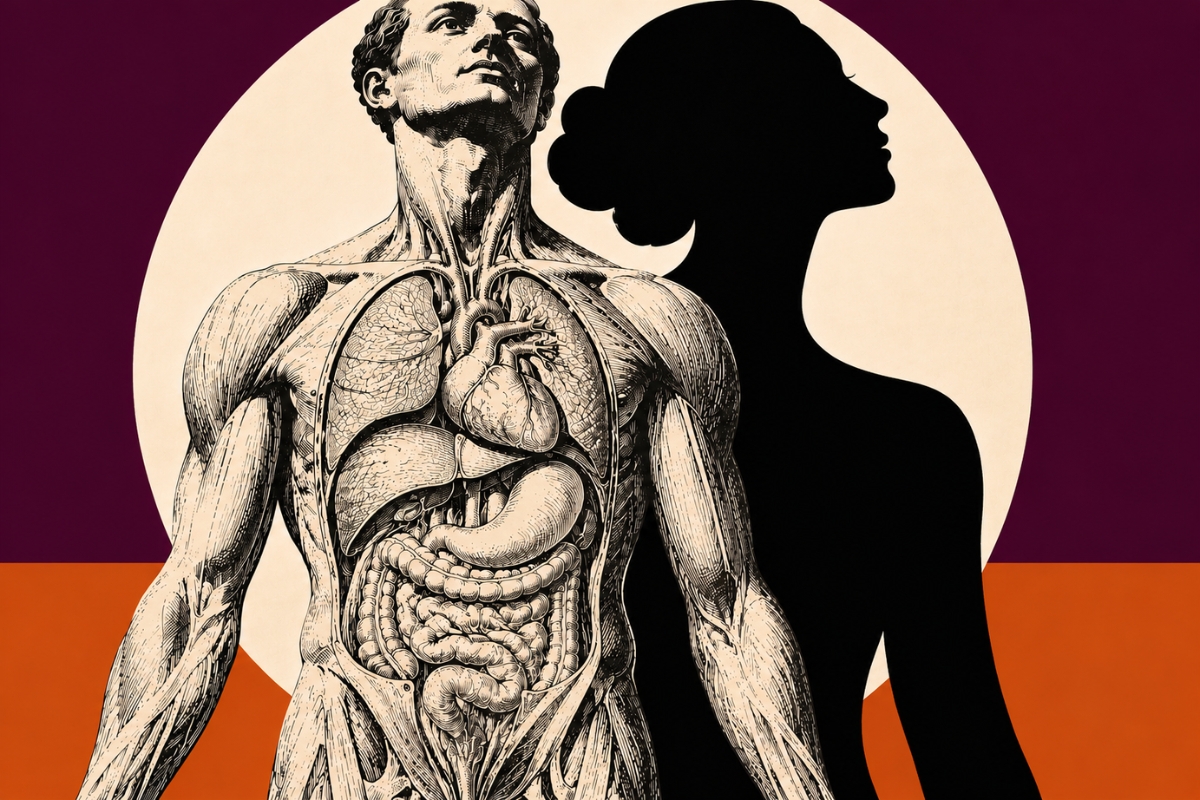
Medicine studied men and assumed women were the same patient with inconvenient hormones. Now we’re paying the price—in our bone, heart, and brain health.
A few weeks ago, I felt a stabbing pain in my lower left abdomen. At first, I assumed it had to do with my digestion (always an adventure these days). But when it recurred, I realized it was closer to my pubic area. Was it something in my ovaries? A cyst? Cancer?
The tendency to go from zero to 60 when self-diagnosing health problems is a hazard for many women at midlife. Never mind the brain fog or low libido. As women go through perimenopause and menopause, many find themselves dealing with an array of symptoms that are hard to name, let alone treat. As a friend complained recently, “There should be a doctor women can text at any time to ask about these weird symptoms: Is this normal? Do I need to worry? Or will it go away on its own?”
Unfortunately, that savvy, available midlife doctor is pretty hard to find. At first glance, it’s not clear why. We’re not talking about a skin condition that afflicts only 2% of adults. Menopause is something most women will experience, so it’s baffling that only 31% of OB-GYN residency programs include a menopause curriculum, and most consist of only a lecture or two.
But it’s not just a lack of trained clinicians that has kept menopause medically invisible for so long, said Dr. Mary Claire Haver, OB-GYN, a certified menopause specialist and author of The New Menopause: Navigating Your Path Through Hormonal Change With Purpose. “For decades, menopause was treated as a natural transition that women were simply expected to endure, rather than a significant stage of life that deserved rigorous medical attention,” said Dr. Haver, who also hosts the unPaused podcast.
“Now we understand that the menopausal transition can affect nearly every organ system in women’s bodies—yet our research, education, and clinical care haven’t caught up with that reality,” she said.
The urgent question today isn’t only what led to such an egregious oversight in women’s healthcare, but what’s being done to remedy it now?
Why Women Were Left Out of Medical Research
The history of gender bias in the U.S. isn’t news. What’s rarely discussed, however, is the historical bias against women in medical research, treatment, and drug development.
Despite critical differences between male and female physiology, sex was rarely even acknowledged as a factor in medical research, said Dr. Lisa Mosconi, director of the Weill Cornell Women’s Brain Initiative and Alzheimer’s Prevention Program. “For much of modern medical history, the male body was treated as the default human body,” Dr. Mosconi said. “Women were often excluded from research because investigators worried that menstrual cycles and hormonal cyclicity would introduce variability.”
An FDA guideline issued in 1977 even stated that women of “childbearing potential” should be excluded from the early phases of clinical research due to the thalidomide tragedy. While this restriction was meant to protect women and unborn children, it was part of a trend that led to many women being excluded from clinical research—for decades. When researchers reviewed 107 randomized controlled trials funded by the National Institutes of Health, which included men and women, 72% didn’t even include sex as part of their analysis. In other words, the under-inclusion of women in medical research wasn’t a blanket ban, but it came close.
Data from the “average” white male used as a universal template helped contribute to profound gaps in healthcare—especially for women and minority groups, said Dr. Mosconi, who’s also the author of The Menopause Brain. “The downstream consequence of these policies is an evidence gap that reaches all the way into the doctor’s office,” she said. “We know less about how certain diseases develop in women, how their symptoms can differ, which biomarkers are most informative, and whether treatments should be timed or dosed differently.”
Distortions in the Data Scared Doctors Away From HRT
Women have paid the price for those research blind spots—often with their health. “The fallout has been enormous,” Dr. Haver said. “We’ve historically paid too little attention to the longer-term health consequences associated with estrogen loss—including changes in bone, cardiovascular, metabolic, and cognitive health. When we fail to recognize these connections, women lose valuable opportunities for prevention and early intervention.”
Even a landmark study in the early 2000s, the Women’s Health Initiative, ended up doing more to derail menopausal treatment than support it. The government-funded initiative aimed to explore key aspects of women’s health, including the impact of hormone replacement therapy (HRT). But in 2002, its estrogen-plus-progestin arm was halted after an interim analysis found that the treatment’s risks—including elevated risks of invasive breast cancer, coronary heart disease, stroke, and pulmonary embolism—outweighed its benefits. A separate estrogen-only arm continued until 2004, when it was stopped after an increased risk of stroke and no heart-disease benefit.
Doctors stopped prescribing HRT. Many women panicked and felt they had nowhere to turn. Earlier this year, PROVOKED did a deep dive into the data, including the types of hormones studied, the fact that participants, on average, were well past menopause, and the fact that many had pre-existing conditions that limited the applicability of many of the study’s results.
Given longstanding gaps in menopause research and care, it’s no wonder that many don’t seek help for their symptoms. A 2025 study by Mayo Clinic researchers found that 87% of women surveyed hadn’t sought care for their menopause symptoms, with most saying they were “too busy” or didn’t know about effective treatment options.
Why Menopause Research Ignored the Brain
Today, there’s a shift ushering in an era of awareness, research, innovation, and treatment for women. One striking example is the growing research into menopause and dementia—a connection that has been poorly understood and is gaining more attention now.
More than 7 million people in the U.S. are living with Alzheimer’s disease (AD)—and almost two-thirds of Alzheimer’s patients are women, Dr. Mosconi said. Women of color are at an even higher risk of developing AD. That doesn’t mean menopause causes Alzheimer’s, Dr. Mosconi said, but that the potential risk factors for women in menopause should be better understood by now.
“If Alzheimer’s biology begins in midlife, when menopause also occurs, that overlap should be an obvious window for investigation,” Dr. Mosconi said. “Yet for a long time, the brain was simply not treated as a primary target organ of menopause.”
Dr. Mosconi’s TED Talk, “How Menopause Affects the Brain,” which has been viewed more than 5 million times, highlights research that shows how lower estrogen levels at midlife impact major areas of the brain, leading to hot flashes, mood dysregulation, memory trouble, and more. “The hormonal transition of menopause is also a neurological transition,” she said.
What’s Finally Changing in Menopause Care
Research and clinical attention to perimenopause and menopause are growing. That doesn’t mean science has all the answers. But it’s getting easier for some women to seek treatment, knowing that their doctors may have solutions—or can refer them to practitioners who do.
Growing public demand, especially from women themselves—think: Halle Berry on Capitol Hill in 2024—has also helped fuel a groundswell of research and innovation. More universities and medical centers are now funding or expanding clinical centers and treatment models that take an integrated approach to women’s menopausal health.
In addition, telehealth platforms may provide greater accessibility, more personalized treatment, and in some cases affordability, thanks to an increase in insurance coverage for telehealth visits in recent years—including those covered by Medicare.
Like many menopausal women, I’ve ended up cobbling together an ad hoc midlife team for myself with my primary care doctor, OB-GYN, acupuncturist, therapist, a weekly meditation group, and other support. When I tried Midi Health recently, the experience was a striking contrast to my DIY approach.
For 30 minutes, I spoke with a nurse practitioner who had decades of experience treating women, and I learned what it felt like to have someone ask me about every aspect of my health—as if I were a whole person, instead of a collection of parts. It felt great to sign off with an action plan to address my concerns. But it was distressing to have a truly in-depth discussion about my history of breast cancer in light of menopause. Why hadn’t that happened before?
I found out because someone finally asked about all of it.
**************
Reviewed by Sonya Maynard, health and wellness fact-checker, in October 2026.
MEDICAL ADVICE DISCLAIMER
DISCLAIMER: This website does not provide medical advice. For health or wellness-related content, SFD Media LLC emphasizes that information about medicines, treatments, and therapeutic goods (including text, graphics, and images) is provided for general information only. No material on this site is intended to substitute for professional medical advice, diagnosis, or treatment. Users are advised to independently evaluate and verify the accuracy, reliability, and suitability of the information before relying on it. You should not rely on the content as a substitute for professional medical advice. Consult with a physician or other healthcare professional for any health concerns or questions you may have. SFD Media LLC is not responsible for any action taken based on the information provided on this website. The use of any information provided on this website is solely at your own risk.