Sponsored by NativePath
Women over 50 are sold dewy‑skin—not whether they can stand up without pain. We looked at the research and one brand to see if collagen is worth your attention.
You know that moment right before you open your eyes in the morning? Before you even move, you’re already doing a systems check. Knees. Hips. Lower back. Is today going to be a good day or a hard one? Will my feet hit the floor without that ankle buckling? Can I get to the bathroom without holding the wall?
This isn’t about vanity.
This is about function—whether you can get up off the floor, carry groceries up the stairs, keep up with your grandkids, and get through a full day without your body staging a protest. But when you go looking for answers, the wellness industry wants to talk about dewy skin and fewer wrinkles.
Most of us would take better skin. But what we need is to keep moving—without pain.
So when collagen supplements started flooding the market with big promises, a lot of us rolled our eyes. Another miracle cure. Another trend dressed up in science. Fair enough. But here’s the thing: Collagen isn’t really about turning back the clock. It’s about whether your joints can do what you’re asking them to do—today, and 10 years from now.
And that’s worth a closer look.
What Collagen Actually Does
Collagen is a protein your body makes naturally. It supports your skin, bones, muscles, tendons, ligaments, and connective tissue—making up about 30 percent of all the protein in your body. Think of it as the scaffolding that holds everything together.
The problem is that after menopause, your body starts producing significantly less of it. The collagen supplements you see on store shelves are derived from animal sources and are intended to help replenish what your body is no longer making on its own.
It’s not magic.
But the biology behind it makes sense.
Why a Little Skepticism Is Healthy
Most studies on collagen are small, and many are funded by the supplement companies selling them, so it’s worth being clear-eyed about what the research actually shows.
A 2025 review found that when researchers looked only at independent, higher-quality studies, the skin benefits of collagen were more modest than the marketing suggests. The evidence for joint and connective tissue support is somewhat stronger, but still not definitive. Several small clinical trials suggest that hydrolyzed collagen can reduce joint pain and improve function—particularly for people with osteoarthritis—but results vary from person to person.
The downside? Minimal, as long as you choose the right product.
What Actually Matters for Your Joints
There are at least 28 types of collagen in the human body, but for most women over 50, two matter most: Type I and Type III.
Type I makes up roughly 90 percent of your body’s collagen and supports your bones, tendons, ligaments, and skin—the structural stuff that determines whether your knees cooperate when you stand up or climb stairs. Type III shows up in skin, blood vessels, and organs, helping to keep tissue resilient and flexible. Both decline significantly after menopause.
These types don’t directly rebuild cartilage, but they help maintain everything around your joints—the bones, ligaments, and tendons that absorb shock and keep you stable every time you move. If you’re going to take a collagen supplement, Types I and III are the ones most worth your attention.
What About Skin, Hair, and Nails?
Multiple small studies suggest that daily collagen peptides taken consistently over 8 to 12 weeks can modestly improve skin hydration, elasticity, and wrinkle depth. It’s not a facelift. But for women noticing looser skin, crepey texture, or thinning hair, it may mean better hydration, subtle improvements in firmness, and a stronger protein foundation for hair and nail growth.
What To Look For—and What To Avoid
The supplement industry in the U.S. isn’t heavily regulated. Products can hit store shelves without FDA approval, and labels can be misleading. Here’s what to look for:
- A short ingredient list with nothing you can’t pronounce.
- Grass-fed, pasture-raised sourcing.
- Third-party testing with verifiable results.
- A brand that’s transparent about where their ingredients come from and how their product is made.
Always check with your doctor before starting any new supplement, particularly if you take medications.
One Brand Worth Knowing About
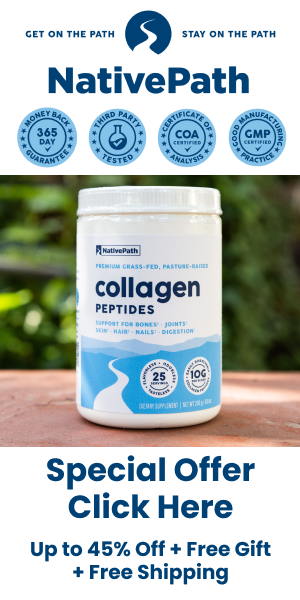
Which brings us to the question: Does any brand actually meet these standards? NativePath takes a straightforward, single-ingredient approach: hydrolyzed bovine collagen sourced from 100 percent grass-fed, pasture-raised animals, rich in Types I and III, with no fillers, no artificial additives, and no unnecessary extras.
Co-founder Chad Walding is a Doctor of Physical Therapy who spent years as a home health PT watching patients struggle with chronic pain and declining mobility. In 2010, he began connecting the dots between poor nutrition and the health problems his patients faced—inflammation, joint pain, digestive issues. Rather than just treating the symptoms, he wanted to address the cause.
After years of research, NativePath was born in 2017 around one simple idea: If you’re going to take a supplement, keep it clean and keep it simple.
NativePath collagen is hydrolyzed, meaning the collagen molecules are broken down into smaller chains for easier digestion and absorption. This addresses one of the most common criticisms of oral collagen supplements—whether your digestive system can actually make use of it. Some research suggests hydrolyzed collagen peptides are absorbed into the bloodstream and may support collagen production in joint tissues.
The powder is flavorless, dissolves easily in coffee, water, or a smoothie without clumping, and contains no milk, shellfish, tree nuts, wheat, peanuts, soy, GMOs, gluten, dairy, sugar, or artificial additives. Every batch is third-party tested for heavy metals, microbial contaminants, and potency—and the results are available on their website, searchable by lot number.
One scoop a day. About 20 grams of protein. Mixed into your morning coffee.
That’s it.
The Bottom Line
Collagen isn’t a miracle. It won’t undo decades of wear and tear. The results are individual. Our genetics, diet, and movement matter more than any powder you stir into your coffee.
But if you’re the kind of woman who takes her health seriously—who strength trains, watches what she eats, and refuses to accept that pain and stiffness are just part of getting older—quality collagen supplementation may give your body the raw materials it needs to keep doing the work.
Some women see real improvement. Others see less. The only way to know is to try it yourself, with realistic expectations and a brand you can actually trust.
To learn more about NativePath’s collagen and how it supports joint health, click here.
******
MEDICAL ADVICE DISCLAIMER
DISCLAIMER: This website does not provide medical advice. For health or wellness-related content, SFD Media LLC emphasizes that information about medicines, treatments, and therapeutic goods (including text, graphics, and images) is provided for general information only. No material on this site is intended to substitute for professional medical advice, diagnosis, or treatment. Users are advised to independently evaluate and verify the accuracy, reliability, and suitability of the information before relying on it. You should not rely on the content as a substitute for professional medical advice. Consult with a physician or other health care professional for any health concerns or questions you may have. SFD Media LLC is not responsible for any action taken based on the information provided on this website. The use of any information provided on this website is solely at your own risk.