
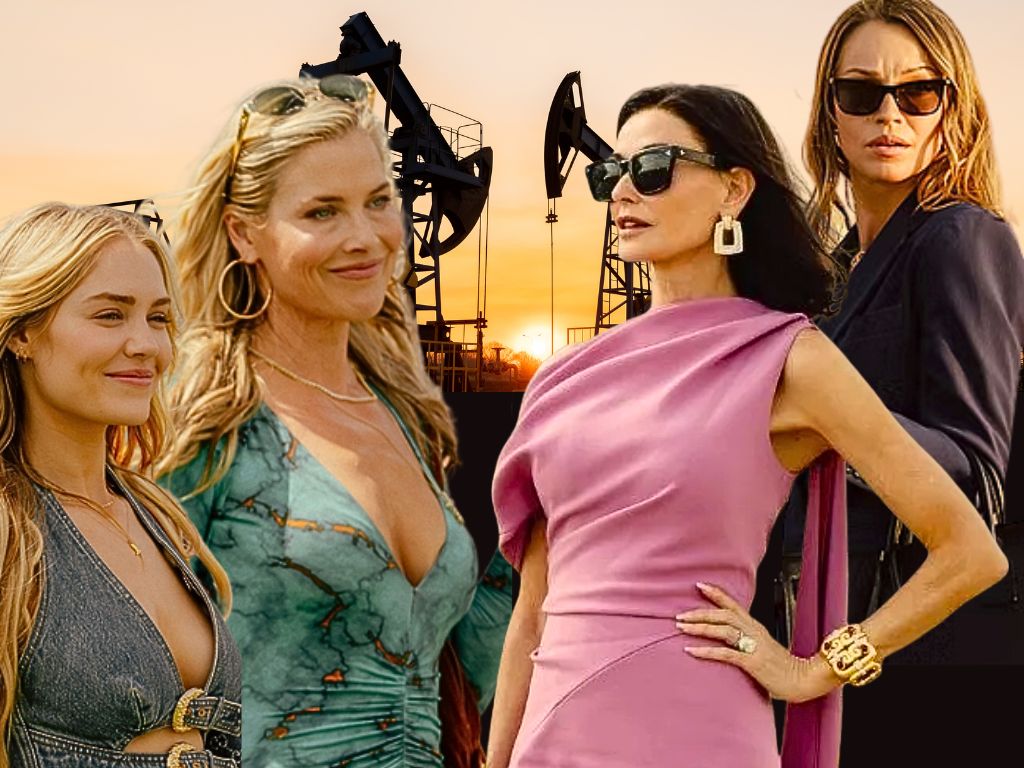
Editor’s note: This piece contains spoilers for Season 1 and Season 2 of Landman.
The oil fields feel real. The stakes feel real. The women are anything but real.
I am, on paper, the woman Landman thinks it’s writing. I’m tall and blonde. I’ve been married to an oilman for decades. I’ve lived in and out of Texas for more than 30 years, raised a family, watched my son play football under the Friday night lights, lived in compounds all over the world, flown into places where the work is dirty and dangerous and the stakes really are life and death. I have never—not once—met a woman like the wives, daughters, and widows Taylor Sheridan has teed up for our viewing pleasure.
The blowjob in the truck was my breaking point. Not because sex shocks me; it doesn’t. My husband has worked in oil his whole career. I understand the language of boom towns and roughnecks, of gushing wells, busted hands, and the kind of men who come home with mud ground into their boot treads. I can live with grit. What I can’t live with is a show that begins and ends an episode by turning a woman’s body into a running gag—Angela sliding down in the passenger seat to “service” her ex yet again—as if her mouth is her main character trait. Once might have been lazy writing. Twice feels like a thesis.
And here’s the worst part: Landman is entertaining. It’s glossy TV built on very real stakes—land rights, corporate greed, the cost of fossil fuel—and the men are written with genuine care. That’s what makes watching it as a real oilman’s wife so infuriating. The show knows how to do complexity. But it refuses to extend that courtesy to the women.
The Sheridan Woman Problem
Taylor Sheridan has made himself the cowboy of our era: the man behind Yellowstone and its spin-offs, Wind River and now Landman. He’s built an empire on a certain story: flawed men in hard landscapes, trying and failing and trying again. Along the way, he’s also built a reputation for something else: He doesn’t know how to write women. We’ve seen the template before. Beth Dutton in Yellowstone is often held up as a “strong female character,” but much of her strength is coded as hyper-sexualized trauma: foul-mouthed, endlessly damaged, filmed as spectacle. Sheridan knows how to write a pornified “badass”. What he doesn’t seem able, or willing, to write is a woman who is complicated without being a male fantasy.
Landman has already drawn fire for this. Early reviews asked if the show “hates women,” calling out its oversexualized female characters and the way they’re deployed as scenery around richly drawn male leads. Fans have questioned whether Sheridan should be “banned from writing women,” and there are threads devoted to the grotesque way the daughter’s storyline is handled. When the people who love your shows are begging you to treat women better on screen, something is broken.
The Blonde and Her Mini-Me: Angela and Ainsley Norris
Let’s start with the blonde at the center of the storm. Angela Norris, played by Ali Larter, 49, is Tommy Norris’s ex-wife. In theory, she’s a woman who’s survived the boom-and-bust cycles of oil money, a mother, an ex-partner who knows where the bodies are buried. On screen, she’s a collage of male fantasies and fears: permanently horny, bikini-ready, emotionally unhinged, addicted to shopping and drama. She’s introduced with sex and defined by it, to the point that major Season 2 beats are literally framed by that car-blowjob routine.
Her daughter Ainsley, played by Michelle Randolph, is supposed to be 17. The show treats her like a teenager and films her like a fantasy. She’s blonde, pretty, and dumb in that old familiar way. What’s striking is how closely she mirrors her mother. They move through scenes as a unit, matching hair, matching bikinis, a mother-daughter set there to take up space with their bodies. Sheridan manages to flatten two women at once, a generation apart.
In my world, oilmen’s wives and daughters are many things—conservative, liberal, religious, cynical, funny, bitter, idealistic. I’ve met women who love a designer bag and a spray tan, who thrive on a little chaos, who flirt too much at the bar. But every one of them can read a room, sense danger, manage money, and protect their children. They’re handling schools and passports, elderly parents, and teenagers straddling three cultures.
When you take the worst clichés about blondes, dumb, narcissistic, sexually available, unstable,and stitch them into not one but two main characters, that’s contempt.
The Widow and the Attorney: Elegance as Fantasy
Then there’s the widow. Demi Moore, 63, plays Cami Miller, the wife of oil tycoon Monty Miller, who dies and leaves her as M-Tex’s top stakeholder. She’s meant to be the complex one: older, wealthy, navigating grief and power. Moore brings charisma and gravitas; she always has.
But Landman doesn’t write Cami as a woman with competence, but more like a woman with couture. The show hopes for the symbolism of a “power widow” without doing the work of giving her power. She poses in her designer ensembles and struts into the oil fields in Jimmy Choos. The one gratuitous scene with her pouring over file boxes on the floor is more staging than character development.
And I call bullshit on the idea that she suddenly has “agency” because she now owns a piece of her husband’s empire. Real agency is asking the right questions. Reading the contracts. Understanding the politics. Knowing which men are lying to you, and why. The woman Sheridan gives us does none of that. She trusts the wrong men and makes a deal with a man who is a murdering drug lord. She’s not running the business. She’s being run by it and by the men around it.
Then there is Rebecca, the attorney.
Rebecca is sharper, younger, and professionally trained. She understands liability and the mechanics of corporate survival. She walks into a room like she belongs there and knows how to speak the language. She is, at least initially, written like one of the men.
And then, inevitably, she’s in Charlie’s bed.
The first time is after a turbulent private-jet flight followed by fear, a rush of adrenaline, and too much alcohol. A drunk, post-crisis hookup that turns into a wake-up-in-his-bed one-night stand. The show frames it as a human impulsive moment, almost understandable. But that’s precisely the point. Why must the competent woman be sexually available? Why does Sheridan insist that a woman can’t just be formidable—she has to be romantically entangled? Rebecca doesn’t get to be the shark. She gets to be the shark who also wakes up tangled in the sheets. When they reconnect later for work, the script plays coy: a professional meeting that softens into flirting, kissing, and a dinner invite. The writing implies, “See? She’s strong. She’s having sex like a man would.” But that’s still centering the male gaze. It’s the old fantasy: the cool girl who can negotiate a contract by day and still slide into a man’s bed by night.
Real women in high-stakes business understand leverage, optics, and risk. That doesn’t mean they don’t have sex. It means they understand timing and consequence. Sex may be private, complicated, even be reckless. But it’s rarely this convenient.
Sheridan is at least consistent: No matter how sharp or ambitious a woman becomes, she will still take off her clothes. Rebecca is a missed opportunity.
The Men Get to Be Complicated
It’s not that Landman can’t do characters. Look at the men. Jon Hamm’s Monty Miller, before the show kills him off, is a swaggering oil baron with charm and rot in equal measure. Billy Bob Thornton’s Tommy Norris is flawed, funny, and frightening. His father, his son, the roughnecks, and hangers-on—they all get to be specific. They all have different character arcs that rise and fall.
Even secondary male characters are allowed dignity. They get to play quiet scenes and make bad decisions. They’re shown working, failing, trying. The camera and the script grant them interiority. The women, meanwhile, are mostly busy bending over things. There’s even a blink-and-you-miss-it cowboy cameo in the arena that sure looks like Sheridan himself—a Marlboro-man self-insert riding his own bronc through the fantasy. Men, in his universe, get to be myth and man. Women get to be myth and mouth.
The Women He Won’t Write
Here’s where I must put my own life on the record. A real oilman’s wife is a logistics officer and an emotional first responder, not a poolside extra. Our husbands sometimes do dangerous work in places that can kill them; they travel to hostile environments and make decisions with consequences that you feel in your body when the phone rings at 2 a.m. We weren’t running off to marry the next thug with a Bentley when things got difficult. I moved all over the f—ing world. I killed my own career, for years, to be a wife and a mother in this life. So did many of the women I lived alongside in expat housing. They were engineers, teachers, lawyers, artists before they became “the wife.” Some kept working. Others couldn’t, because of visas or kids or geography. All of them doing the emotional labor to hold it together. Have I known women who love sunshine and a martini poolside on a Thursday? Of course. Big hair and big hearts are real in Texas. Big hearts don’t cancel out bad writing though.
Why Still This in 2026?
It’s 2026. We’ve watched wave after wave of “prestige television.” We’ve sat through MeToo, reckonings about workplace harassment, endless think pieces about representation and the male gaze. Women like me—over 50 with our own money and our own streaming passwords aren’t fringe viewers. We are the audience.
I don’t need every show about oil to be a feminist masterpiece. I do, however, expect that a man, given this much money and power, can manage to write one woman, just one, who doesn’t exist solely for the male gaze. That’s the bar. We deserve better stories than this. And frankly, so do the men who have to live with the real women Sheridan refuses to see.



21 Responses
I hadn’t watched a Taylor Sheridan show before, and I wanted to love this one. Why? Because I love Billy Bob Thornton. I never asked myself what Angelina Jolie saw in him because I got it. I managed to get through 4 episodes and gave up. Sheridan would have to bring Elvis back from the dead for me to watch Landman again.
Hi Brandi, Thanks for this. You made me chuckle just a bit. I agree! —susan
Late to the party here but decided to comment anyway. While I read the original article about Landman and agreed with every word, I just now discovered the excellent response from the oilman’s wife. Is that really you, Susan? Well anyway, I thoroughly enjoyed it. I do agree about that show and the sexist condescension in how women were depicted; it was the reason I also stopped watching it. I loved Yellowstone but never watched any of the other Sheridan shows.
That said, I invite you to take a look at the latest spinoff titled “Dutton Ranch.” Beth, Rip and their young ward, Carter, have moved on and are carving out a new life in Texas. Although the strong undertones of violence and cutthroat ambition are still present as they were in Yellowstone, when it comes to the female character characters I’ve noticed some nuances which IMO give new depth to the female characters.
There’s Beth of course, who has matured and changed a bit … still strong, intelligent, witty, and wholly intimidating but without the need to prove it to everyone she meets. Plus there is an added layer now of something resembling maternal instinct. There’s a caring and a tenderness she shows in her relationship with Carter which seems to have softened her rough edges. I’m finding her to be a much more interesting character now.
Then there is Oreana, a gorgeous young blonde who’d look right at home on the Landman set. Admittedly, she started out a calculating, manipulating, I’ll use sex to get what I want type, typical of Sheridan‘s others. But it’s also been hinted that she has a backbone we’re going to see more of, possibly with a little coaching from Beth.
Finally there is Beulah – Beulah Jackson who runs the nearby mega ranch called 10 Petalplayed to the absolute hilt by the inevitable Annette . She’s as tough as they get Then there is Oreana, a gorgeous young blonde who’d look right at home on the Landman set. Admittedly, she started out a calculating, manipulating, I’ll use sex to get what I want type, typical of Sheridan‘s others. But it’s also been hinted that she has a backbone we’re going to see more of, possibly with a little coaching from Beth.
Finally there is Beulah – Beulah Jackson who runs the nearby mega ranch called 10 Petals. Portrayed brilliantly by the remarkable Annette Benning, she’s as tough as they get, and they get tough in Texas. It’s hard to sufficiently describe her performance here with words. You have to watch to appreciate the depth of her character. Let it suffice to say that Beth may have met her match. One would expect to see a battle of wills between these two strong women, but it’s been hinted that there may instead be a joining of forces for a profitable partnership. Or maybe not. The point is, when these two get together there’s not even a hint of a bimbo in the room. And if one happened to pass through, she’d be very sorry she did.
Sorry this is lengthy, but I really do see promise in this new show. Perhaps Sheridan is trying to redeem himself? I’m not sure I’d go that far, but it’s well worth watching if for no other reason than to see the great Ed Harris as the grizzled, introspective veterinarian. He’s sort of a background character, but being Ed Harris, he can’t help but steal every scene he’s in. No one could do it better.
Hi, Yes, it’s really me. (I am truly an Oilman’s wife, I write, and I answer the comments; that’s the job!) And this might be on of my favorite comments, because you didn’t just agree with me, you argued me somewhere new.
I just started Dutton Ranch. Everything you describe about Dutton Ranch is the thing I said Landman couldn’t imagine. Beth with nothing left to prove, plus her maternal instincts toward Carter? That’s the evolution I wanted that Sheridan was incapable of—up until now? And Annette (he even gave her a cool name, one of the oldest of all the female names) running a mega-ranch as Beth’s possible equal rather than her rival — “not even a hint of a bimbo in the room” — you just wrote a line better than the networks could come up with. But will the character arcs last?
So now I have to watch, which means you’ve cost me a weekend. The real question your comment raises, and the one I can’t stop turning over: is Sheridan actually learning to write women with depth, or did he finally hire and listen to people who can? Either way, it’s an improvement. Comments like yours make my day. Thanks for being here! —susan
Susan you hit the nail on the head. I have found Taylor Sheridan to do this in all of his shows starting with Yellowstone. There’s an uncomfortable, watching an accident kind of feeling I get watching all of his female portrayals. They are beautiful sure, but, mostly unkind, tragic and sorry but “b “words. He even made my beautiful Michelle Pfeiffer unlikable. Maybe Taylor has a problem with women?
Hi Margo! Great to see you here in the comments. You are definitely not alone in feeling this. What fascinates me about Taylor Sheridan’s women is that they’re often introduced as “strong,” but many are written through a lens that feels punishing, cynical, or strangely contemptuous underneath the glamour.
Beth Dutton especially became this cultural icon of female power, but if you really step back and look at her, she’s also written as chaotic, cruel, self-destructive, sexually weaponized, and emotionally brutal. On first glance, you think it is strength but it is filtered through damage and volatility. Sheridan returns to this pattern over and over.
What unsettles me is that the women are rarely allowed ordinary complexity, warmth, softness, or intelligence. They often feel less like fully realized women and more like male fantasies of dangerous women.
And yes, when someone as lovely as Michelle Pfeiffer starts feeling cold or inaccessible on screen, you do start wondering whether the issue is the character… or the worldview behind the writing.
Clearly he taps into something audiences respond to. But I also think many women are beginning to notice the same uneasy undercurrent you described, and catching on. At least the women I have been talking to do. Thanks for being here. —susan
Agree, agree, agree… great article!!! So who is the best writer out there today representing women? Shonda Rhimes maybe?
You had me at Shonda. I’d put these four at the top right now: Shonda Rhimes (Grey’s Anatomy, Scandal, How to Get Away with Murder), Jenji Kohan (Weeds, Orange Is the New Black), Michaela Coel (I May Destroy You), and Phoebe Waller-Bridge (Fleabag, first-season Killing Eve). Would love to hear what other’s think?! —susan
Yeah… but even Shonda had her two early, famous women doing the “oops, I’m going to endanger my career by sleeping with the boss” thing going on.
I HATE THAT. Most women I know who are in professional capacities, would definitely NOT start an affair with either the doctor who is their attending, OR the freaking president right under his wife’s nose.
Yet, Dr. Grey’s affair with a married man far above a resident gets turned into to some sort of Romeo and Juliet BS. Most of the plot of Scandal wasn’t about her role as a fixer, but about her OWN scandal with Fitz. UGH.
And feminist views aside, the women in Landman are just. annoying. Like so damn annoying. They are the kind of women who pull all the violent crap just because it’s easier to be a bitch than grow a brain. Although, there was a really good moment when the daughter said something just classically, horrifically dumb and you could see a bit of regret on the mom’s face. Like, “I screwed up with this one.”
And seriously, the mom is over sexualized and basically portrayed as a high end call girl, but not as stupid. And her ex is definitely not dumb, nor her brother.
So, how exactly did that stupid girl come about?
Hi, You and I are watching the same show with the same rising blood pressure. The “competent woman torches her career for the boss, and it’s framed as romance” pattern is exactly what gets me — Grey, Olivia, all of them. And you’re right that the daughter makes no sense in that family; that flicker of regret on the mom’s face— I can’t decide what she was telling us there. Thanks for reading closely enough to be mad about it.—susan
Terrific article Susan! On a side note- as someone who worked in the industry for your husband there is no one better in corporate America. A true gentleman who is beyond lucky to be married to you! Keep up the great work. Love Provoked!
Thank you for writing this. I am an attorney that grew up in Texas and now live in New York. While on one hand, the show was great entertainment and I keep tuning in and have so enjoyed so much of it, but every week felt ashamed that I like it because the women feel so wrong on so many levels: As if written solely for the purpose of men’s fantasies. How many times should we endure jokes about how women’s period’s make them crazy? I did not have the words to convey what you have so eloquently summarized. Thank you for this review.
Totally agree with everything you wrote. My adult daughter and I were both disgusted with these characters and then to throw in the “physical therapist “ for the dad? Just ridiculous. I’m over this show
Susan, your writing is both eloquent and enlightening, and I mean that in the most “now I need a stiff drink” kind of way. I have never seen Landman, and after reading this, I have added it to my “absolutely not, not even on a plane, not even if the alternative is staring at the seat-back pocket” list.
It bothers me greatly that these types of stories are still aired, and nay, celebrated, on TV. Our daughters and sons are watching and we know that TV informs behavior in insidious ways.
Leaving now to compose my strongly worded letter to Paramount+, for all the good it will do.
Thank you for this fine and articulate piece. Your analyses are spot on. It’s the little things that end up poisoning the stew.
I never watched the show because I figured it was soft-core porn for the MAGAs just like Yellowstone – which I did watch. Entertaining and easily forgotten.
And yes, it is 2026. Taylor Sheridan writes the type of fantasy that kept Jeffrey Epstein in business for all those years.
You said it far better than I, Johanna. Thank you.
I chose not to watch it after seeing some of the trailers. Who needs more images such as these?
GREAT article, Susan. Thank you, as well!
I am happy to realize I am not the only one who sees this. I have been discouraged and dismissed by men and women when I shared similar thoughts throughout my life. This is very validating. Thank you.
My husband and I stopped watching it mid-Season 2 for this very reason. The conversation about ending the loyalty to the show started with the same sentence – “I think Taylor Sheridan hates women”. The last straw for us was Ariana’s “fight me”. She’s Landman’s Monica from Yellowstone and we can’t stand either of them. Sheridan had an opportunity to write culturally different women at a minimum in a more interesting way, but dropped the ball and turned them into petulant caricatures. We’re not coming back for Season 3 either.
Never could watch these shows where women are glittery, stupid beings, with no worthy purpose in life. I spent my career around women who were seeking solutions to poverty, unwanted pregnancies, housing justice, health inequalities, and civic duty. Most wore sensible shoes…
This is perfect. I watched the first season but couldn’t watch anymore precisely because the women were so poorly written. I don’t know if it’s laziness, contempt, or something deeper, but it’s insulting to see women written as nothing but scenery. I won’t waste my time on something that demeans every female character. Thank you!
Thank you, Susan; you said it brilliantly. I won’t waste a single minute on this B.S. If my husband wants to watch it, he’s on his own. I am thoroughly sick of women being written as props.