
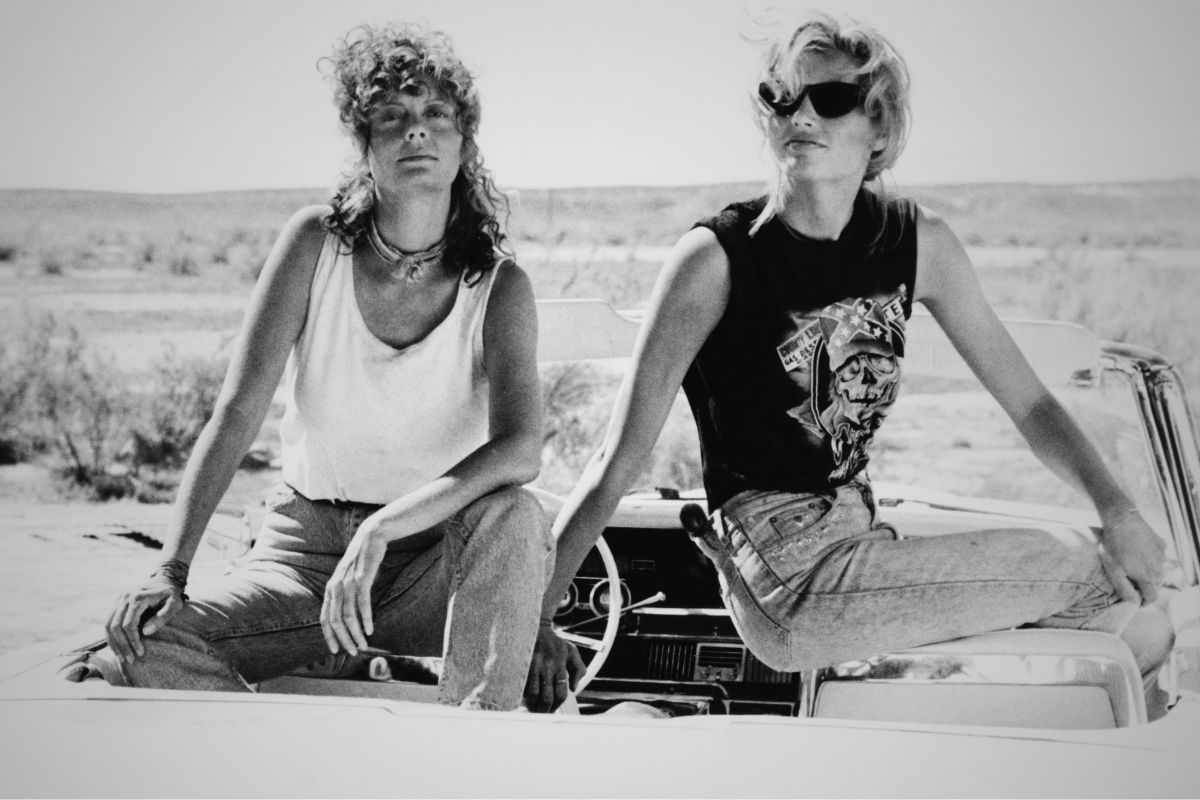
The feminist landmark gave us an unforgettable friendship. Its hardest question still doesn’t have an easy answer.
When Geena Davis and Susan Sarandon, as the accidental outlaws Thelma and Louise, clutched each other’s hands and accelerated off a cliff 35 years ago, female audiences were stunned.
We’d never seen such a fierce female friendship on screen. We finally had our Redford and Newman. We’d also never seen such a simmering condemnation of modern male chauvinism in a mainstream movie. It pushed these women over the edge.
Thelma & Louise was heralded as a feminist film when it premiered at the Cannes Film Festival in 1991. The protagonists were dubbed “heroines” again this year when Cannes honored their 35th anniversary by splashing them across the event’s official poster.
Going Out In a Blaze
Even so, when I asked female friends how they felt about the movie back then, they admitted to misgivings. I remember feeling the same unease. I loved the characters and their journey, but their decision to die troubled 20-something me.
The culture still romanticizes Thelma and Louise’s iconic middle finger to the man in their decision to go out on their own terms. Like Butch Cassidy and the Sundance Kid before them, they were immortalized in a no-surrender freeze-frame ending that left them permanently suspended in time—and just moments away from certain death.
Now I understand what other midlife women discovered before me—the harder work is figuring out how to resist without dying, how to discover yourself or change your life and your loyalties without disappearing.
Would It Be Different Today?
In 1991, screenwriter Callie Khouri and director Ridley Scott determined that death was their protagonists’ only or best escape after an attempted rape ends in murder and sends the two women on a crime spree. We like to think we’ve come a long way in 35 years.
In the post-#MeToo era—where abuse is more openly acknowledged, abusers more likely to face justice, and trauma increasingly destigmatized—we like to think they would go to the police and be heard. We like to think that women are less invisible, men more considerate, laws more fair and society more egalitarian today. We like to think these hard-earned freedoms and opportunities extend beyond white, middle-class women.
Then again, a recent survey found that 31% of Gen Z men (and 18% of Gen Z women) say a wife should obey her husband. Women widely complain of an exhausting form of “mankeeping” in their heterosexual relationships. And, oh yeah, there’s a rising movement in the U.S. looking to repeal women’s basic rights and autonomy, restrict our participation in public life, and return men to their rightful thrones.
In 1991, we watched the Anita Hill hearings (then elected so many women to office, 1992 was dubbed “The Year of the Woman”) and inhaled two new feminist works—Susan Faludi’s Backlash and Naomi Wolf’s The Beauty Myth. In 2026, we’re dealing with the Manosphere, Bimbocore, and Masculinism.
Radical Friendship
Why did Thelma & Louise feel so radical in its day? Some women saw themselves in the archetypes—the housewife itching to let loose from a suffocating existence, and the buttoned-up single waitress just trying to get by and maintain a sense of order in her life.
The two transform over the course of their journey from opposites-attract besties into something much deeper: a fiercely reliable mutual support system. Their primary loyalty becomes to each other—not men, careers, children, the rule of law, or even their individual lives or desires. Friendship is the only institution that doesn’t fail them.
Men, the law, society—they all betray Thelma and Louise. “You get what you settle for,” Louise likes to say, but there don’t appear to be better options. That bond still feels radical today. But in 1991? The culture couldn’t even imagine them surviving outside the lines of a male-dominated world. Their alliance had to end in flames.
The Men They Could Never Escape
The men in Thelma & Louise also can’t imagine the women surviving without them. Decades before “toxic masculinity” entered the lexicon, this movie’s parade of male figures personifies sexism’s impressive range—from despotic husbands and untrustworthy boyfriends to arrogant abusers and a small but zealous army of agents.
They all see themselves as naturally entitled to authority over women. Their individual actions leave Thelma and Louise with emotional and physical scars—and, in their view, no real way out. They know they’re doomed as soon as they respond to violence with violence. Nobody will believe their side of the story.
Louise, it’s hinted, has prior experience with this. And when Thelma throws off the symbolic shackles of her marriage, there’s no turning back. “Something’s crossed over in me,” Thelma admits. “I can’t go back. I just couldn’t live.” It’s Thelma who ultimately suggests they just keep going forward, straight into the abyss.
The Fantasy of Revenge
The women do savor moments of empowerment before their fiery finale, rousing scenes that earned whoops and laughter in theaters. Thelma beds a hottie and robs a store like a pro, while Louise frees herself of emotional deadweight. They’ve gone from invisible to fully themselves, just as Khouri imagined.
In a climactic scene, the pair confront a trucker who’s been making lewd gestures at them for days. “Where do you get off behaving like that?” they taunt him. “How’d you feel if somebody did that to your mother or your sister or your wife?” Then they blow out his tires and explode his truck in a giant fireball. It’s a cathartic feminist fantasy—all the things women might dream of saying and doing to the perverts and the misogynists and the abusers—while looking iconically cool.
But Thelma and Louise only have the freedom to fulfill that fantasy because they’ve got nothing to lose, no future to worry about. Their freedom is its own fleeting fantasy, one that disappears entirely over the course of the film as their crimes rack up. Their dream of escaping to Mexico turns into a mirage on the lonely desert highway. Finally, they see nowhere left to go except over the cliff’s edge.
35 Years Later
I thought about this as I watched Charlize Theron’s new release Apex, another outwardly feminist film that sees the 50-something Theron outsmart and physically outperform a male predator in the Australian outback. A final scene shows her literally scaling a cliff to escape the sadistic killer. We’ve gone from driving off cliffs to scaling them—but we’re still fleeing male aggression in the Hollywood imagination.
In one swift stomp on the accelerator, Thelma and Louise opt out of the system entirely rather than letting it take them down bit by bit. Some celebrated their bravado, others uncomfortably accepted their choice, and still others took offense.
“How many times these women gonna be f*cked over?” Harvey Keitel, playing the empathetic police agent in Thelma & Louise, explodes at the film’s end.
It’s still a valid question.



7 Responses
It’s good, glad I joined, going to share with a couple of friends 🤗
The film’s ending makes a point about how society views women who choose to live on their own terms. We face two stark choices: Live obediently under a patriarchal society or die.
Those choices haven’t changed. If you think they have, just try pushing the envelope. Try joining #metoo or running for Congress (or the White House) or becoming an astronaut or even living as a single woman without a husband or children. See what you get. Do women do it? Yes. What we don’t see, often, is the damage they sustain from family, friends, and society. THAT is what has to stop.
I really struggled with the ending of this film. I still do. While I completely understand why they took such a drastic step, in my mind they would have done a cross-border blitz to Mexico: ultimately ending up operating a cantina on their own terms, in some anonymous beach town. But that’s how I would have imagined it, and I realize my opinion may be in the minority.
The male abuse and misuse would have continued as we see 35 years later.
I like your re-envisioned ending. And as a 72-year-old California (still)girl who lives part-time in Mexico, I see this reality all the time. Women 50+ from the US and all over the world living their lives & dreams to the fullest with creativity, laughter, and friendship at it’s core. In these dire global times, it gives me a smidgeon of hope.
In my version of the ending, they jumped the canyon-esque hole and made it to the other side. The open-ended nature of the film leaves the ending open to the viewer’s interpretation.
I like your ending best Wendy, 1st one disappointed as you wanted them to escape it all, but Not Like That 😥