
She drove a Cadillac, washed paper plates, and was the most financially sophisticated person I’ve ever known.
I have loyalty cards for three grocery stores. A closet of T-shirts that are legally old enough to vote. And last week I did an exhaustive cost-benefit analysis before buying a $15 dish drainer.
I blame my grandma, and I mean that as the highest possible compliment. She turned financial anxiety into a lifestyle decades before it was a default coping strategy for women managing mortgages, retirements, and families of their own.
She drove a Cadillac, owned nice jewelry, and got her hair done every week without exception. She and my grandfather built a business from their basement, raised six kids, and lived long enough to watch more than 80 grandkids and great-grandkids cycle through. They started with nothing, which eventually turned into early retirement and the ability to watch The Price Is Right every morning on a large-screen TV.
She also washed and reused paper plates, and stretched a single wooden toothpick well past its natural lifespan.
Free Condiments Are Free Condiments
The clearest window into my grandma’s financial philosophy came during a trip my best friend and I took to Florida in eighth grade.
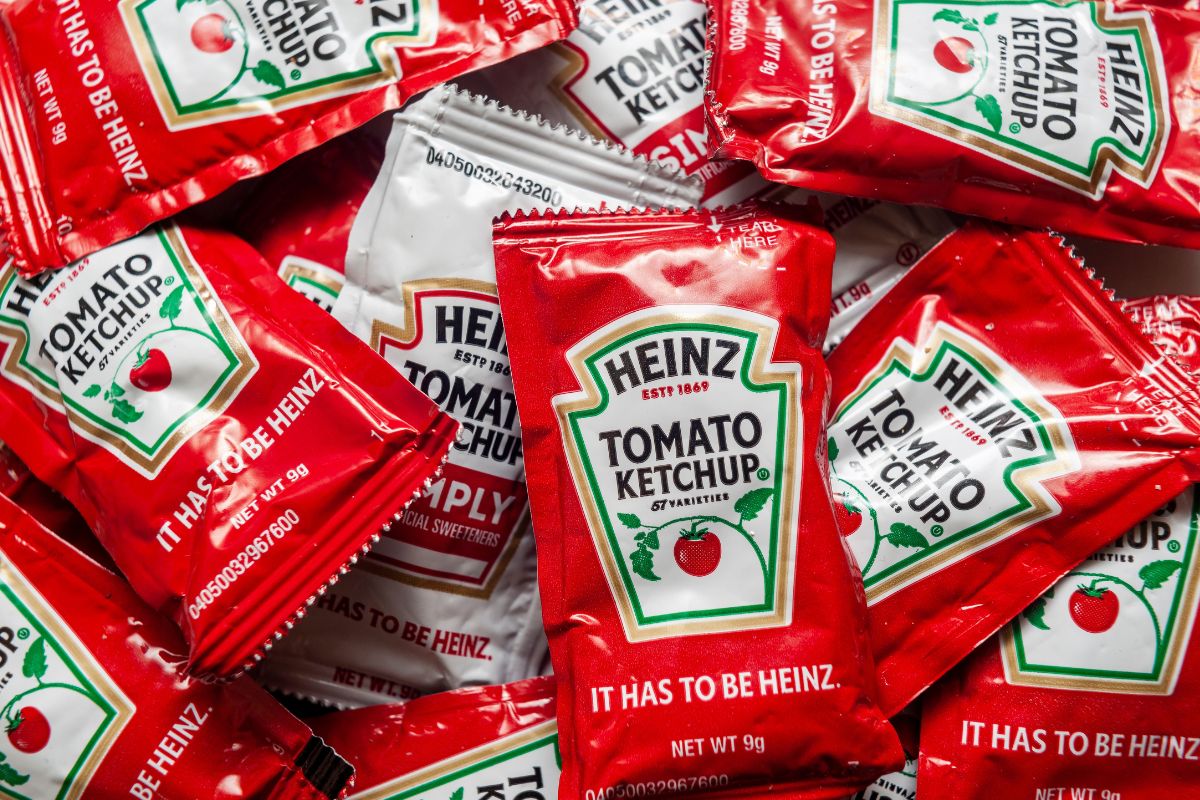
My grandparents spent winters at their Florida condo, which meant we were operating under their terms. The main one being that my grandma believed cooked meat didn’t require refrigeration and could sit on a warm countertop until consumed, which would happen without fail, because she never threw out leftovers. What did require refrigeration—or more specifically, a dedicated section of the freezer in large rinsed and reused off-brand Ziploc bags—were the ketchup and mustard packets from every fast food establishment within driving distance that offered free condiments.
Motivated partly by genuine affection and partly by a strong desire not to spend spring break in a hospital, my friend and I regularly lobbied for dinner at actual restaurants. My grandpa was immediately on board because he would eat anything anywhere, and because Happy Hour was 2-for-1 as long as you ordered both drinks at the same time. Every Applebee’s and Outback between 4 p.m. and 6 p.m. was packed wall-to-wall with senior citizens pushing oxygen tanks to the edge of their booths to make room for two rum and Cokes. More than once I watched them tuck whatever fit into the “big purse” on the way out—sugar packets, a ramekin, silverware that would “accidentally” find its way back to their own kitchens.
I was mildly horrified the way only a 13-year-old can be—loudly, and with zero historical perspective.
But the beach trip is what broke me.
My grandparents announced we were going to the beach about an hour away. My friend and I packed our bags, piled into the Cadillac, rolled down the windows, and listened to Neil Diamond the entire drive. As we got closer, we gathered our things and waited for the car to slow down.
The car did not slow down.
“This is the beach,” my grandpa announced, gesturing out the window as we drove past it. I asked where we were going to park.
My grandma turned around and looked at me as if I’d just suggested only playing six bingo cards at one time. “What? Why would we? It’s too busy, too hot, and too expensive to park. Do you girls want some ice cream?”
The next time the car stopped was at a McDonald’s just off the highway. My grandpa ordered sundaes and cones while my friend and I sat in the backseat in what I can only describe as stunned grief. No sand. No ocean. Just the Cadillac and “Sweet Caroline” on repeat.
As we pulled up to the pickup window, my grandma leaned across the driver’s seat and gave the drive-thru worker very specific instructions about the condiments. Not the optional nuts for her sundae, as I had somehow still managed to assume, but the ketchup and mustard packets.
“When you’re paying 99 cents for each ice cream,” she said, turning to face us, “you better make sure you get your money’s worth.”
She Wasn’t Cheap. She Was Precise.
She handed us $20 for candy that she knew only cost a quarter. She gave to her church every week and her family without fail. The Cadillac, the hair, the jewelry, and the large-screen TV—she spent freely on what mattered and almost nothing on everything else.
I don’t blame her, or any of those senior citizens quietly committing petty theft at Applebee’s, because they were operating from a scarcity mindset earned over decades of actual scarcity. The math she was doing made sense. She lived the shortage and knew what it felt like when there wasn’t enough.
I haven’t, not really, but somewhere along the way I inherited the fear anyway. My version is a $15 dish drainer I debated for four days, a generator I bought before I needed one, and a plastic bag filled with 50 plastic bags because they work great in my bathroom trash can. Even when things feel okay, there’s still the background worry of “what if” that I’ve never quite been able to put down.
I decided somewhere in my early teens that I would always be financially independent with my own account, my own safety net, regardless of what my life looked like. My grandma didn’t have that option, like most of her generation, which is part of why her precision made so much sense. She controlled what she could.
The ketchup packets, the toothpicks, the paper plates—none of it was really about the money. It was about knowing exactly where she stood and making sure she stayed there. Turns out that’s the thing you can’t put in a Ziploc bag, and she passed it down anyway.



19 Responses
I think of my parents as pioneer recyclers. My dad did a lot of his own automotive work. He’d collect lightly-used paper napkins after meals and use them in the garage to wipe off engine parts and tools. He’d also save any junk mail that had a blank side, cut it up, and make scratch pads for use by the phone (and it was a party line. Look it up!). My mom repurposed leftovers so well we often preferred them to the original meal. Frugal habits like those enabled my parents to help me make the down payment on my first house.
Ok, Abby, TWO comments here…
I know all about ketchup packets. The grandmother is my life would take me and my three young children to McDonalds, and we could order whatever we wanted but, on the way out, she would stuff handfuls of ketchup packets and stacks of napkins into my purse. “Put these in your car,” she would say. “You never know when you will need them.”
I would love to hear your grandmother’s take on ketchup packets in my glove box all summer long.
The second comment is that my favorite home improvement store has the ONLY plastic check-out bags that fit my 20-year-old round straw bathroom trash can that I can’t really say that I love but why replace something that is perfectly usable? Because the customer bags their own purchases, ten items equal ten bags, right? But every other store I use reusable shopping bags because I’m trying to save the planet.
I love the story. I believe you must have talked to my mother before you wrote this. My mother was a product of the Great Depression. The family was comfortably off when the stock market collapsed in 1929, and her father had invested heavily, and they were almost immediately broke. Her Dad left them, and her mother became ill and almost died. My mother would wash aluminum foil, paper plates, reuse paper bags, save envelopes to write grocery lists on, and a number of other “saving money for a later day tricks”. I used to be so embarrassed by her “cheapness and now that I am over 50 and dealing with an economy that is dealing with crazy food prices, escalating gas and utilities that only go up, I can understand it. I am not washing paper plates… yet… but who knows what habit I will adopt. Thanks for the story and the fantastic memories it brought back to me.
Thanks to my grandmother, I don’t think she or my grandfather ever bought paper napkins. She’d take a handful from the dispenser wherever they went, and we could tell where they had eaten by the different colors and logos in the stack sitting on the table. I don’t take extras, but I get enough that I’ve had the same package of store-bought napkins for years.
I’m Gen X.
But raised by my Depression era grandparents.
I thought I was the only one!!!!!!!!!!!!!!!! who washed and reused cheap zip lock bags!!!!!!!!!!!!!!!!! Or even cheap non zip lock ones. I throw away the ones that have had meat in them is my only boundary.
I use my giant pet food bags as trash bags when they are emptied.
I applaud the grandmother who used the same roll of wrapping paper for decades !!!!!!!!
and am still laughing so hard at “there’s the beach” as you roll on by. LMAO omg.
i also spend freely on what matters. Take out for my son and I if its in the budget, trips, streaming platforms that carry the shows I watch with my sons, anything my youngest wants that is in the budget… I spend freely on what counts. And recycle reuse repurpose EVERYTHING.
I have an old silverware dishwasher insert hanging on my bathroom wall as a container for my hair brushes, toiletries, etc.
the food on the counter – is that a farm cultural thing or a generational thing? My boomer mother does same. and has food poison on the regular. lol
Inherited frugality. I’m seventy. My grandmother was born in 1900 and canned everything. My mom saved almost everything. . you might need it someday. My son thinks I don’t throw enough away. I’m not a hoarder but I’ve paid for four cars in my lifetime and my house. And yes I am a recycler, and have picked up a few habits from both of my elders. Maybe they knew something we should learn from.
In my opinion, they knew everything and I learned my whole life from them. I miss them so deeply.
‘Is the juice worth the squeeze?’
‘Does it move the needle?’
i know how much my time is worth. i know how little leisure time, or time to myself, there is in any given day, week, month, year.
I am not wasting my thinking time on a $15 purchase. I will either be working, making 3 to 15 times that amount per hour, or spending precious time, the ONLY thing that cannot be replaced, with my family, my friends, myself.
Am I extravagant, wasteful, with money? No.
Do I understand and live by Cost/Benefit analysis, Break Even analysis, and Incremental Cost analysis? Yes.
Wow. Do you ever just laugh?
I grew up somewhat like this but we did take vacations and actually stayed for a week at a time! But my mom re-washed plastic bags & pieces of foil, re-used wrapping paper & ribbons and used grocery bags (paper ones!) as trash can liners but honestly i don’t think plastic garbage bags came on the scene until after I was out of the house? I’ll have to google that one. In any case, I’ve adopted these re-use habits and part of it has to do with saving money in this sucky economy but it also keeps these items out of the landfill. And tbh, i’m proud that little habits like this make an actual difference no matter how small.
Oh, wrapping paper is still something we save and have learned to open very carefully. I actually have more than 70 cousins and second cousins, and no joke, there was ONE HUGE ROLL of a certain Christmas wrapping paper my grandma used for literally decades. Every present. For everyone. (Of course we were a much smaller crew 30 years ago.) After she passed, one of my cousins gave my mom and uncles the most perfect gift—a framed piece of that very wrapping paper that had been used in our family for years. My grandma also refused to write on card envelopes so we could reuse those as well. I guess every little bit helps 🙂
Whew! Just reading the title sent me flying back to my childhood, but it was my mother, not my grandmother who collected the freebies. And because there were three daughters, the freebies were gathered by all. And the food on the counter! That is the story of nightmares in our house. My father took to marking everything edible coming in to the with the date as she would purchase by the case when on sale (in the 70’s before big warehouse stores). My parents were depression era children and lived with scarcity. As an adult, I understand but as a child, I was terribly embarrassed. I just with she had been as good about finances though, because she couldn’t pass up what appeared to be a “good deal” but was often just a marketing hook.
It sounds like you did learn a lot from that though—both how to avoid food poisoning and marketing ploys. 😉 But yes, as a kid you just want to be “normal,” without realizing that doesn’t exist for most families.
For my grandmother it was glass jars, plastic containers (especially Kool-Whip), and any scrap of ribbon. She was born in 1902. Oh, and buttons. Vats of buttons!
Of course! All leftovers were kept in empty (off-brand) Cool Whip and margarine containers.
Thank you for sharing! When we are young we say we don’t want to be like our parents or grandparents….it goes so much deeper than that!
We are who we are because of them!
Exactly! What’s funny is that my uncles and cousins are actually commenting on Facebook about it (where I shared the article), and it’s been fun remembering all their stories too. At the time we didn’t get it, but decades later we’re actually grateful.
All of us should remember this: “she spent freely on what mattered and almost nothing on everything else.”
It’s not necessarily about how much money you have, it’s about aligning your spending with your values and priorities.
Love this.
My parents were exiles from Cuba. We arrived in the United States with nothing. My dad had been a successful professional in Havana, and we had enjoyed a wealthy lifestyle there. My dad refused to scale down, even though he was only able to get a job cleaning floors at a coin laundry. He would scour second-hand stores for fine china and crystal, refusing plastic tableware…at a time when we had no dining room table. On Sunday, when we went to visit relatives, he’d wear a suit and tie; my mom looked gorgeous in the one embroidered linen dress she had. My dad would drive an ancient Ford with several large holes on the floor. It was horrifying to look down at the road whirling away just inches below your feet. My parents must have invented the term “cognitive dissonance.” It was a scary time to be a kid.