
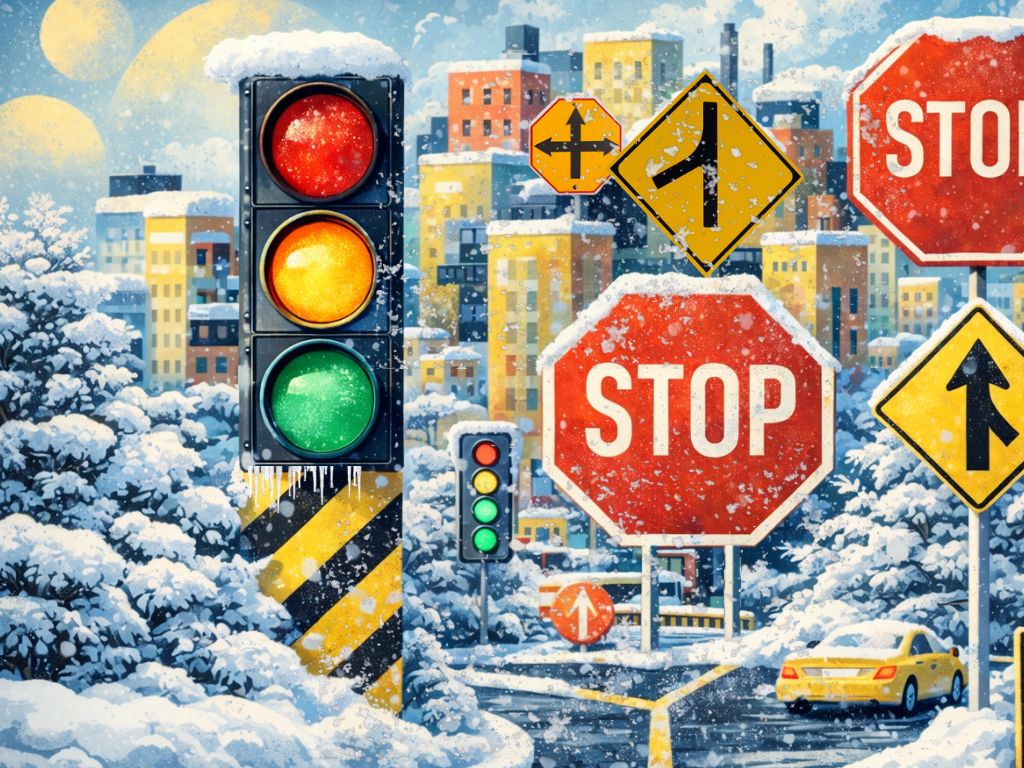
Turn signals, roundabouts, and the middle-aged women holding civilization together.
By the time you reach middle age, you’ve learned two undeniable truths:
- Civilization is far more fragile than advertised.
- It collapses fastest in a Trader Joe’s parking lot.
Driving, as it turns out, is the clearest moral barometer we have. Forget political debates, personality tests, or religion. Put someone behind the wheel for nine minutes and you’ll know everything you need to know about their character, emotional regulation, and relationship with accountability.
It should be a cooperative activity. A silent agreement that we all want to get home alive and preferably not screaming into the void. Instead it’s a live-action social experiment conducted entirely by people who believe rules are optional, patience is overrated, and everyone else is in their way.
And the reason society hasn’t completely crumbled yet is because middle-aged women—defensive drivers thanks to years of dodging everyone else’s mess—are out here doing the work.
One cautious merge.
One perfectly timed honk.
One deeply judgmental glance at a four-way stop at a time.
Merging: Proof That Society Is Hanging by a Thread
We need to talk about merging, which has devolved into a chaotic blend of panic and entitlement. Let’s review the definition, since it appears to have been wiped from the collective memory: Merging means adjusting your speed to fit into the flow of traffic without causing a pileup, a standoff, or emotional trauma.
It does not mean:
- Racing to the end of the on-ramp and launching yourself into traffic like you’re auditioning for Fast & Furious: Suburban Reckoning
- Slamming on your brakes at the end and hoping traffic parts like the Red Sea
- Drifting diagonally across three lanes while refusing eye contact and whispering, “Eh, screw it.”
Middle-aged women merge the way we do everything else: with planning, situational awareness, and a quiet rage built on experience. We signal early. We assess. We spot the weak link immediately.
We’ve been managing chaos for decades.
That Kia with a “Coexist” bumper sticker doesn’t stand a chance.
Turn Signals: Not Confidential Information
Using a turn signal used to be basic courtesy. Now lifting a finger for half a second has become an intimate act of generosity, like donating a kidney. Apparently, some drivers are either too lazy or believe signaling gives away power, like announcing your intentions will somehow destabilize your negotiating position in traffic.
Either way, if you change lanes without signaling, I assume you also:
- Don’t return shopping carts
- Talk loudly on speakerphone in public
- Cut in the Starbucks line because you’re already late for Pilates
We signal because we believe communication prevents conflict.
We’ve spent years translating passive-aggressive emails, managing family dynamics, and deciphering tone in a single “K.”
A blinking arrow is the least you can do.
Roundabouts: A Psychological Assessment
Roundabouts were designed to keep traffic flowing. Despite evidence to the contrary, they don’t actually create chaos—they reveal it. And what they reveal is how deeply some people struggle with shared systems that require thinking beyond themselves.
There’s always someone who stops dead at the entrance, eyes frozen wide, as if they’ve been asked to defuse a bomb. Another barrels in at full speed, fueled by overconfidence and zero understanding of physics.
And then there’s us.
We instantly assess the situation.
We read the traffic.
We enter smoothly.
We don’t make it weird.
It’s a circle, not a MENSA test.
Please act accordingly.
Parking Lots: Where Hope Goes to Die
Parking lots are where the last shreds of social order evaporate.
Cars cut across empty spaces and drift unpredictably. Someone is always driving the wrong way with complete confidence. Others back out without looking, spiritually aligned with chaos. Pedestrians wander diagonally while staring into their phones, as if Costco exists outside the bounds of time and space.
We navigate parking lots the way we’ve navigated life: slowly, alertly, and with the knowledge that someone will absolutely do something unhinged at any moment.
We don’t trust brake lights.
We trust experience.
And if you honk when waiting for my parking spot? I promise I’ll take longer. I’ll adjust my seat. My mirrors. I’ll find the perfect song. I may text someone.
This is now a teaching moment.
The 4-Way Stop: Civilization’s Pop Quiz
Roundabouts test confidence. Merging tests entitlement. Parking lots test chaos. Four-way stops test whether someone understands civilization at all. It’s the only driving scenario that requires shared rules, memory, turn-taking, mutual trust, and zero enforcement. No lights, no authority figure, just four people agreeing to remember how systems work.
And yet someone always freelances. The early arriver who waves everyone through. The late arriver who guns it on hubris alone. The person who forgets they already stopped and just … waits. Meanwhile, we remember the order, make eye contact, and go. Because we understand this isn’t about being polite. It’s about being predictable so the whole damn system works.
Saving Civilization, One Blinker at a Time
We’re often accused of being overly cautious. Defensive. Careful.
Correct.
Most of us drive this way because we’ve been paying attention. We assume someone will run the red light. We assume the drifting car has no plan. We assume mayhem.
And we’re usually right.
Because driving today reveals a generational divide. Some drivers are distracted by phones or the 1,000 unnecessary options on their touchscreen dashboard. Others believe rules are flexible suggestions designed to be bent for convenience. And then there are those who understand that shared rules are the only thing keeping society from descending into chaos.
Middle-aged women fall squarely into the last camp.
We stop fully.
We wave people through.
We park between the lines.
Not because we’re perfect. But because we understand systems only work when people care about more than themselves—and we’ve spent our lives trying to keep those systems from completely collapsing.
So yes, we’ll keep holding the line. One signal. One yield. One perfectly timed merge at a time.
Now use your blinker.
And for the love of all that is good in this world, please don’t make the roundabout weird.



15 Responses
I just can’t believe how many articles, like this one, spit out so perfectly what’s in my brain, although I could never say it all so well!!
Thank you so much all of you intelligent, talented, beautiful women. 🩷
Abby, love this article. Women try to leave early enough so they can drive with care and not go ballistic when the light turns red. I thought Alabama was the only place where when your light turns green you count to ten and then, if nothing seems to be coming too fast, you go . . . and pray.
You are spot on about everything you said in your article! Very well-written, but the truth of everything you said is a sad commentary on how people behave badly on the road and everywhere they go in today’s world. This country has become an angry, entitled, dangerous population while lacking concern and empathy for anyone but themselves. And as you pointed out, it shows in their driving as well.
Awesome and entertaining article, thanks! I will add one note about merging: the “zipper” merge is designed for everyone to take turns when cars in the merging lane move into the straight lane. (Not those who are acting “fast and furious.”) If drivers alternate (take turns, as we learned in kindergarten) – like they are supposed to do and as it was designed to do – it’s a beautiful and safe thing. But when even one driver acts like, “Oh no, you’re not getting in front of ME!” it fails. It’s not rocket science; just be kind and courteous.
Yes! It’s actually this running joke on my city’s Reddit page (the memes are endless) about how no one knows how to zipper merge and/or make a “Michigan left.” But yet…sigh.
This is hilarious and so true! I work in the Automotive industry and I’m seriously considering posting this on LinkedIn for all of my Automotive contacts because it’s just so entertaining.
Ha! That would be amazing. Thank you so much for reading (and sharing). 🙂
You are just fabulous! This was spot on AND entertaining!
When there is “weather’ all bets are off and people drive stupidly.
I live in Michigan. If it’s not snow season, it’s construction season. Either way, people lose their damn minds.
As someone whose husband often drives like a fighter pilot–and he’s far from the most aggressive on the road–I can definitely relate. Thank you for the laugh, Abby!
Fasten your seatbelt, Carol! Thanks so much for reading and being a part of our community. Maybe next time ask if he’s open to taking on a co-pilot role 😉
I feel seen! Your description of the wild wild west of today’s driving is painfully spot on. I am about to share this fabulous and super accurate piece with my husband who absolutely qualifies as a middle age woman because he drives like one.
Ha! The more people like us on the road, the better. (Well, most of us.) Thanks so much reading and being a part of the PROVOKED community.
‘It’s a circle, not a MENSA test.’ 🤣 I don’t know where you learned to drive but, they taught the basics well. 😉 I peed myself. Loved it Abby!