Editor’s Note: Not every woman wants this life. Many never will. The trad wife conversation is everywhere right now and it’s often reduced to either romantic fantasy or feminist failure. This isn’t an endorsement or a rebuttal. It’s one woman’s honest account—not a fantasy Instagram feed, but a lived experience, chosen deliberately and shaped by her marriage, finances, and values. Understanding a choice isn’t the same as making it.
The Instagram version is a lie. Duck boots, chicken sh*t, and not a single regret.
As I watched my husband tangle with the hardware cloth and 2x4s for the run of our chicken coop, I checked the heat index. At 10 a.m., it was already a punishing 108 degrees. And though I knew his answer, I asked anyway. “Do you need any help?” As I expected, he replied, “No, this is my job; your job is to make me lunch and bring me water.”
Not gonna lie, I was a little relieved. Seriously, what fool would want to be out there working in that heat if they didn’t have to?
And no, this isn’t a scene from Yellowstone’s 1883. This is my life—right now, in an era when “trad wife” has become one of the internet’s favorite labels to debate.
I handle the meals, housework, and sourdough starters while my husband tackles the heavy lifting—tractors, trees, and teaching the kids to drive.
And I couldn’t be happier.
Yes, I’m a Trad Wife
If you’ve spent any time on social media, you’ve probably seen the phrase “trad wife.” A portmanteau for “traditional wife,” the term describes women like me who lean into homemaking and raising children while their husbands take the lead for the family.
Recently, trad wives have become a cultural flashpoint of sorts, sparking some heated debates across social media, mainstream media, and maybe a dinner table or two. While critics view the lifestyle as one that sends women hurtling back to the 1950s, living a Stepford wife-esque life in silence without agency, I don’t see it that way.
This lifestyle is us—taking a seat at the table—the kitchen table, as it were. We’re prioritizing care for our family over climbing the corporate ladder in a world that tells us not to. And while most people assume that it’s also about erasing agency, those of us who live it see it as intentional choices, a reassessment of personal values, and, believe it or not, a profound level of freedom.
I don’t see my choice as a rejection of feminism. I see it as a reflection of feminism itself—those before us fought for choices, and this one is mine.
The Moment That Changed Everything
My life as a trad wife wasn’t an overnight decision. It was an evolution.
In the early years of our marriage, I worked full time, juggling two kids, daycare runs, and endless to-do lists while my husband was deployed overseas. There was a lot on my plate, but spending quality time with my kids never felt like one of them.
The tipping point for me came after the birth of my second child. At daycare pickup one afternoon, my baby reached for the babysitter as if she were her mom and I was just a stranger.
That moment changed everything. My idea of a life well-lived wasn’t someone else raising my kids while I chased titles and money that no one will remember when I’m gone.
Women Can Have It All … Can We Though?
After much reflection, I’ve decided that the notion “women can “have it all” is pure bullsh*t—our mothers were sold a bill of goods wrapped in an Enjoli jingle. Sure, we could “bring home the bacon and fry it up in a pan,” but what they failed to mention were all the other things women were responsible for.
What we got was just more plates to spin. And decades later, those plates are still crashing in mom blog essays about burnout and mental load. Trad wives, like me, are choosing differently: We’re giving the best years of our lives to our families, and in return, our kids grow up knowing we’re there—every soccer game, every math problem, every good day, every bad day.
And I do realize how lucky I am. I know not every woman gets to make this choice, and that the freedom to step back from a full-time career only comes from financial stability, a strong partnership, and the privilege of safety. I don’t take that lightly. But after years of juggling everything—and catching a glimpse of what I’d really be losing—this was the decision that made sense for me. And maybe for others, it’s worth asking why this kind of life is suddenly calling to so many of us.
Ultimately, I think this lifestyle resonates with so many today because it’s like an antidote to chaos. We live in an age where we’re almost required to be “always on.” When we add in the weight of constant notifications, hustle culture, and maintaining the illusion of balance—everyone’s exhausted, lonely, and desperate for something that feels real. And for so many, deleting all of the above is the answer.
Will the Real Trad Wife Please Stand Up?
Across social media, some trad wives have co-opted the lifestyle into carefully curated Instagram feeds of full hair and makeup at some ridiculous hour of the morning and kitchens that look like a Martha Stewart Living feature. And while it may be pretty, it’s not real.
The fact is, trad wives who exist for social media don’t say the quiet part out loud—it’s work. Social feeds that hide the real labor and complexity behind domestic life are doing us all a disservice.
The truth? We work hard, and it isn’t Insta-worthy.
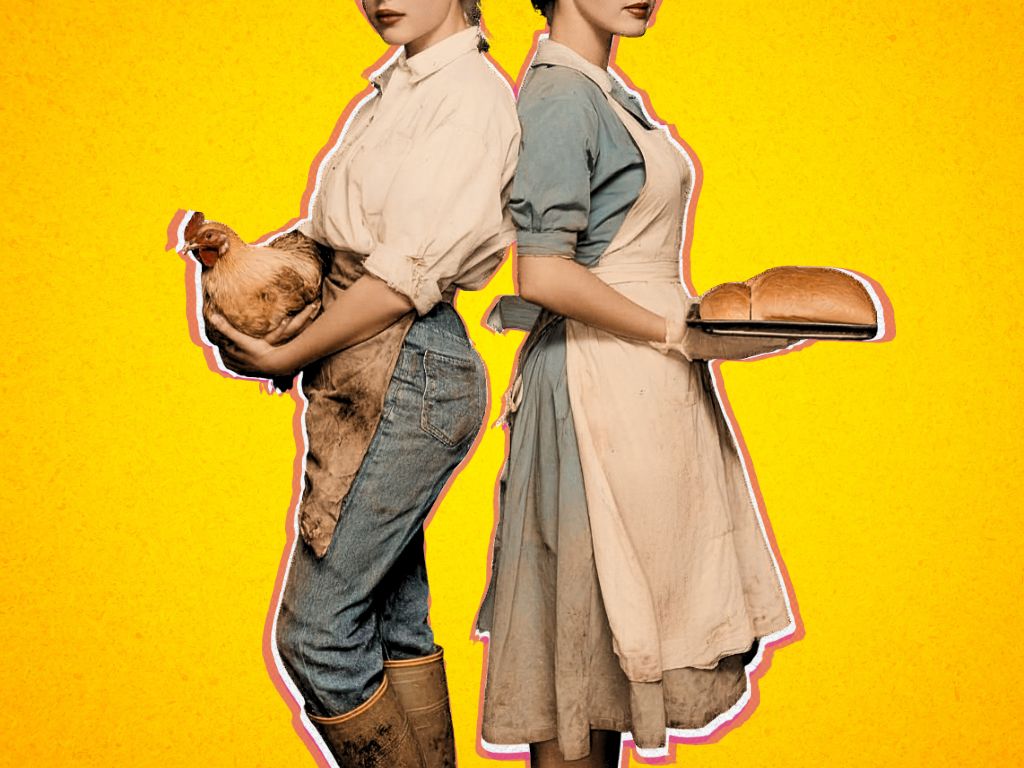
These days, you’ll find me carrying a chicken instead of my Chanel handbag and trading in my YSL Opyum pumps (they live in my closet now) for duck boots. Jeans and work shirts are the new normal, and most days, you’ll also find traces of chicken sh*t on said apparel. My husband documents the evolution of our farm for our future grandkids, but that means most photos of me are candid, messy, and sweaty. You’ll never find my Instagram feed cluttered with perfectly staged photos or slow-mo videos of me cracking open a sourdough loaf for your auditory pleasure. (I can’t, guys—sourdough is way harder than it looks.)
Is This for Everyone?
F*ck no…
Trad wives on social media typically flex on things like $30k stoves and designer kitchens. Cute. But the real flex? Being married to a man who is all in on his family.
It takes two to tango to make this lifestyle work. And it only works when it’s chosen, not imposed, when there’s respect, communication, and partnership.
No woman in her right mind should sit back and let an irresponsible, lazy, or otherwise obtuse man steer the ship. I’m happy at home, scouring Pinterest for new dinner ideas every week and keeping the dust off my baseboards, because my other half leads with purpose—steady, smart, strong, and present. Nice flex.
Not Sorry
For me, being a trad wife isn’t about telling a story on Instagram. Nor is it about submission, oppression, or some weird cosplay nostalgia. It’s about prioritizing my family and leaning into what makes me feel fulfilled—even if that looks wildly different from what our culture tells me I should want. Those of us who identify with traditional roles do so with nuance, blending independence with old-fashioned values. In the end, the problem isn’t the choice itself but how it’s portrayed.
And while I get the discussion, I refuse to apologize for my choices because what I found is far greater than what I “lost.” And what I found was the quiet satisfaction that lives in small acts of order and love—folding warm laundry, pulling a loaf of bread from the oven, and feeding the bellies (and souls) of the people I love. I never thought that stillness could hold its own kind of momentum, but here we are.
I know the trad wife lifestyle ruffles feathers. But here’s the thing: My life, my marriage, and my happiness don’t require a stamp of approval—from anyone. Being a trad wife fulfills me—deeply—and if that gets under your skin, maybe that says more about you than it does about me.

20 Responses
Great debate/ discussion on such an important topic.
Here’s how I see it:
Parenthood forces a tough choice right from the start.
Your lucky if you have a choice but here is the truth – both options are still riddled with problems and dilemmas.
You either:
Give up your career, mental stimulation, and financial independence—relying heavily on your partner not to let you down financially, emotionally and intellectually
Or-
Keep working and hand over most of your child’s waking hours to caregivers—trusting that they’re fully engaged, loving, and not quietly harming your child’s development, especially during those critical first six years when personality and brain wiring take shape.
Both paths demand real sacrifice and a giant leap of trust. Both are terrifying. Both encounter days of regret and fear you 100% made the wrong choice and days of confidence and clarity you 100% made the right choice. And both leave you with guilt and self doubt most of the time.
I say if you’re lucky to have a choice – Choose one and lean in hard. No guilt no second guessing Give it 110%. But if it feel’s wrong. Switch and try the other path. You get to change your mind. It’s ok.
Either way having kids no matter how hard will be the best thing you ever did and worth all the work, fear and uncertainty.
Elizabeth, So much to unpack here, and this is such a clear, honest way to frame it. I think you’re right about the part no one really says out loud: there isn’t a clean, consequence-free path here.
Both choices ask something real of women. Both come with tradeoffs, and both require a level of trust—financial, emotional, structural—that isn’t always guaranteed.
What struck me most in what you said is the permission to change your mind. That’s the part we don’t talk about enough. We treat these decisions like they’re permanent identities instead of seasons we move through.
And you’re right—whichever path you take, the guilt has a way of showing up anyway. Which is probably the clearest sign this isn’t an individual failing. It’s a system that was never designed to fully support either choice.
So grateful to have you here. —susan
You lost me being willing to hear you out when you said “ and let my husband take the lead for our family “.
Ever heard of co- parenting. Families, partners, whatever their gender, equally raise the children, do housework, laundry and share the chores. No one told you to do “ farming in 108 degrees “ so you and your husband chose to do hard laborious work for a living so I’d say to you, for his sake, and for the sake what you are teaching your children about yes “ trad “ gender roles, share equally. But it appears that you both have continued the manifest destiny gender trap that many, and I’d say more than ever, have built slow, hard, bridges through in even just general human consciousness to be able to CHOOSE also. Co- responsibility of a family, whatever that means to you, without “genderizing “ the roles is the kind of freedom to most of us now choose. And it is a freedom for us women especially, that we will never give up. There. I came at you only because I can now speak up when many before us had to hide from what we truly thought was fair for too long, and could not say so.
Thank you for taking the time to share your perspective. The freedom you’re describing, the ability for partners to define family roles without rigid gender expectations, is something many women fought very hard for, and it matters.
What this piece is really about is choice. For some women that means equal division of everything. For others it means building a family structure that looks more traditional, but still feels intentional and mutually agreed upon. Women should be able to choose the life that works for them without being dismissed.
I appreciate you joining the conversation. Thoughtful disagreement is part of what keeps these discussions meaningful.—susan
I was a full-time, SAHM for my children’s entire lives and I felt really, really lucky. But I was in charge of the ship. I managed the entire household, made all the major decisions. I loved it. My one caveat is that it’s way harder to get by and save for retirement on one income.
Hi Judy, Thank you for sharing this. What you describe: running the household, making the major decisions, and feeling proud of that role is something many women relate to, even if it often goes unrecognized. Managing a family and a home is real work.
Your point about the financial reality is important, too. One-income households can work beautifully for some families, but they do come with real trade-offs, especially when it comes to long-term savings and retirement. I appreciate you adding your experience to the conversation. Stories like yours help show how many different ways families navigate these choices.—susan
Your version of trad wife
A term that emanates from the right wing project 2025 extremist way of controlling women- assumes a family can afford to have mom at home.
Be very careful here.
First they came for a woman’s right to choose.
Calling female-dominated professions- nursing, physical therapists, social workersand teaching as non-professional
Next up the save act coming for voting rights that took 70 years to get
Women having credit cards and bank accounts without their husbands’ approval.
Contraception unavailable without a man’s consent.
Divorce off the table.
All in the plan to control women.
Rather than the right to choose one’s life. And path to travel.
Loved your comment
Nancy, I hear the concern behind what you’re saying. The right for women to make their own choices about their lives, work, bodies, and finances is something many generations fought very hard for.
This piece is one woman describing the life she chose for her family, and why it works for her. For other women, that choice looks very different, and that’s valid.
The purpose of running stories like this is to talk honestly about the many ways women build their lives today. The freedom to choose your own path, whether that’s a career, staying home, some combination of both, or something else entirely, is exactly the freedom worth protecting.Thanks for being part of the conversation.—susan
I would have loved to be a “trad-wife” in the real sense, not the instagram sense, but my husband didn’t earn enough and was not willing to handle enough of the home load to make me working and being a wife-mother a situation destined for anything other than complete burn-out. I think everyone should have choices, but our society makes those choices very limited for most people. If anyone is lucky enough to be able to choose being a fully stay-at-home mother with enough faith in her husband that she won’t eventually become a desperate single-mother, that is a perfectly valid choice. The war between women who make different choices only hurts us all.
Well said!
Joan, Thank you for sharing your perspective and experience. You mentioned something really important. The economic reality behind these choices often gets left out of the conversation. For many families, the question isn’t “Which lifestyle do we prefer?” but “What can we realistically afford?”
And you’re absolutely right that the tension between women making different choices doesn’t help any of us. The real issue is making sure women actually have choices: whether that’s staying home, working outside the home, or some combination that works for their family.
I appreciate you adding this perspective to the conversation.Thanks for being here. —susan
Having come of age at a time when women were working hard to claim their own space and their own identity, I bristle at “trad wife.”
In the 60’s, while women were fighting for equal rights, there were others who wanted to hold tight to the traditional role. To me, they were the crazy ones. Like “The Total Woman” author, Marabel Morgan, who encouraged women to take a back seat to the Man of the House. Or Phyllis Shlafly, who fought the Equal Rights Amendment by planting fear that women wouldn’t be allowed to stay home and raise their kids. Is it any wonder, with role models like those, why “trad wife” echos the same ‘anti-women’s movement’ vibe?
I get it. Today’s trad wives grew up in a world where they had every option. And they did, because generations of women before them pushed back against the limits and crushed the weighty restrictions so women could finally, like men always, choose their own path.
All the while reading this, I kept wondering when the kids are grown, if the marriage doesn’t continue, then what becomes of a trad wife?
Then I read the author’s bio and realized she also has her own, separate identity (and significant social media presence) apart from raising their kids, chasing the chickens and supporting her husband. So, actually not an entirely traditional housewife, but more like a woman wanting and working to have it all. And for the the record, all that is only true because milions before her busted beyond the kitchen to make the lives that called to them.
True, “you can have it all” was wildly misleading because it ignored the investment that any singular goal or role requires. We had to adjust that to “You can have it all. You just can’t do it all well or all at once.” But at its core, the concept was a game changer that encouraged women to see options beyond the traditional housewife role.
Be a mom if you want. Adore your husband. Enjoy your home. But if there is more that calls you, answer it. That should be the tradition we all share and support.
Very well said. Thank you!
Cindy, Thank you for such a thoughtful reflection. You’re absolutely right that the choices women have today didn’t appear out of nowhere;they exist because generations of women pushed hard against the limitations that once defined our lives.
That history matters, and it’s part of why conversations like this can feel so charged. For some readers, the phrase “trad wife” echoes a time when women’s options were tightly constrained. For others, it represents a personal choice they’re making in a very different cultural moment.
The tension between those perspectives is real. What I hope pieces like this can do is open space for women to talk honestly about the lives they’re building now, with the understanding that the ability to choose our own path is something worth protecting for everyone.
I appreciate you adding such a thoughtful voice to the discussion. Thanks for being here. —susan
No feminists are going to come at you for doing what you felt was best for yourself and your family. Because it’s about choice. Your choice.
It’s the ones who think women ought to be forced back into it because of religious beliefs, or the ones who call us working and happily childfree and single women selfish we come at. Hard. Because every woman deserves to make that choice for themselves.
I agree with you on this 100%. Let it be a choice a woman has an option to make. I won’t have any path or lifestyle dictated to me.
Hi, I appreciate the POV you have shared. The idea that women should be able to choose the life that works for them, whether that’s staying home, building a career, being childfree, or some combination — is really the heart of the conversation.
Where things tend to get tense is when those choices start being framed as the only acceptable path, in one direction or the other. Most of the women reading here are simply trying to build lives that make sense for their families and their circumstances.
I’m glad you added this perspective. At the end of the day, protecting women’s ability to choose their own path is something many of us can agree on. Thanks for taking the time to comment. —susan
A wonderful summary of the joys of being there for your family and for yourself as well. There is beauty and satisfaction in a life well lived. I was lucky enough to have my mom home until I was 8 years old and my sister was four, before she returned to the workforce. The days of of coming home after school to warm chocolate chip cookies, telling mom about my day, and the smell of dinner in the oven are some of the most comforting memories. But mostly I remember mom’s constant presence and support in our lives. Your story is beautiful. 💐
Hi Shannon, Thanks for sharing this. Those kinds of memories—the smells from the kitchen, the chance to tell your mom about your day, just knowing she was there—stay with us in a powerful way. Those hard core memory bonds can be such a gift. —susan