
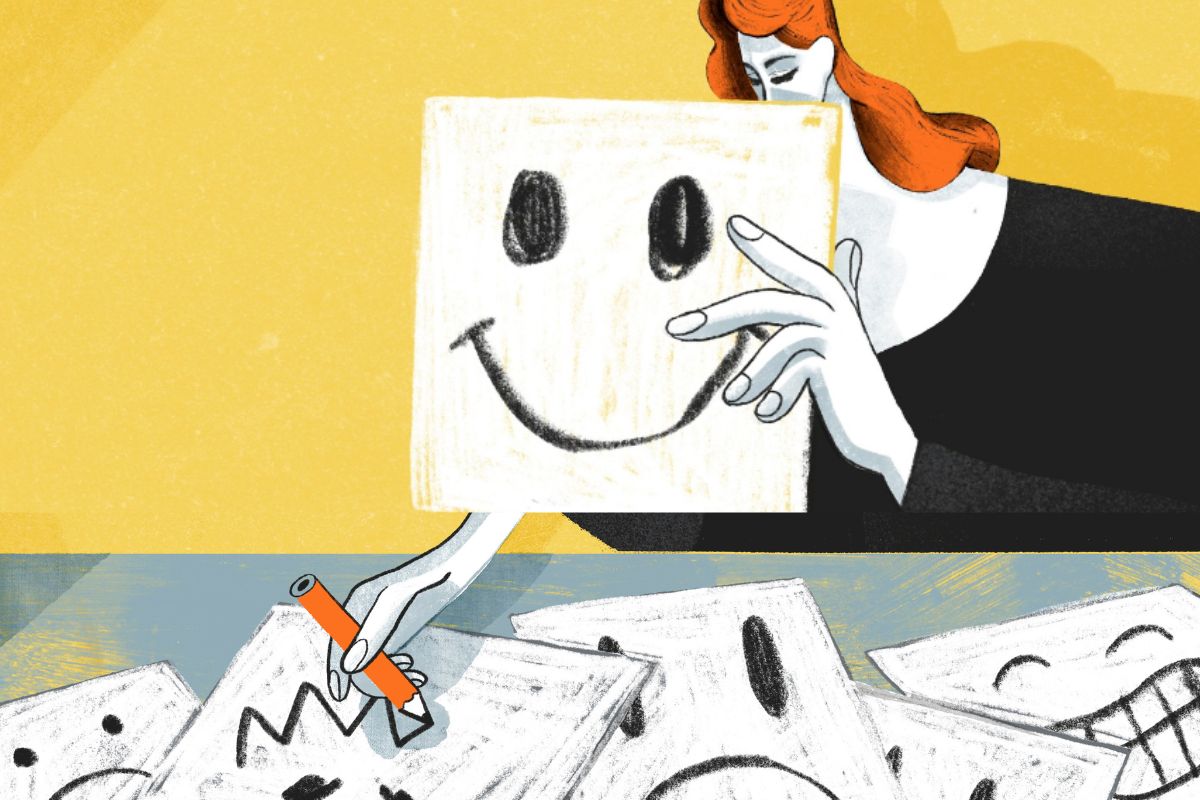
We were trained to keep the peace. The cost was higher than anyone admitted.
If you’re a midlife woman who cares about her own health and well-being, you might want to wipe that smile off your face. Women 50+ have been trained to appear like the original emoticon, outwardly radiating resilience even if quietly falling apart inside. There’s a term for this condition: toxic positivity. It’s pernicious and, yes, largely a female thing.
“There’s a cultural expectation for women to stay positive, no matter the difficulties they may be going through or the feelings they’re experiencing,” Lisa A. Kendall, CSW-G, told me, calling toxic positivity “metastasized politeness.”
Society has systematically set us up to keep quiet and carry on. A symptom of superwoman syndrome, toxic positivity isn’t merely Instagram “inspiration” leading us to exude fake joy. It’s a trap, and the older we get, the more entangled we become.
It’s Different for Girls … and Women
Toxic positivity is a system that benefits everyone—except us. Our men, our kids, our bosses, our politicians all gain something when we bend over backwards on their behalf. They get the smooth happy version. We get the cracked version underneath.
Sadness is human. So is anger. Yet as children, though boys may be scolded for crying or yelling, they’re also typically encouraged toward physical outlets for letting off steam. Girls, admonished to “play nice,” aren’t often offered such options—at least not when we boomers and millennials were little. If we had to cry, we were sent to our room to do so alone. Any surprise we grew up without learning to recognize, manage, and express invalidated emotions?
The roots of performative positivity may be even deeper. We all know about fight, flight, or freeze survival mechanisms. Recently, however, a fourth “F” has come to the fore: fawn—and Bambi’s got nothing to do with it. Also known as the “please and appease” response, fawning refers to sacrificing one’s own priorities, boundaries, and safety to make others comfortable and avoid conflict.
Either way, we wind up swallowing our “bad” feelings until, fast-forward a few decades, we can’t even recognize ourselves anymore. Busy managing everyone else’s expectations, we concede to workplace ageism, caregiving responsibilities, and any favor asked—overextending ourselves without a peep of pushback. And war, abuse, injustice? We put on a happy face and look away.
Forced Happiness Hurts
We’re at our best when there’s alignment between our emotions, physicality, and spirituality. Toxic positivity is a diabolical kind of denial that throws those elements out of whack. “The result is stress and possibly inflammation that can lead to illness,” Kendall cautioned.
When what we feel doesn’t jibe with what we say, something’s got to give. Usually, it’s our health. The body remembers every “I’m fine!” we didn’t mean and comes back to kick us in the butt, if not the entire body. As in: Hot flash? What hot flash? I’m just glad to be alive!
Should we dare to not beam like Midlife Ms. Sunshine, we’re likely to hear about it. “So many women over 50 experience having a strange man pass them on the street, telling them to ‘Smile!’” Kendall noted, wondering, “Why is it that women have ‘resting bitch face’ but men just seem deep in thought?”
Our culture fosters toxic positivity to keep women compliant, dutiful, and pleasant. As time goes on, that “good vibes only” attitude becomes so ingrained, it doesn’t even seem like the servitude it is. It’s tricky, too, since our ability to handle virtually any load tells us we’re strong—yet our strength may not stop us from living out the workers’ march from Fritz Lang’s Metropolis.
What’s more, when we repress our authenticity, we don’t set the best example to the generation coming up. It’s a confusing time to be a young woman, and they need to see how important it is to speak your mind, and your heart.
The Upside of Anger
How important is it? Important enough that nothing changes without it. “I don’t think you get political progress without anger at injustice and inequality,” Rebecca Traister, author of Good and Mad: The Revolutionary Power of Women’s Anger, told Publishers Weekly. “People must feel furious dissatisfaction with the way things are in order to engage in a fight to make them better.”
Openly releasing anger can connect us with people who feel the same way. The secret, according to Traister, lies in communicating your own frustrations while listening for signals from the people around you to build community, strengthen bonds, and foster resilience.
Consider how things played out recently in Montclair, New Jersey. Johanna Coxeter was appalled by the noise and fumes of gas-powered leaf blowers when she moved there. “At first, I tried to grin and bear it, but it was like, ‘Why should I suffer in silence when what’s upsetting me is so loud?’” she told me.
A graphic designer who works from home, Coxeter found the constant cacophony messing with her flow; it also made it impossible to relax in her backyard. “I refused to put up with it anymore,” she said simply. So she hit a town hall meeting to air her grievance, and guess what? Several other women stood up to rage against the machines as well. Ultimately a largely female coalition of 20 was formed, and the women even convinced a few fellas to join their ranks.
Despite obstacles—including being called neurotic and hysterical by opponents—in less than a year the group won a 100%, year-round ban. Next, they helped a neighboring town pass a similar ordinance, and now New Jersey Democratic leaders hope to banish gas blowers statewide.
Saying What You Mean
Remember a time someone asked “How are you?” and you automatically replied “Fine!” If they’d been holding up a mirror, would you have appeared fine? Or would your clenched jaw and overall body language have told a different story?
Putting a stop to toxic positivity frees you to be honest with yourself. Sometimes that’s fine, sometimes it isn’t. There can be a price, sure. Some folks who rely on your accommodating manner may be upset; relationships and opportunities could fall by the wayside. But imagine the gains.
It lets us protect our time, our space, our stuff, and the way we want to live. Instead of “breathing through” experiences, you’ll genuinely enjoy them. When you choose to say no, people will stop piling your plate. And you’ll drop those unnecessary explanations and apologies from your interactions. This isn’t selfish. It’s a liberating act of self-care.
Surrounding yourself with supportive people, as Coxeter did, surely helps. For her, winning the Montclair leaf-blower battle was life-changing. Though a gentle, friendly, “nice” person, she took the risk, picked up the mic, and told her truth. “I’d always felt helpless in the face of bureaucracy,” she said. “Now I know the power of stating your case and being persistent. I’m still on cloud nine from our success!”
Cloud nine, perhaps, but steadfastly down to earth. These days, Coxeter participates regularly in protests against government policies she can’t abide. Same woman. New attitude.



2 Responses
I’m reminded of my parents being so proud of Jackie Kennedy for being so dignified, standing tearless and erect as her husband’s coffin moved past her.
Much later I told my father, who still believed that women should not become “ hysterical “ ever, “ Yeah dad, but no one of your generation ever mentions the well played video of her reaching over the back of the car to try to scoop up her husbands brains that had just been blown out of his head in front of her.That was Jackie’s world shattering. “
That suck it up when hurting so inside and being so full of dignity in front of others is, and always has been, bullshit.
Being told by an older sister while in my 20’s that the molestation of 4 sisters by their grandfather was not to talk about it. In fact, we were all “okay”. At the time all married and happy(?), we were to bury it and not talk about it. I didn’t accept it but couldn’t say that. Looking back almost 50 years later, how did it impact our lives?