
Why some women confuse being needed with being loved, and what it takes to break the pattern.
A week after a bad breakup in my early 30s, I attended a close friend’s wedding, solo. While checking in to the Catskills hipster hotel, Suzanne Vega’s ballad, “Calypso,” piped through the speakers, its mournful melody registering the heartbreak of a goddess who healed and loved a man who washed up on her shore, and then, reluctantly, had to let him go.
The song slapped me in the face. People milled about while I stood still, realizing I had also let go of a man I’d rescued and restored—not once, but twice. Reeling from the breakup and my own Calypso heartaches, I beelined for my room and bawled.
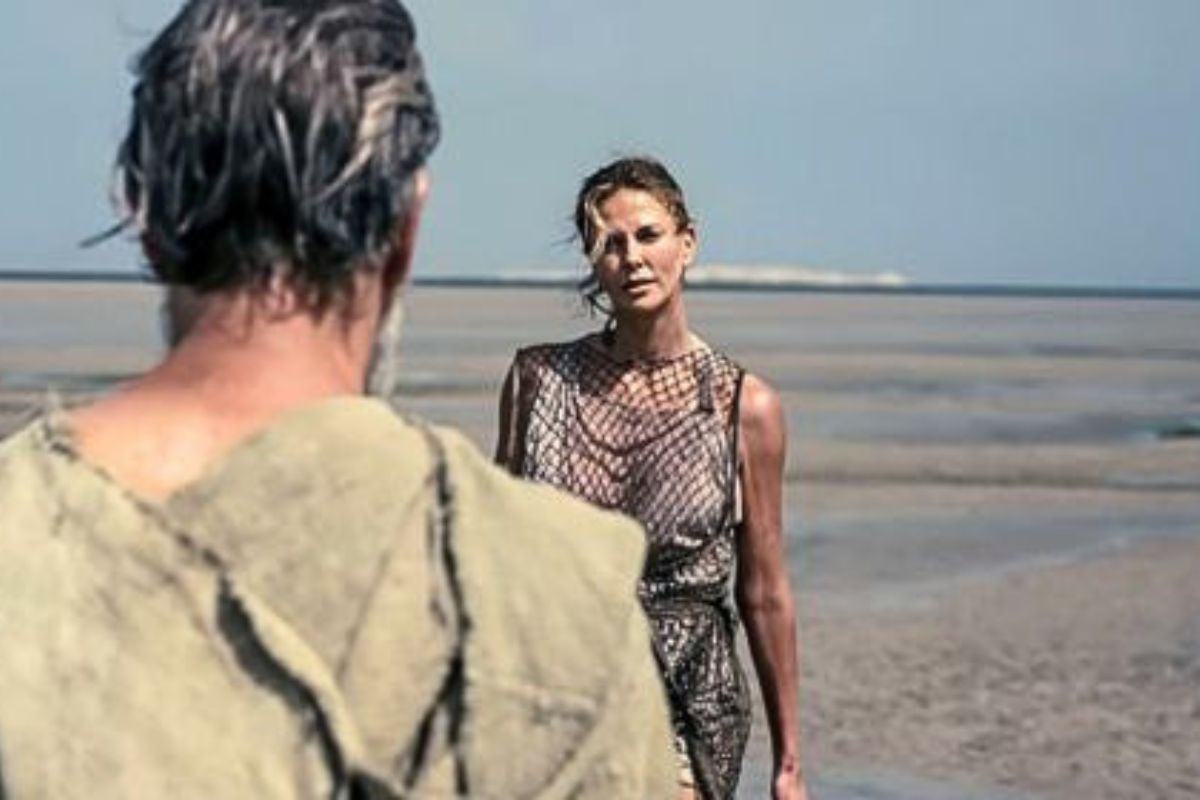
That memory resurfaced when I saw Christopher Nolan’s The Odyssey, with Charlize Theron playing the mythical nymph Calypso. Nolan’s portrayal is but a shadow of the complex goddess, and it left me curious about the original Calypso myth and what it might reveal about women who rescue their partners and end up alone.
The Calypso Myth
The myth begins with the nymph Calypso, daughter of Atlas, living alone on the Eden-like island of Ogygia. When Odysseus nearly drowns offshore, she saves him, heals him, and has one or two children with him, depending on which version you read.
But as Odysseus recovers, he yearns for his homeland and wife Penelope, and pulls away. Calypso keeps him in Ogygia—offering him immortality if he’ll stay—for seven years, until Athena, knowing how badly Odysseus wants to go home, petitions Zeus to order Calypso to let him go.
Calypso rails at the gender double standards, becoming the only feminist in the pantheon. She tells the messenger, Hermes, that while male gods can do whatever they want with female mortals, female gods are punished for taking male lovers. In the end, she chooses to let Odysseus go.
The Need To Be Needed
What drives self-sufficient women to rescue partners, only to be left by them?
For me, it started with loneliness.
When a handsome graphic designer, D., washed ashore at a New Year’s Eve party, wrecked from a toxic relationship, I’d basically been living on my own Ogygia. Intentionally celibate at an ashram for two years, I endured two more years of unintentional celibacy after I left. My body was so hungry for intimacy, I wouldn’t have seen a red flag if you brandished it in my face.
But loneliness can make you vulnerable even when you’re surrounded by people who love you. Or in midlife, after you’ve finally left the dead marriage and the kids have grown and flown.
On our first date, in the candlelight glow of a Greenwich Village restaurant, D. beamed at me and said, “You’re just so present,” over and over. Each iteration fluffed my ego, as if my presence conjured his love. But deep down I knew: his last girlfriend must have been really checked out.
In the giddy throes of new love, I resuscitated D., lifting him up when he put himself down, especially regarding his ex. I played therapist, offering insight and summoning a feeling of power and intimacy. But this wasn’t as powerful as it felt.
“There’s an element of control in rescuing,” said Shauvan Scott, LMFT, a psychotherapist and author. “Because taking care of someone makes the relationship feel more predictable.”
Predictability is definitely something I craved after living with a rageful parent. But according to myth educator Susan Kacvinsky, M.A., my motives were a little darker. “There’s a deep shadow to this archetype,” she said, “which is about mothering the partner … instead of partnering the partner.”
In search of predictability, and perhaps the mothering I never received, I mothered my partners, and often my friends.
The Cost of the Rescue
The name Calypso is derived from the Greek word kalyptō meaning “to hide.” By mothering and playing the healer, I may have been offering a lifeline, but I was also hiding. I was keeping my need, and my younger, unhealed parts tucked away. I feared abandonment, and by hiding, created it just the same.
D. went into therapy. As he healed, he became more confident, and also more critical of me. Like Calypso watching Odysseus gaze toward Ithaca, I knew that he was leaving, even as we continued to talk about our future. Panic flooded my veins. My desperate pleas of “what’s wrong?” only served to push him further away, until he left.
“That’s the interesting paradox,” Scott said. “If the rescue works, the person may eventually outgrow the relationship that was built around needing to be rescued.”
That’s possibly what happened to a friend I’ll call Margot. When her new friend Eva got cancer at 58, Margot held her hand through grueling chemo, talked her off the ledge when Eva started planning her death, and brought homemade chicken soup. Eva told her, “At a time when most of my friends have disappeared, I’m so grateful to you.”
Margot was there when Eva got better and rang the bell at the cancer center, signifying that she had beat it. And then, Eva disappeared.
Margot felt betrayed, confused, and rejected. She understood that her presence might remind Eva of a painful time she needed distance from, but the feelings of being used persisted.
Scott put it in perspective: “It’s terribly painful for the rescuer, because her experience may be, ‘I stood by you through all of this, and now that you’re doing well, you’re leaving me.’”
Had Eva betrayed her? Or had Margot betrayed herself?
Breaking the Pattern
If you’re stuck on a Calypso merry-go-round, there’s hope. Kacvinsky said that healing yourself requires feeling the pain of your own mother wound, ideally in therapy or a supported process. She also recommended viewing your circumstances as a Jungian dream analyst might—as if you’re all the parts. You may be feeling Calypso’s heartache, but if you can understand that you’re also the suffocating mother, the goddess, and the antsy masculine hero, and explore your situation from all those roles, you’ll gain incredible insight and won’t need to repeat the cycle.
For me, it took years. I thought I had processed all my pain about D. and my mother, when four years later, I met a guy with no obvious shipwreck to speak of. But then, somehow, I found myself at the Catskills wedding alone, determined never to play goddess-healer again.
The Courage To Step Back
Although I spent many years in that mothering role, I finally had the courage in my late 50s to avoid diving in for a rescue.
A new friend going through a bitter divorce asked if I would “keep her company” when her partner came to the house to take what was his. I liked her and understood her need for support. But I also knew I would be a witness to their animosity, be compelled to analyze it, and struggle to bite my tongue about what I saw. I declined, hoping the relationship would survive my rejecting such a vulnerable ask. So far, it has.
Calypso whispers that while we may be able to heal our mother wound, we still might confuse being indispensable with being loved. And we certainly can’t stop immortal dramas from upending our wish for predictability.
But Calypso also reminds us that in times of strife, we can lean into our insight, aloneness, and rage; speak truth to power, and never hesitate to confront the gods about their patriarchal bulls*it.



18 Responses
Ah, the pleasures and chains of indispensability! Perhaps some men can also play a Calypso-ish role with some women. (“Speaking for a friend.”)
Ahhhh. Wounded healers are (were?) we. Thanks for commenting, Dan.
This line really hit home.
“…we still might confuse being indispensable with being loved.”
Thanks for the reminder!
Insightful and entertaining! If I needed to be rescued, I hope a smarty Calypso like you finds me!
Well done. So honest, soft but sharp and informative at the same time. I learned something new about you and me!
excellent article. where do I find more information on the archetypes? I don’t recall learning much, if anything about greek mythology – other than, of course – the greek gods (male)…
There are so many great resources for this! Search Carl Young /archetypes and look up Susan Kacvinsky on Substack. She can point you to a treasure trove of resources.
lots of good insight and a good reminder that every broken space doesnt need immediate response. listen and observe before leaping into rescue mode.
YES.
Dang if this doesn’t smack you right in the face. Felt!
Brilliant and insightful. Even though it resonates in some way, I was lucky to escape this, still married to a good choice whom I met at a newsstand in 1986. But I especially love your intro: “Maybe because I’m middle-aged, every piece of culture I take in seems to remind me of something else. It’s fun being able to translate it for a broader audience.” This I share deeply.
Thanks for checking it out, Julie! Age is really useful for storytelling.
Beautiful, Blair. You did the archetype justice. Your honesty is unflinching. That’s a perfect response. Thank you for illuminating this archetype.
great article.
Well written and too relatable!
Thanks for checking it out Carol!
I feel attacked!! Lol.
Seriously LOL and ugh, sorry!