
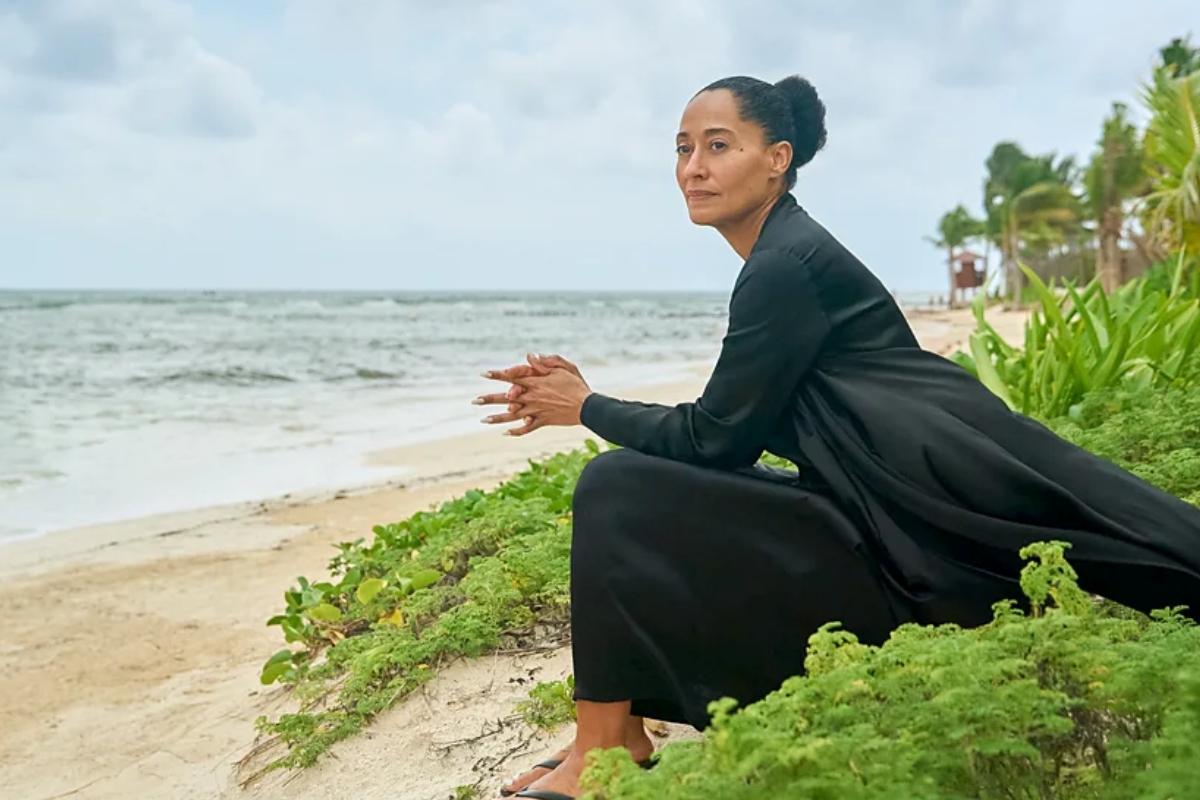
Three women on what it costs to travel alone. What it gives back. And no, it’s not a trend.
My traveling life began at nine years old, in the cramped backseat of a 1960s VW Bug, crossing the Alps on a family trip to Italy. For two decades, I moved through the world in the safety of family and friends. Then, at 36, I cut the cord and toured Egypt alone. That journey was a declaration of independence. Since then, solo travel’s taken me from the boiling rim of an Ethiopian volcano to the cockpit of a helicopter over Victoria Falls.
Decades later, Tracee Ellis Ross, the Black-ish actress and unofficial North Star for the independent woman, confirmed what I’ve always known: There’s something vital about traveling alone. Her series, Solo Traveling with Tracee Ellis Ross, has tapped into a massive shift. According to JourneyWoman, 67% of women over 50 now identify as solo travelers. In the U.S. and Canada, this demographic’s projected to spend $519 billion by 2035.
Like Ellis Ross, my first solo trip “clicked” when travel shifted from a two-week, annual, supervisor-approved vacation to a self-funded manifesto. As a freelance project manager, I pivot between low-budget treks and luxury retreats depending on what the quarter brings in. This allows me to rub shoulders with a wide spectrum of the world, proving that solo travel’s a sovereign act. It doesn’t require a celebrity budget or an elite job. It’s a mindset, not a mileage count.
The Kinetic Pivot: Beyond the Backseat
Sovereignty often begins with a refusal to wait for permission. For Gina Norgard, who spent 40 years working as a nanny in New York before reinventing herself as a professional organizer, the spark came from the film, Gorillas in the Mist. In 2011, at 50, she headed to Uganda to see the endangered mountain gorillas. Exhausted by the rain-soaked tangle of the Bwindi Impenetrable Forest, her legs gave out. The guide slowed the group’s pace; a porter steadied her steps to enable her to reach a silverback family play-wrestling in the vines. “I wasn’t prepared for the generosity of the community,” Norgard said. “It was life-changing.”
Aruna Paramasivam, a data technology expert, assigned herself the lofty goal of visiting every country in the world. She found a role with a global media firm that allows her to work from any international office for six weeks a year. While working in New Zealand last year, she checked off her remaining Pacific countries, bringing her total to a staggering 193.
For Khiara M. Bridges, a UC Berkeley law professor and classically trained ballerina, the pivot was about reclaiming the “work trip.” Currently on a seven-week solo tour for her book, Expecting Inequity, she researches ballet classes, walking trails, and vegan restaurants before arriving in a new city. “It makes the trip less like an obligation and more like an adventure,” she said.
The Architecture of Independence
Building a life of solo travel requires a specific kind of logistical rigor: what I think of as “working to live.” My career in finance was never the destination; it’s the fuel for my passions for travel and art.
Norgard’s independence is built on 40 years of service. When she fell in love with the Ugandan village, she didn’t just visit; she returned to co-found Educate Bwindi, a nonprofit supporting a local school. In 2018, she built a house on the edge of the forest. A friend gave her a piece of advice that shifted her power dynamic: “Let them see you do everything.”
“That meant putting bricks on my head and hauling jerry cans of water from the river,” Norgard recalled. “I dug trenches for the foundation with a pickaxe. We formed a team.” Her sovereignty wasn’t granted; it was excavated.
Assumptions, Dismissals, and the Interrogative Lean
Despite the empowerment, moving through the world alone as a woman of color carries a “friction.” Returning through passport control at JFK, I’m often met with the “interrogative lean.” On a recent arrival from Tanzania, the immigration officer’s eyes fluttered between my face and my passport.
“Isn’t a safari expensive?” he asked. It was a demand seeking to justify how a woman like me occupies a luxury space. “Yes,” I replied, “but I travel in the off-season when it’s cheaper.” I offered the logistical truth to quiet the assumption that I didn’t belong. Even at 70, the world asks me to prove my right to be here.
Norgard faced similar scrutiny in Bwindi. “I designed the house myself and had to push back,” she said. “I’m not weak and I don’t need coddling, but having opinions can be tricky as a woman here. Even the colors I chose for the house were judged.” By doing the labor alongside the men, she forced a shift in the local “norm,” eventually seeing the community adopt the very styles they once questioned.
Tactical Autonomy: The Data of the Road
Solo travel’s a masterclass in problem-solving. Bridges cautions her law students that giving up what they love—be it music, travel, or poetry—is a recipe for anxiety. “My best days are when I dance in the morning and do my ‘think work’ in the afternoon,” she said. This duality allows her to navigate a new city with the same confidence she uses to dissect the intersections of race, class, and the law.
Paramasivam, despite not being a strong swimmer, became a certified scuba diver across six continents. “The more you show up, the better you get,” she admitted. For her, the “fear” other women cite about traveling alone’s an opportunity for data collection. “Having a sense of self means knowing you can figure it out if it goes sideways.”
From Invisible to Indispensable
In New York, Norgard has felt the “invisibility” that society inflicts on women over 60. Solo travel offers the antidote. “Bwindi provides me with literal grounding; my feet touch the earth every day,” she said. In the village, she’s no longer a “nanny” or an “older woman.” She’s a pillar of a collective focused on educating children.
Paramasivam finds that her travels actually fuel her corporate competence. “Instead of thinking how my work helps my travels, my travels help my work,” she said. The ability to stay calm when a canceled flight snowballs into a missed connection translates directly to keeping your cool in a boardroom.
Bridges calls it “unilateral agency.” “If I can figure out how to get around Paris and I don’t speak French,” she quipped, “I can work out how to battle my homeowners’ association.”
The Sovereign State of One
It’s not about the passport stamps; it’s about the “kinetic pivot”—the moment you realize you’re the captain of your own itinerary. Whether it’s a weekend side trip or building a house next to an impenetrable forest, solo travel’s an act of reclaiming the self.
It doesn’t require a celebrity budget or a perfect body. It demands the willingness to face the “interrogative lean” of the world and wave yourself through. From the grit of Norgard hauling bricks for a porch overlooking the gorillas to Paramasivam’s data-driven path toward her 194th country, from Bridges’ scholarly jog along the Seine to my own pursuit of a sky-high perspective, we’re all proof that the world’s brightest when you navigate it on your own terms.


8 Responses
This article came at the perfect time for me.
I have felt like I owed an explanation my entire life for my love of being alone. I have been married, had earth rattling relationships, spent most of my adult life as a single mom to my favorite human, and running businesses or boardrooms. But when I look deeply at my life – I do more, am inspired more, enjoy more, and feel more like me when I’m solo.
My fondest memories play back to two solo experiences. Sailing alone for the first time when I was 12 and eating lunches alone under the Chicago Picasso in my first job after college… just dreaming, writing, reading and people watching. It took me decades to realize the reason I loved those memories was because I was alone.
I’ve traveled for work on my own, but I’m off on my first solo trip for personal pleasure. And it’s backpacking! I started going again last year with some girlfriends – but have been dreaming about a solo trip since high school. Never thought it would happen. My countdown to launch is winding down and this article was just what I needed for a boost of confidence.
At 56, this is the most excited and scared I have been for a trip. The only person I have to appease and keep alive – is me – in the middle of nowhere. I can’t stop smiling…
Thank you for reaching out to the world with your article and sharing that women are enough on our own. It’s a privilege to enjoy your own company, and I think the people that question it are just not lucky enough to understand it.
Super article! I hope it inspires more women to take that solo step! They won’t regret it.
Thank you for sharing such a beautiful reflection of your own journey, Jen. I’m touched that my article reached you at this pivotal moment. From sailing at 12 to backpacking at 56, you have always possessed that rare gift of being ‘enough’ on your own. Wishing you a trip filled with the deep, quiet joy that only a solo path can provide!
This is my pivot year. . . 70 brings me to this point. And, I am solo for the first time in my life.
I just wrote…live your dash.
I just read…find your rhythm and let that be enough.
I am happy where my feet are, for sure. Awe and wonder is right outside my window. Yet, I am curious about life beyond what I see, what I can hear and what I think I know.
Solo travel…as an otrovert, I can only imagine what joy there might be to explore more!
I’m so glad that PROVOKED brought this idea my way.
So…am I ready for the next leap of faith?
What? When? Where? Why? How?
I am provoked….thanx!
Truly enjoyed and absorbed this article. When I was 47, widowed, living alone, working remotely I woke up one morning and said to myself, I could live anywhere. Within the next 30 days, I auctioned my belongings, to my family for free, packed a couple of suitcases and my dog and move solo to Mexico. Now at 52, I keep moving forward and not back. Thanks for the encouragement.
You are brave.
Namaste!
Awesome article! Gina was my roommate on that initial trip, which was life changing for me as well. I call it the “Bwindi effect…” Despite the fact that most villagers don’t have much, they will openly share what they do have. Beyond this, what captivated me was the “soul joy” I witnessed. Gina & I both had silent tears that we didn’t confess to one another until the last day of the trip. They weren’t tears of sadness, rather a sense of hope & love that touched us both throughout the years & multiple return trips. Grateful!
Fantastic article. It’s interesting to see how solo travelers can more easily mesh with the residents to form a close connection. It really forces one to open up to the community. Great interviews that are very informative.
My own personal travel has opened my eyes to the world that make it impossible to return to regular reality. Maybe others want to live in ignorance but I am forever enthralled by the call of adventure that is finding a coffee shop in a foreign country.
Great article Giannella!!! you’re an inspiration!!! for real