
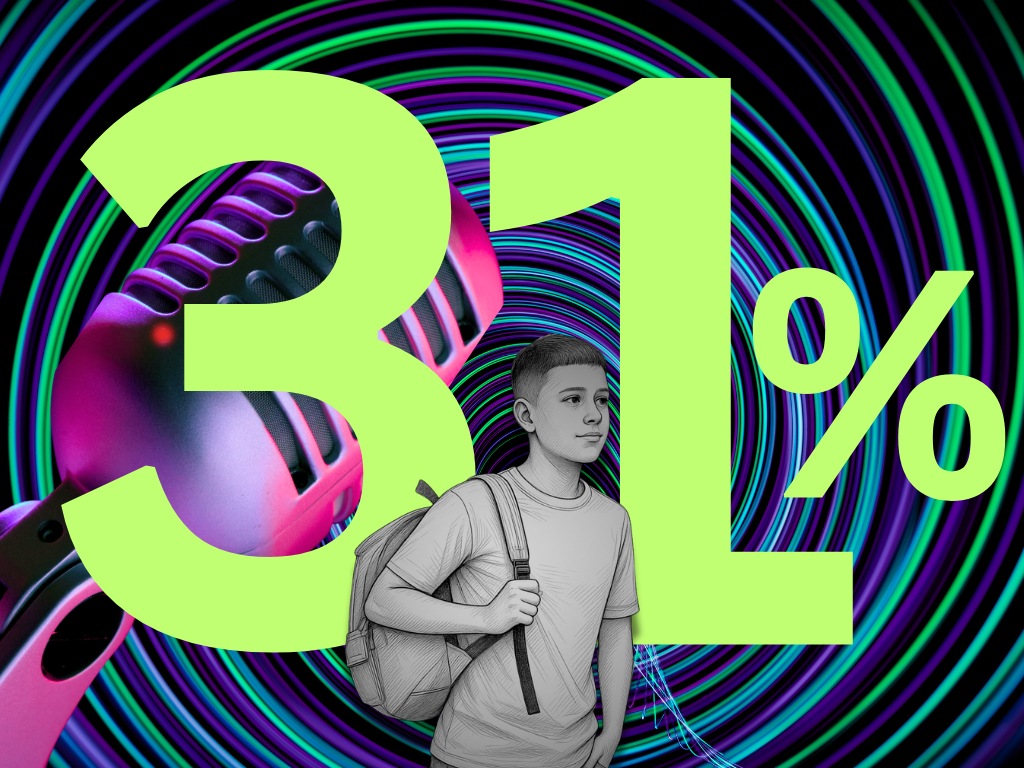
A global study shows Gen Z men are twice as likely than their grandfathers to believe a wife should obey. The question isn’t what changed. It’s who got to them.
31%
That’s the share of Gen Z men—boys who grew up with Ruth Bader Ginsburg, Beyoncé, and #MeToo—who say a wife should always obey her husband. I’ve spent decades sitting across from those boys, as a college admissions consultant, watching them audition for adulthood in 650 words, and I still had to read that number twice.
The Numbers That Shouldn’t Add Up
The research from King’s College London/Ipsos, a global study of 23,000 people in 29 countries, was released for International Women’s Day. In that data, 31% of Gen Z men agree a wife should always obey her husband; only 13% of baby boomer men say the same. So the men who came of age before Title IX, before Roe, before no‑fault divorce, the ones we picture as permanently stuck in Mad Men’s 1960, have much more of an equality mindset than the generation we just finished raising.
It gets stranger.
Here’s what the women have to say. Only 6% of boomer women agree a wife should obey. Among Gen Z women, it’s 18%. The daughters and granddaughters of the women who fought for credit cards and contraception are three times more likely to sign up for obedience.
The study also found that when you separate people’s private beliefs from what they think “most people” believe, a gap opens up. Only 21% personally agree men should have the final word at home, but 31 % think that’s the social norm; only 17% personally believe women should take on most childcare, but 35% think that’s what their country expects. A lot of people are performing traditional gender roles they don’t even believe in because the culture is loud enough to convince them “that’s just how it is.”
The Boys I Actually Knew
My last cohort of students were almost all Gen Z or late millennials raised in the trophy years: everyone special with each success laminated and stuck on the fridge. Their mothers, often my peers and younger, hired tutors, test prep, essay editors, consultants like me, and then cleared every obstacle out of the way.
Then COVID hit. Overnight, the entire scaffolding for boyhood disappeared. No Friday night lights, no prom, no scouts, no band, no dumb lunchroom antics. The boys who relied on practice, games, and AP calendars suddenly had nothing to push against. Meanwhile, the girls, on the whole, coped better outside organized life.
We haven’t been honest enough about that difference. A lot of adolescent boys simply aren’t as resilient without formal structures as girls are. When those vanished, many of them retreated into themselves, their rooms, their screens. And the internet was fully ready for that moment.
In those rooms, they didn’t just find video games and memes. They found new “teachers.”
A 2025 report from the Movember Institute found that nearly two‑thirds of young men engage with “men and masculinity influencers” online—creators who make up what the report calls the “manosphere.” That’s not a fringe population.
Inside the Manosphere, which hit number one on Netflix in March, follows a handful of the movement’s most popular figures and the boys who hang on their every word. A young fan looks straight into the camera and explains what he’s learned: Life as a man means you’re born without value, and the only way to matter is to dominate. Another boy says the men on his screen are “the only ones telling the truth.”
As Briana Edwards, a graduate student researching the manosphere at UNC‑Chapel Hill, told The Daily Tar Heel, “It’s really the weaponization of progress. Women are to blame for where men are in the United States, and the world more broadly, since it is a global phenomenon.” That’s the story so many of these boys heard, often for the first time, from men they’d never met but saw every night: Your problems aren’t about mental health or a pandemic that blew up your life. They’re about women.
The Mothers
Somewhere off‑screen in all of this are the adults who love these boys.
Many of them are Gen X parents, especially mothers, who write to me and describe themselves as the “lost generation.” Latchkey kids who raised themselves, watched their boomer or Silent Gen parents live larger and richer, and walked into adulthood with the sense that no one had planned for them.
Their anger is real and earned. I share a lot of it. But I keep circling a harder question: I moved around the world, changed houses and schools every two years, raised my son inside some of the most conservative cultures on earth. Somehow he turned out to be the man in this piece who does half the diaper changes and would be offended on his wife’s behalf at the mere suggestion of obedience. I don’t know how much of that is parenting, how much is luck, and how much is timing. That uncertainty is exactly what frightens me about my grandsons.
Bell hooks wrote that “to indoctrinate boys into the rules of patriarchy, we force them to feel pain and to deny their feelings,” and that a mother who tells her son to “be a man” is helping enforce that patriarchal will, whether she means to or not. Go ahead and swap in “be strong,” “don’t cry,” “protect your sister”—all the day‑to‑day scripts that say: Your job is to be in charge. Pair that with snowplow parenting and you get boys who were told they were exceptional but rarely asked to do the slow, boring work of becoming emotionally literate humans. Then the world shut down, and the algorithm finished off the job.
The Counter Attack
Susan Faludi called this pattern 30‑plus years ago in her book Backlash: The Undeclared War Against American Women: Every wave of progress for women is met with a cultural counter‑attack. What she couldn’t have predicted was TikTok, YouTube, and whatever other manosphere ideology is streaming into teenage bedrooms at scale. The numbers make that story explicit.
In one summary of this research, 57% of Gen Z men say efforts to promote women’s equality have gone so far that they now discriminate against men. A fifth of young men who have heard of Andrew Tate—the self-described misogynist influencer whose TikTok clips have racked up billions of views—view him favorably, not because he invented misogyny, but because he packages it as self‑help for boys who feel left behind.
The Deal Boys Were Sold
These aren’t just opinions about women. They’re rules about themselves—rules that say: Don’t be soft, don’t be tender, don’t be present with your children, don’t tell your closest friend you love him.
In a recent viral clip, actor and activist Jameela Jamil makes a point that clarified what I’d been circling. If women were naturally submissive, she argues, patriarchy wouldn’t have needed centuries of law, violence, humiliation, and economic pressure to force them into line—and even then, women keep getting back up. Her darker suggestion is that patriarchy’s real success story is men.
I see artifacts of patriarchy in both the King’s College data and the boys I knew. For thousands of years, male ritual has centered on being both a leader and a team player—learning to be obedient in pursuit of a larger collective goal. They’re told they’re meant to lead, but most of the models they get are about lining up: teams, fraternities, workplaces where you earn approval by taking orders from the loudest man in the room. By the time the manosphere finds them, they’re already fluent in obedience. All that’s left is to convince them obedience is power.
Where My Own Boys Land
My son was born in 1990, he’s a millennial, which means he missed the worst of the manosphere but got enough internet to understand the world had changed. I have two grandsons who are in diapers. I’ve helped hundreds of high school boys navigate their first big step into adulthood. And now, I’m looking at a generation of young men and women who, in measurable ways, are more willing to sign up for obedience than their grandparents were.
I can’t look at this data and not see the faces I love. I can’t see “31%” and not picture those boys in my office, their brows furrowed over college acceptances, and wonder which TikTok rabbit hole they fell into since I last saw them.
There’s still time with my grandsons. Time to teach them the only thing that actually matters—how to be a decent human being in a world that keeps trying to talk them out of it.
But I no longer believe that progress moves forward on its own. It bends as we push it—and whoever is pushing harder tends to get their way. Right now, a very organized, profitable corner of culture is pushing boys back to an untenable past.



8 Responses
I’m glad my boys didn’t grow up with weak women around them. They didn’t buy into the crap because they saw me as a single mom raising them and taking care of the grandparents. They were given love all the time. Their maternal grandmother was a spitfire who wouldn’t listen to anyone. Their grandfather was very manly, but he cleaned house and let his wife rule the roost. They saw balance. And when I divorced my 2nd husband, he turned to my son as he was leaving and told him he was the man of the house now and needed to take care of me. I turned around as soon as he left and informed my son that I was the adult, and I would take care of myself and him and his siblings, and he should continue to be a little boy and enjoy his childhood. He did. And my boys are still just as affectionate as they were as kids. They’re good guys. My older boy is married to a very lovely woman, and she has a job. He cooks for them. They both clean. He does all sorts of nice stuff for her and teases her relentlessly (which she loves). He’s warm and funny and doesn’t need a slave. My youngest is autistic, but he’s studying to be a chef. He’s very nice to women, and he doesn’t carry that ideology either. My daughter is the eldest, and she also set a good example. She was a tomboy (self-declared), and very independent. She left home at 18, and today she’s married with 2 kids. She chose to stay at home with them, but her husband defers everything to her. She runs the house. She plans to enter the workforce when the kids are grown. Her choice was mainly because of her husband’s health issues, plus her father is living with them and has health issues, and her in-laws who live just a few houses down need her care. It wasn’t feasible for her to work with everyone she’s taking care of. But she’s as far from submissive as I am. I believe that things like that are important in keeping boys from these misogynists. Strong but loving female role models. An environment where they see strong men who don’t dominate is also important. And not throwing toxic ideologies at them is also important. Don’t start with the be a man idea. Don’t shut down feelings. Don’t tell them what boys do and don’t do, aside from basic manners. Don’t make your independence as a woman into a men-bashing thing or show yourself as domineering. If they see you are hateful or mean to men, they’re going to be more open to these internet idiots. You show respect for men and women, and your kids will mirror that.
Thank you for this—there’s so much in your comment, and all of it is earned. The story about your second husband telling your son he was the man of the house and you immediately correcting it is exactly the kind of small, specific moment that can make a difference. And the rest of your family — your older son cooking for his wife, your youngest studying to be a chef, your daughter holding three households together with her husband’s support — that’s not luck. That’s what you built—the example you set. Thank you for sharing it here. Stories like yours are why this conversation matters. —Susan
Before I even got through the first paragraph, I knew what the influence was. And, it makes my blood boil. So much on-line brainwashing. I am so thankful our kids grew up in the time they did. Even more grateful to be a boomer. Great piece, Susan!
I spent 23 years in college classrooms teaching many business, communication, and popular culture subjects. It astounded me how many had never heard of Gloria Steinem, or many of the other feminist icons. Reading these stats I can’t help but think that if the birth rate is low now, it’s only going to get lower as young women chose not to have kids with males who think they are their property. Makes me ill. Hopefully, the tide will turn again and another backlash will make a course correction.
Hi Randye, Thank you. That’s such an important point—and honestly, a little scary. When foundational figures like Gloria Steinem aren’t part of the conversation anymore, it shifts what younger women expect—and what they’re willing to tolerate. I also think you’re right that these patterns show up in bigger ways, including decisions about relationships and family. History has a way of circling back hopefully in the right direction. Thanks for being here. —susan
Could not agree more with your comments.
Obeying someone you fully believe to be trustworthy and who has demonstrated they have your best interests at the forefront might not be such a bad idea. But obeying someone who is just as, if not more, clueless as you are is a recipe for disaster.
If someone wants me to obey, they have to first earn my trust and demonstrate that their decisions are correct over time-for them. Even then, my obedience will be on a case by case basis, based on whether I think they have the knowledge and experience to issue a reliable directive (thinking doctors, attorneys, safety officials, etc).
Hi Lori, Thanks for making this distinction. I hear you—and I actually think what you’re describing makes total sense in the right context. We all rely on people who know more than we do in certain situations. My husband of 43 years is fully trustworthy, truly. And I listen to him on all kinds of issues. Even ‘obey’ his wishes at times. But he had to earn that trust and recognition. And that goes both ways for us.
What caught my attention, though, was that this isn’t showing up as situational or earned. It’s showing up as a consistent percentage—across studies—of young men who believe women should be subordinate.
That’s what made me dig deeper, and a lot of that thinking seems to be heavily influenced by the manosphere, where control is being reframed as normal, even desirable. Where self proclaimed misogynists are ‘teaching’. I find that truly worrying. —susan