
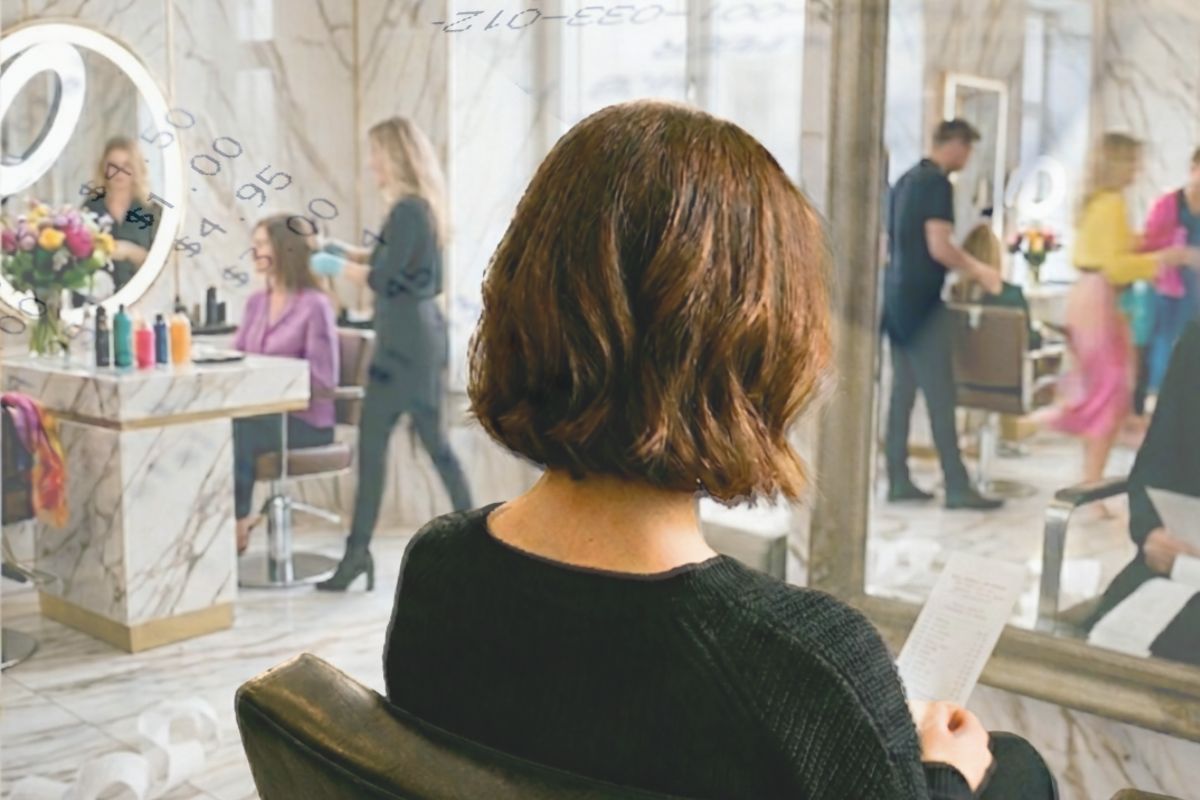
From Botox to box dye, women are spending thousands every year just to look “acceptable.” Here’s what the math actually looks like—and what it costs to get off the treadmill.
“How do you like it?” the hairdresser asked.
A fresh cut and color, and I felt brand new. Until I saw the bill and my stomach dropped: over $300.
I have one of those faces that says everything before I do. Trying to fix my face before she noticed, I signed the receipt and quickly got the hell out of there. Without the threat of being noticed, I thought, “OMG?! When did a simple cut and color cost the same as a cross-country flight from NYC to LA?” What was supposed to be a treat now felt financially irresponsible. “I can’t do that again,” I thought.
But then the pesky grays returned. I tried to ignore them. Accept them. I couldn’t. So I found myself roaming the aisles of CVS months later, looking for hair dye in a box.
That’s how the maintenance cycle begins. Once you start, it’s hard to stop. In the moment, it feels like the investment is worth it. Until years go by and you realize just how much money and time you’ve spent focused on your appearance.
I’ve probably wasted years of my life and thousands of dollars on keeping up appearances. I feel too smart to be like this, yet too shallow not to care. But it’s not about willpower or vanity. It’s about being in a system designed to keep you hooked. And that’s the trap.
From Little Luxuries to a Lifetime Sentence
A mani-pedi. Botox for the brows. Facials, hair dye, and waxing. We get these treatments as a treat. Self-care. But these “little luxuries” become a lifetime sentence, and they’re hurting us financially, while generating billions in revenue.
Added up, average beauty costs could easily set you back several thousand dollars or more per year, if you stick to the rigid “recommended” schedule. Every two to three weeks for nails. Every two to three months for hair. It starts to feel like a part-time job, but instead of earning, you’re spending. The entire business model is based on recurring revenue—your spending. You might not be able to move your forehead, but your bank balance is going down.
It’s kind of brilliant. You get hooked on the results and keep paying for treatments. All the while, the business keeps getting paid.
What Your Beauty Maintenance Costs: The Real Numbers
As women, we’re taught that youth and beauty are currency. The irony? To maintain it, we fork over our hard-earned money trying to outsmart the impact of time. Are we exchanging money for power? Or losing both?
Across generations, women are spending thousands a year on beauty products. And while spending varies by age group, the numbers are clear: Beauty maintenance isn’t cheap.
Recent Statista data shows just how much this adds up. Women in their 30s are spending close to $10,000 a year on beauty. By their 50s, that amount drops—but still surpasses $4,000 annually. Even as women reach their 60s and beyond, the number doesn’t disappear. It settles around the $2,100 mark.
From head to toe, women are spending good money to make sure their appearance is socially acceptable, or at least something they can live with.
Men are spending more on their appearance, too. But costs are still relatively low in comparison with haircuts, gym memberships, and maybe even a razor subscription. Their expenses tend to stay flat, while women’s costs compound over time.
The Pressure Is Real
Realizing just how much you spend can be a rude wake-up call, but it’s not a personal failure to spend money on what makes you look good. It’s a financial system that keeps us locked in and wanting more. It’s also living in a society and a culture that teaches us that our worth is tied to how we look.
The last thing you want is for people to think you’ve let yourself go. Or worse, take you less seriously.
I have a friend who was the CEO of a financial services company. She used to do full hair and makeup before work. During the pandemic, while we were all working from home, she showed up on Zoom bare-faced. Later, she told me her employees expressed concern.
The unspoken question: “Is she okay?”
I personally have been in the position of scaling back on maintenance and people casually mention how tired I look. Thanks! I am tired. Tired of people commenting on my body or appearance. The pressure is absolutely real.
If you feel the upkeep is making you crazy, save your sanity and your money—opt out completely.
Lori Cirolia, director of operations at Rooney Law, said she used to get manicures, hair color, Botox, and lasers—and stopped entirely. As a result, she’s saving $15,000 per year. While it’s an adjustment, Cirolia said, “It’s okay to look my age and I’m getting used to that.”
If you’re not ready to opt out, start by figuring out what you can and can’t live without—and budget accordingly. I still buy my hair dye in a box. Instead of coloring my hair every two to three months, I typically dye it every six months, which keeps my recurring spending down. I’ve also gone to beauty schools to cut costs.
Paying full price for beauty treatments (and tipping 20%) can put a huge dent in your wallet, and I’d like to retire one day.
“I used to regularly get Botox three times a year (it cost me around $400/session) but I had my last appointment in August 2023,” said Juliana Spaven of SilverHighlights1971. “I started researching and discovered Frownies—facial patches that you wet, place on your forehead, and they harden, forming a cast that you sleep with.”
She’s saved $2,500 and now spends about $250 per year.
Your Way Out
Sticking to the recommended frequency for beauty treatments can make you feel like you’re on a hamster wheel and can’t get off. Maintaining your appearance suddenly feels like a subscription you can’t cancel.
The question isn’t whether you should or shouldn’t spend money on beauty. It’s how much of your life and money are you willing to give up to stay on the maintenance treadmill?
What does it cost to stay—and what does it cost to leave?
******
FINANCIAL DISCLAIMER
The information provided on PROVOKED is for general informational purposes only and does not constitute financial, legal, tax, or investment advice. SFD Media LLC and its contributors are not licensed financial advisors, investment advisors, brokers, accountants, or attorneys. You should consult with a qualified professional before making any financial decisions based on this content. While efforts are made to ensure the accuracy and timeliness of the information, SFD Media LLC makes no representations or warranties, express or implied, regarding its completeness, accuracy, or applicability to your individual circumstances. Reliance on any information from this site is solely at your own risk and discretion.



13 Responses
Im sitting in the Sally Beauty Supply parking garage lot waiting for them to open. I need #10 Developer so I can color my hair at home again. I’m 65 and can no longer afford to have it done professionally. Thankfully, my hair is short. I get a lot of compliments on the color so I’m definitely getting better at applying color. I do get a professional cut every 4 weeks. I’ve got to pay that expense, no matter what.
I recently retired from a 30-year career in the cosmetics industry and after years of spending thousands of dollars on antiaging skincare and makeup products, and convincing others to do the same, I can honestly say it’s been a joy to purchase skincare and makeup at CVS. I stopped cutting and coloring my hair too, and now love my natural curls and free highlights (my white hair)
Freedom from maintaining unrealistic beauty standards is amazing. I love retirement and I love natural me.
BRAVA! Great article. I am pretty lazy and reasonably low maintenance. When I got a promotion I “treated” myself to a cut and color. Horror at the bill greatly outweighed the pleasure I felt looking in the mirror just moments before getting that nightmare bill. It was the start (and end) of upscale salons for me. The trouble is, I cannot seem to find a middle or lower end salon. I would love to learn how to cut my own hair. Or at least give myself an even trim.
On another note, thank you beyond words for the excellent journalism of Provoked. It is truly appreciated and enjoyed very much. I feel seen, heard, acknowledged and supported by women of a certain age (. . . of a certain age to thrive unapologetically!)
Hi Phyllis, This made my day — thank you. That walk from “I look fantastic” to “I’m sorry, HOW much?” is one of the great whiplash experiences for women. You’re not alone in the salon in the middle being non-existent, they seem to have quietly disappeared, leaving us to choose between a bill that requires a payment plan and a place that hasn’t updated its posters since 1994.
The at-home trim is a trick, I’m told, to cut far less than you think and to never, ever do it angry. You may have just pitched us a piece we need to run!
And your note about PROVOKED — that’s exactly why we do this. Feeling seen, heard, and unapologetic at our age isn’t a small thing; it’s the whole point. So glad you’re here. —susan
I’m 69 and have never dyed my hair. Don’t care as I know I’m too lazy and cheap to do it. I used to love to get dipped nails on every few weeks. UNTIL I figured out the nearly $90 (tip included) a month and the significant damage to my real nails. I quit and it took my nails almost eight months to come back. I’m done with all of it!
The last time I dyed my hair I had to because I had been laid off at 58 and was not getting hired with all that gray. Dyed back to brown and got a job my first interview after. When COVID hit, I decided to take advantage of the quarantine to grow out my roots. I cut back to gray and now have a long mane of salt and pepper hair that I love! Hopefully, at 66, I will remain in my position for another 3 years and then retire. Now that I’ve been on the job for 8 years, I have established credibility here and no one cares about the color of my hair.
it was so like clockwork evry 6-8 weeks from the very ripe age of forty in the salon I walked to sit in this dreadful salon chair for jet black hair color by the way that grew out in four weeks! My lovely daughter saw how miserable I became because i would say im going today to hear a squishy squeaky sound of stokes of a brush being slapped across my scalph! My daughter replied mom just stop coloring and I said yes I had enough! Yes 15 years later I am a beautiful salt and pepper color now ! I am a happy wife,,mother , grandmother, I am free free free from the trap of the hair coloring world. So grateful for my daughter and those words she blurted out just stop coloring . Well my mother who is the golden age oif 80 now is trying to stop the cloring. I was told by my mother well you can’t stop cloring your hair because I am stiill coloring mine and im your mother how will that look? I instead decided to choose my daughters words. I am so glad i did……
I tried several times to stop the color wheel/treadmill. Finally, when the hairdresser said I had enough grey to make it work, I did it. My hair has grown out very long over the last few years, and it is quite beautiful, apparently, judging by the compliments I receive. I still believe in a good skin care routine, and I always will, but some of the high maintenance stuff — I just said enough is enough. Great article! It should take a deeper dive into procedures like fillers, surgery etc. Maybe a followup?
Hi Mary, Thank you for this thoughtful comment — and congratulations on making the leap. Growing out gray can talk forever.
I relate to what you said about the “high maintenance treadmill.” A good skincare routine feels different to me than the endless chase to erase every sign of aging. There’s a point where many women start asking: am I doing this for myself, or because I’ve been conditioned to fear looking my age?
And yes — we are absolutely working on deeper coverage. I just brought on several new writers in beauty and wellness specifically because I want PROVOKED to tackle these conversations great reporting and facts. Fillers, facelifts, lasers, regenerative procedures, the newest techniques, what works, what doesn’t, what women are really spending, and the emotional side of all of it. Not shame or propaganda. Just smart, nuanced reporting for grown women trying to make informed choices.
So stay tuned. This is only the beginning of that conversation. So glad you are here. —susan
This article just reinforced everything I felt last week after leaving the salon. I actually asked myself, “when does this end?” I then went home, added everything up and your numbers are very close! Fast forward, I pictured myself at CVS looking at hair dye in a box… it’s real! I’m at the place where I’m not sure how to let go but for retirement I know it’s something I have to look at and take seriously. Well done article!
Hi Lorna, “When does this end?” may be the most honest beauty question women ask each other privately and almost never say out loud publicly.
Because it’s not really about the salon bill. It’s about realizing the maintenance schedule never stops unless you stop it. The color appointments, the products, the touch-ups, the quiet pressure to remain “fresh.” At some point, many women start doing the math financially, emotionally, and psychologically.
And I think retirement or reinvention forces the question in a new way. Not because women should “give up,” but because we finally start asking what is actually worth it to us versus what we were trained to believe we had to do.
Also, the CVS hair dye aisle is practically a midlife spiritual experience. We’ve all stood there (especially during COVID) staring at those boxes like they contain either freedom or surrender.
Thank you for reading and being part of our community. —susan
As much as I liked my cosmotologist the 6 week cycles and hours in the chair began to weigh on me psychologically; why wasn’t I pretty enough as is? Then I got injured and have to spend time in physical therapy and face down on the chiropractic table. Makeup and contacts became wasteful. Natural hair became ideal. Voila — I’m good enough…
Age 59, I am Team gray all the way! Let it grow!
I have colored my hair less than 5 times in my life. Cost and time sitting was not worth it. I had my nails done once, meh, I can do that at home if I want. Makeup, on occasion. Skincare, daily. Sunscreen a must.