
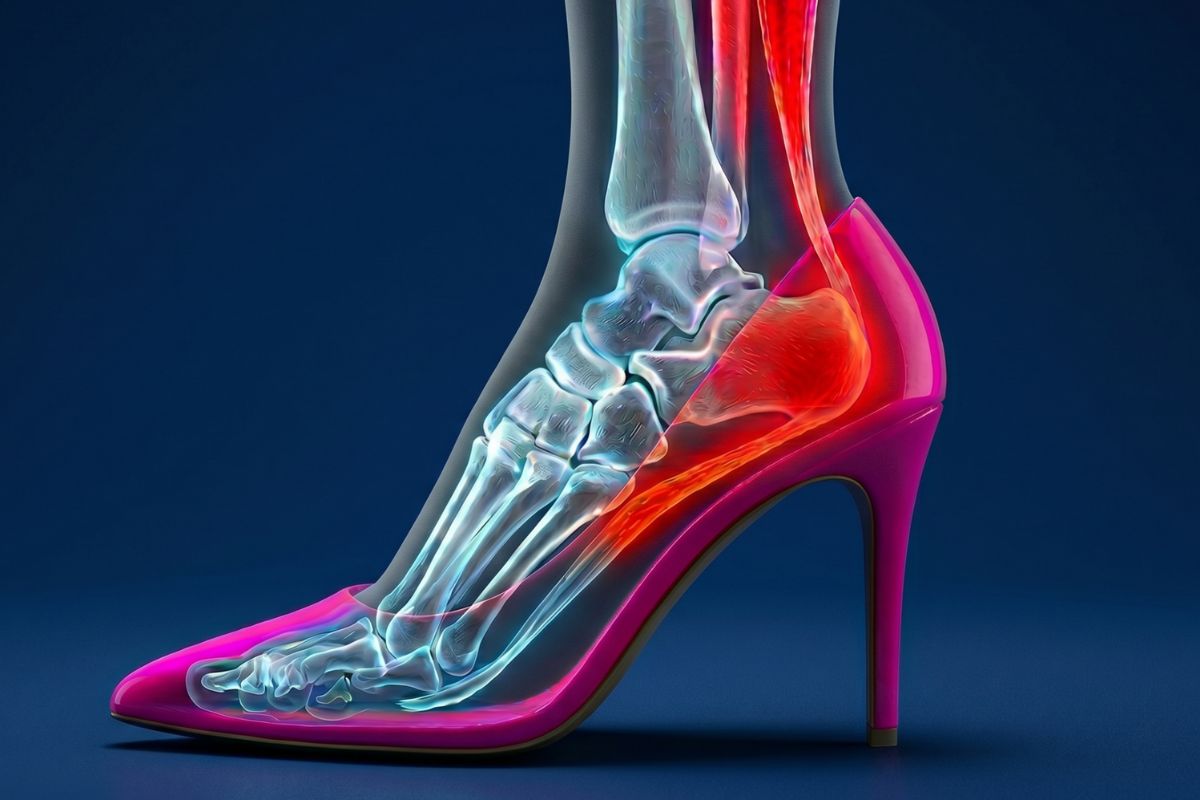
Corporate America demanded heels as proof you belonged in the room. Decades later, more than our feet are paying the bill.
Some women left corporate America with stock options. I left with plantar fasciitis.
I worked in corporate sales in New York City during the go-go ’80s. Women were expected to wear heels. It was just part of the uniform.
I searched in vain for a pump that would stay on my narrow feet without crushing my toes. Impossible. I settled for slingbacks, and I pounded the pavement in those babies until I bled. We may have worn Reeboks while commuting on the subway, but we threw them in our lower desk drawers and slipped on the heels before our first meeting.
Until one day, one of my arches collapsed. The pain was unbearable. The podiatrist told me that, in my 20s, I’d already lost the fat pad on the balls of my feet.
But give up heels? Ridiculous.
The Original Power Shoe
Sex and the City’s Carrie Bradshaw could trace her Christian Louboutins back to Louis XIV. The French monarch wore red-soled high heels, and only aristocrats with his permission could do the same. On special occasions, the king’s heels were ornamented with hand-painted scenes of his military victories, showing he could crush his enemies underfoot.
By the 18th century, heels were almost entirely women’s. Taller, thinner, and built for a different job—lengthening the leg, tilting the hips, catching the male gaze. On a man, wearing heels had said, “I have power.” On a woman, it said, “I’m sexually desirable.”
Aren’t we lucky.
The Institutionalization of Pain
June Cleaver famously vacuumed her carpets in them. By the time boomer women flooded corporate America in the 1980s, “professional footwear” and “business-appropriate attire” became a standard that could make or break a career.
We took the shoe that once signaled dominance and wore it to ask permission.
Shana Ayabe spent more than a decade as a senior marketing executive in asset management before founding Grace Media Digital. She describes the pressure to wear heels as a “beauty tax.”
“The standard is universally understood: blowout, makeup, chic clothing, a proper bag, and heels—the higher the better,” she said. “At senior levels, add designer labels.” The signal was clear: Look like you belong, or be dismissed before you open your mouth.
The first person who told Ayabe to wear heels was her mother, a secretary at a law firm—that’s how the standard traveled, woman to woman, generation to generation.
But it was the men who made it clear, through who got promoted and who got sidelined, what happened when you didn’t follow the rules. Too polished and you were a climber; not polished enough and you were unserious.
Ayabe wore heels to the office every day for seven years.
“They became the foundation of my professional identity,” she said. “It meant I knew the rules of the game and I was there to play. It was the secret password to get through the door.”
When she appears in videos for her company wearing heels and a suit, her content consistently performs better. The data, she said, doesn’t lie.
Madness? Or Masochism?
For the 20th anniversary of The Devil Wears Prada that was everywhere this year, those iconic five-inch red stilettos were front and center on all the promotional materials. Two decades later, and we can’t look away, because the power those stilettos represent is real. We feel it.
The problem was never the heel itself. It was what the culture demanded of us: extreme heights, shoes narrowed to a point, worn without support, day after day for decades. We know what these shoes do to us. We’ve always known. But we still do it anyway, to claim our power or to live up to men’s definition of sexy.
Somewhere along the way, authority and sex appeal got tangled—until we couldn’t separate what we were doing for ourselves from what we were doing for them.
The Bill Comes Due
Our bodies work incredibly hard to conform as we cram our feet into Barbie-like positions, adjusting bones and soft tissue. Over the years, the damage becomes pathology: bunions; hammertoes; chronic foot, hip, and back pain. The Achilles tendon and calf muscles shorten.
Midlife is the turning point, not because heels suddenly become harmful, but because the body can no longer compensate. Hormonal shifts only accelerate it—less elasticity, slower recovery, a body that’s done absorbing punishment without complaint.
And now? We’ve reached the point where some women use foot numbing spray to get through special events. A product designed to chemically remove sensation from your feet so you can stop hearing your body scream.
Someone identified our willingness to suffer and built a business around it.
The Doctor Will See You Now
Dr. Samantha Landau is a biomechanics-focused podiatrist, professor at Touro New York College of Podiatric Medicine, and director of its Gait Lab. She’s seen it all. Women who force their feet into heels for years, finally submit to surgery, and are back in pumps practically before the stitches are out.
“A lot of times they’re in agony,” Landau said. “Some people think surgery allows them to wear high heels. It just corrects the deformity.”
Here’s what I didn’t expect: Dr. Landau herself still wears heels. Every day. But she’s quick to clarify: This isn’t a contradiction. Her own heels are lower and wider. When she wants to wear higher heels, she uses custom orthotics that she also designs for her patients. The counterintuitive part? Flats aren’t the answer, either. A little heel, she’ll tell you, is actually better for most feet than none at all. Landau wears heels because she knows how to do it without destroying her feet. The irony is that most of us never did.
I’m No Cinderella
In my case, my ankle instability built up over time, causing a couple of sudden falls around age 60—even while wearing flats. My ankle never fully recovered, despite more than a year of physical therapy. Now, I’m nervous about any movement requiring a side-to-side pivot. Dancing. Stepping off a platform in an exercise class. Things I didn’t think twice about before.
Having to be so conscious of every step I take makes me feel old, but I don’t have much of a choice anymore. My feet are so bad, I sometimes get blisters under my calluses. When I get a pedicure, it’s not for vanity’s sake, but to be able to wear shoes comfortably at all.
Instead of searching for heels, I’m on a never-ending hunt for comfortable shoes that don’t make me look and feel like my grandmother. Many of us have simply run out of options. For others, you’ll have to pry those heels from their cold, dead feet.
“Until society rewrites the dress code,” Ayabe said, “I will continue to wear my red bottoms into every room where business gets done.”
Louis XIV wore those red-soled shoes to show he could crush his enemies. We’ve spent decades crushing ourselves for the privilege of being taken seriously. At some point—at 55, at 60, when the body is done negotiating and the surgery looms—we have to ask:
What exactly are we still proving, and to whom?



17 Responses
Please publish links of shoes that are comfortable for people with bunions. I have searched the globe and cannot find any that aren’t granny shoes. We need fashion shoes for bunions. Thick sole or platform with wide toe box and attractive styling.
I am 67 and still work in an office. I have adopted the Doc Marten’s with loose pants look. It looks trendy but not trying-to-be-20-years-old-so-you-look-at-me trendy. Platform rubber soles are so comfortable. Never going back.
After several years of heels, I’ve come to the conclusion that they are best worn, and enjoyed, when I am on my back.
Ahh you touched on my favorite topic. It was a good article, and I feel for the many who engaged without limit, till it hurt, but I still love my stilettoes. During my years in management, I reveled in wearing my heels. I loved heels for the look it gave to my legs. I liked the look. The joke became, that the men I worked with were fascinated with my wearing heels. I never spoke on what I learned about how to wear heels, over the years. Such as I only wear leather. This is where my conservation and my self care collide. I tried the vegan leather, but my feet cold not breathe. Plus, the leather shoes would quickly conform to the shape of my feet, avoiding the rubbing and blisters of vegan leather. At work, I kept the heels at 3-4 inches, never higher. I marvel at those women that can strut in 5 inch heels. Not me. Now in my 60’s I still love my heels. No corns, no blisters, no bunions. I do understand that for so many, heels were a painfilled, and detracting practice, and to all who now wear flats with the sound of AAAHHH, I say good for you. Be comfortable. I will be the one still striding by in my spring yellow heels, watching for those cracks in the sidewalk (those will mess anybody up). I have already instructed my kids, that I better be wearing heels before the cremation begins. Put me at the 0.05% that actually enjoys my heels, and still hope to live to 115 years old. Yep and wearing them too. 🙂
There is a current TikTok trend where women parade their high heels and the higher and more elaborate the better. Some rate them for wearability but the message is the art and workmanship in these $800-2000 shoes is worth the misery. What a sad message but I admit the shoes are so beautiful. If only the same craftsmanship went into beautiful and comfortable shoes. I am glad to be retired and in flats almost everyday. I do not miss buying shoes in a pricy Ferragamo store in the airport because I just broke a heel running for a flight.
I keep desperately looking for non-grandma shoes in size extra-jumbo. They’re not out there. I resort to sneakers with jeans and sandals in summer, but sandals won’t accommodate the necessary orthotics. Sooner or later I’ll have to make the switch to the grandmas, but I’m still resisting with all my heart.
This is such a true (and sad) article! I spent years only wearing heels to work and now have the bunions to pay for it. My Instagram is now filled with wide toed, semi- flat shoes I would have never looked twice at growing up. Thanks for such a fantastic article that I completely resonated with me.
Great take here. So many women deal with feet issues which could have been avoided. 80% of patients with foot problems are women, and 90% of those issues stem from habitual use of stilettos, narrow-toed shoes, or non-breathable synthetic materials.
Hi Nancy, Scary what the algorithm knows. One minute you’re buying stilettos for a board meeting, and the next Instagram is gently pushing you toward orthopedic chic.
This is one of those conversations women rarely have openly enough. So many of us spent decades forcing our bodies into what professionalism, femininity, and attractiveness were supposed to look like, and our feet suffered the consequences. I escaped much of this because I am very tall, so was always conscious of my height and rarely wore heels. I put on a pair of heels this past weekend, and I barely made it to the car and had to turn around to change. I forget the torture and pain.
What struck me while working on this piece is how many women quietly arrive at the same crossroads: style versus comfort, vanity versus mobility, aspiration versus reality. And eventually the question becomes less “Are these flattering?” and more “Can I walk through my life comfortably in them?” or in my case, can I walk at all… Bunions are no joke. I have watched several of my friends go through the surgery.
Thank you for reading — and I’m glad the article resonated with you. —susan
Wow, I totally relate to your every word. Me? I ran through the 80’s and 90’s in “4-inchers.” Once in a while, “3.75’ers…” I stood, feet shifting, on cement in 10 hours stints, 4 and 5 days in a row working trade shows, I huffed miles through city streets, clicked in and out of business offices and scooted through airports, always reaching my end-of-day destination to soak the dogs.
One eventual day, 10 years later, after motherhood, mostly sneakers and flip flops, board of ed meetings and one too many special event back in “those shoes,” both the right and left big toes completely gave out. A permanent burning sensation seared through both big guys 24/7; it shocked me. Diagnosis: halux rigidis. The cartilage that had long served as master cushion, located between last bone of foot and first bone of big toe was gone — all gone. I had bone on bone. Choose between full joint replacement or Cartiva Implant surgeries in both toes. I chose the latter.
Present status: 10 years later, I wear only “3.5-inchers” to very, very rare events, a few hours at a time and always feel like I’m dying after an hour.
Oh, how often I sing the well-known Rod Stewart verse, “I wish that I knew what I know now, when I was younger. Oo la la…”
This comment should honestly be required reading for every woman limping home from a conference in “presentation pumps.”
You just described an entire generation of women performing competence, ambition, femininity, and endurance simultaneously — often in shoes that defy gravity. Trade shows on cement floors in four-inch heels? I am in pain just thinking about that. How did you manage?
And your line about motherhood, sneakers, school board meetings, and then returning to “those shoes” for special events hit me hard because so many women know that exact arc. We adapt our lives, our priorities, our identities… but somewhere in the back of the closet, the “pretty shoes” are calling us.
The saddest part is how normalized the damage became. We talked about handbags and polish colors, but not cartilage loss, surgeries, burning pain, or permanent mobility issues. Women absorbed all of it quietly.
Also, that Rod Stewart lyric? Perfect.
Thank you for sharing this. Truly.—susan
Nicole, that sounds horrifying! Maybe, as the article’s author, I shouldn’t be surprised you’re still willing to wear those 3.5-inchers to events, but girl, feeling like you’re “dying” after an hour doesn’t sound you can even enjoy the event you went to! I hope you find some stylish shoes that are kinder to you. Hell, I wore flats at my wedding, but then they were covered by a big gown. 🙂
Early 20s and my feet protested loudly — nerve damage stopped me from walking across the street into the office parking lot. Several male colleagues saw me unable to move forward, came out and carried me into the office. One of the partners told me to call my doctor ASAP. Metatarsal damage that required surgery. Seldom wore heels after that. Rose through the ranks well enough to be securely retired.
Hi Sonya, What strikes me about your story is how young you were when your body said, absolutely not.
We normalize so much pain for women that it almost takes a public collapse for anyone to acknowledge something is wrong. The image of your colleagues literally carrying you into the office says everything about how extreme this became for so many women of our generation.
And yet, the ending matters too.
You seldom wore heels again… and still rose through the ranks and built a successful career. That part feels important because so many women were quietly sold the idea that suffering was somehow tied to competence or authority.
Thank you for sharing your story. I suspect a lot of women reading it will feel deeply seen.—susan
I don’t accept that comfortable shoes supposedly make me look like my grandmother. they make me look like a happy me. I find uncomfortable shoes of any kind no more than than shackles that make a woman unable to move like she can.
🎉🎈🎊🎈🎉 Walking happy and proud in grandma shoes, too!
I totally agree! I wear fashion sneakers like the men. I am so sick of women feeling like we have to meet this sexiness standard to move up in the ranks.