
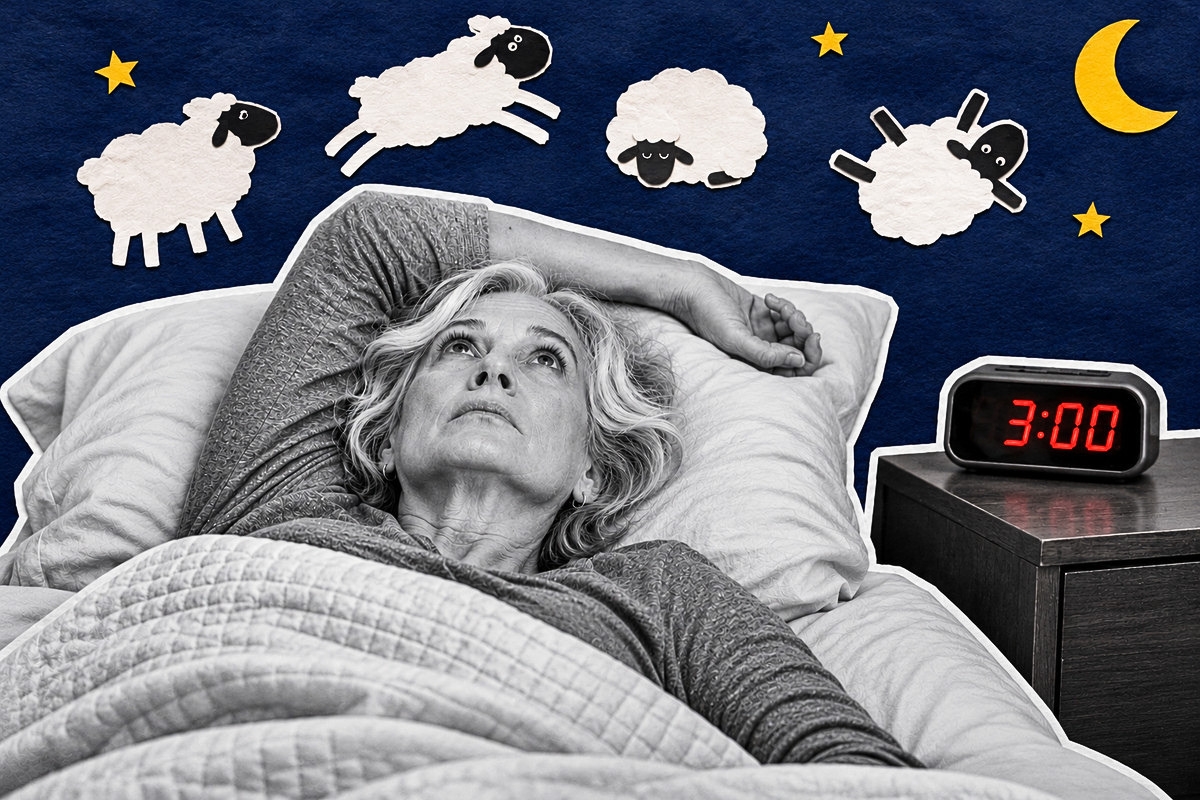
The screening tools were built around men. Women get told it’s hormones, then stress, then age.
When women over 50 say we’re exhausted, we don’t mean “I-need-a-nap kind of exhausted.” This runs deeper, and it’s a new kind of tired—even to us, and it’s insidious.
We wake up with headaches, battle brain fog on the daily, drag ourselves through the day, and wonder why we’re constantly anxious when, technically, everything is fine.
So, we blame menopause. Or stress. Or aging. Or the unholy mental load we’ve been carrying for the last quarter century.
And when we mention it to our doctors, we have a good chance of hearing some version of: That’s on brand for your age.
But what if it isn’t?
What if the problem isn’t that you’re sleeping badly?
What if the problem is that you’re breathing badly while you sleep?
Not-so-fun fact: The risk of obstructive sleep apnea (OSA) symptoms rises sharply during and after menopause.
One analysis of U.S. health data found that 53% of postmenopausal women had symptoms associated with OSA, compared with about 36% of their premenopausal counterparts. And even after accounting for BMI and other factors, postmenopausal women had 57% higher odds of reporting OSA symptoms.
But standard screening questions were written around male symptomatology; women—and, perhaps more concerning, their healthcare providers—aren’t taught to recognize it as a sleep disorder requiring treatment.
Sleep Apnea Has a Branding Problem
With any mention of sleep apnea, our thought bubbles will instinctively pull up images of an overweight old man sawing logs as he sleeps. He snores loudly, and every so often, he stops breathing in dramatic fashion. The lack of air wakes him—and his wife—frequently. This is sleep apnea—OSA, to be exact.
That image isn’t entirely wrong, but it’s incomplete. Women can have sleep apnea too, and the risk increases after menopause.
Dr. Chelsie Rohrscheib, neuroscientist, sleep expert, and head of sleep at Wesper, a home sleep testing company, told me: “During perimenopause and menopause, declining hormone levels, especially estrogen and progesterone, lead to loss of muscle tone in the muscles that control your upper airway. Additionally, women are more prone to weight gain during this period, which places more weight around the neck and jaw. Both factors contribute to upper airway collapse during sleep, leading to sleep apnea.”
But the problem isn’t simply that women may develop OSA after menopause. It’s that women often delay testing because they don’t even suspect sleep apnea, nor do their doctors—because we don’t fit the profile.
The most common OSA screening questionnaires, including STOP-Bang and Berlin, were developed and validated in male-heavy populations. Not only do these risk assessment tools explicitly count male sex as a risk factor; the questions are often built around the symptoms associated with the stereotypical sleep apnea patient: loud snoring, witnessed pauses in breathing, high blood pressure, a higher BMI, and obvious daytime sleepiness.
However, for women, OSA isn’t always “textbook,” and symptoms are often subtler. According to Rohrscheib, “Women may have shorter and less obvious breathing pauses that don’t even result in loud noises. They also tend to present with insomnia, headaches, chronic sleepiness, and fatigue, and cognitive issues such as brain fog and irritability”—symptoms that may not rack up enough points to raise the alarm.
Ultimately, women may look “low risk” on paper while still having a genuine sleep disorder. One article on the gender gap in OSA even noted that women have more healthcare contacts than men before diagnosis.
Mary Beth Thought It Was Hot Flashes
The fact is, it’s the same sleep disorder, but women may experience and describe it differently. When they do seek care, OSA may not even make the list because many of these symptoms overlap with those of menopause, and the way we’ve been taught to recognize sleep apnea was never built around women.
Mary Beth Harper told me that she experienced nearly every symptom in the OSA playbook for women. First came the snoring. Then she started waking up hot at night, which she assumed was hot flashes. Blinding morning headaches were attributed to hormones, and her need for more and more caffeine to stay awake all day was blamed on stress. Eventually, she needed detailed lists to keep up with daily tasks, which she chalked up to aging.
Then she started waking up choking.
“It was my husband telling me he was worried about how I sometimes gasped in my sleep that finally made me wonder about sleep apnea,” she said.
Harper initially kept her symptoms to herself. “It’s a bit of a ‘shameful secret’ for women to admit that they snore,” she added. So, she tried to manage the problem herself with nasal strips, new pillows, and sleep positions. But none solved the problem; they only left her and her partner increasingly fatigued.
Once she finally told her doctor, she was referred to a sleep clinic. Harper said she received an OSA diagnosis within three months, though experiences may vary.
What to Say to Your Doctor
Sleep hacks are everywhere, but if you suspect a sleep disorder like OSA, another supplement, improved sleep hygiene, or curbing your screen time before bed won’t treat your OSA. This one is a conversation with your doctor, and knowing how to advocate for yourself is key. Here’s a checklist.
- Be prepared to describe your symptoms: Keep a sleep diary, noting frequent wake-ups, snoring, and any breathing pauses your partner notices.
- Explain how you feel: Tell your doctor if (and how often) you feel excessively tired or irritable or have trouble concentrating.
- Mention menopause: Be sure to tell your doctor if your sleep has changed during perimenopause or menopause.
- Just ask: “Could sleep apnea cause my symptoms?”
- If you’re dismissed: Ask, “If it isn’t sleep apnea, what else could explain these symptoms—and how can we rule it out?”
What Actually Happens During a Sleep Study
A sleep study, or polysomnogram, can involve an overnight stay in a sleep lab. Sensors on your head, chest, finger, and legs monitor things like brain activity, breathing, blood oxygen levels, heart rate, body position, and muscle activity while you sleep.
For suspected OSA, sleep technicians closely monitor your breathing to establish your apnea-hypopnea index (AHI), or the average number of apneas and hypopneas per hour, to help determine the severity of your sleep apnea. OSA is typically categorized as mild, moderate, or severe.
- Mild OSA: 5 to fewer than 15 events per hour
- Moderate OSA: 15 to fewer than 30 events per hour
- Severe OSA: 30+ events per hour
You Have Sleep Apnea. Now What?
For moderate to severe OSA, continuous positive airway pressure (CPAP) is often the first stop. CPAP therapy uses a machine to deliver a continuous flow of pressurized air through a mask, keeping your airway open while you sleep. Though CPAP therapy is widely regarded as the gold standard for OSA treatment, compliance is the biggest issue for many people, and barriers to adherence range from physical discomfort to financial burden.
Other treatments for OSA include:
- Oral appliances: custom-made mandibular advancement devices
- Surgical implants known as hypoglossal nerve stimulators
- Lifestyle changes: weight management, avoiding alcohol and smoking
- Positional therapy: sleeping on your side
Harper noted that CPAP therapy was anything but straightforward. She spent years trying different machines, masks, hoses, and accessories, but often struggled with mask leakage, noise, and the intense pressure needed to keep her airway open. And dental appliances weren’t a better fit: They moved her teeth and caused significant jaw pain.
Eventually, she opted for Inspire, an implanted hypoglossal nerve stimulation device. Noting that “recovery for any surgery is longer than simply plugging in a machine and putting on a mask,” Harper said she wouldn’t go back. “I don’t need lists, I don’t need naps, the brain fog is gone, the headaches went away almost immediately,” she beamed.
But again, experiences may vary. Before you run off to ask your doctor for an Inspire implant, know it isn’t an option for everyone. The implant is intended for those with moderate to severe OSA and a BMI of 40 or lower. Prospective recipients must meet the clinical criteria for positive airway pressure (PAP) intolerance, and before implantation, your doctor must assess the pattern of your airway collapse to ensure the implant can treat it.
Menopause is messy. And for many of us, it’s the villain we love to blame in our midlife stories. Sometimes that blame is in the right place. Other times? It may be more than menopause. Listen to your gut here. Check in with yourself, and then check in with your doctor. And if you’ve asked the right questions and your doctor still can’t identify the cause, ask for a referral to a sleep specialist.
Menopause can explain a lot—but it shouldn’t explain away everything.
************
MEDICAL ADVICE DISCLAIMER
DISCLAIMER: This website does not provide medical advice. For health or wellness-related content, SFD Media LLC emphasizes that information about medicines, treatments, and therapeutic goods (including text, graphics, and images) is provided for general information only. No material on this site is intended to substitute for professional medical advice, diagnosis, or treatment. Users are advised to independently evaluate and verify the accuracy, reliability, and suitability of the information before relying on it. You should not rely on the content as a substitute for professional medical advice. Consult with a physician or other healthcare professional for any health concerns or questions you may have. SFD Media LLC is not responsible for any action taken based on the information provided on this website. The use of any information provided on this website is solely at your own risk.