
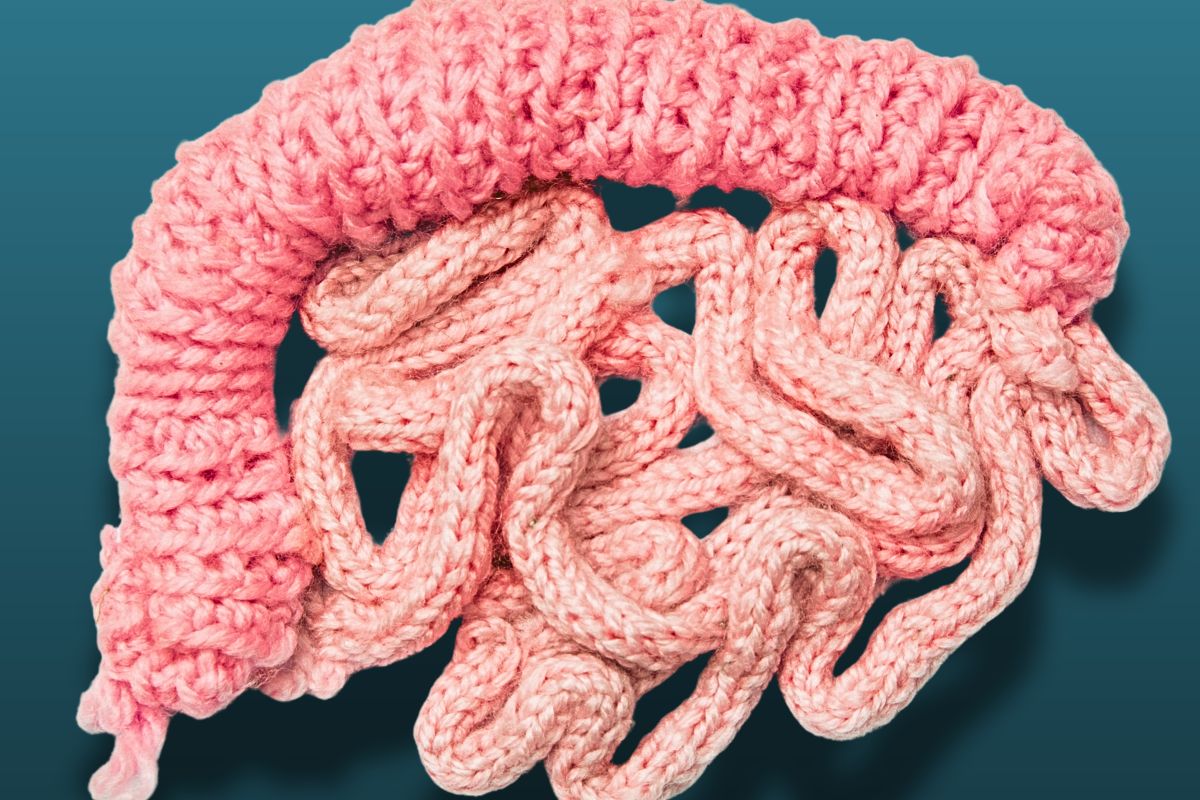
Your anxiety, your dread, your inexplicable 3 a.m. spiral? Your gut has been running that operation for years. And nobody told you.
Sometimes I hate my own guts.
Not in a dramatic, swearing-at-myself way. More like in a quiet, Tuesday-afternoon way, when anxiety shows up uninvited and I can’t find a reason for it. No big deadline looming, no family drama, just a low, humming dread that settles somewhere between my chest and my stomach and refuses to explain itself.
For most of my life, I filed that feeling under just how I am. I did the therapy, the journaling, the yoga, the deep breathing that never quite reached wherever the feeling lived. I blamed my personality, my hormones, Mercury retrograde, the news.
Turns out, it might have been my intestines.
While we’ve been busy blaming ourselves for our anxiety and inexplicable bad days, our guts have been running a parallel emotional operation—one that science has only recently begun to understand. The roughly 500 million neurons lining your gastrointestinal tract form what researchers now call the “second brain,” or the enteric nervous system. It’s in constant, chatty communication with the brain in your head via the vagus nerve, and the trillions of microbes living in your intestines—your microbiome—produce critical mood-regulating chemicals that heavily influence how you feel.
Consider this: About 90% of your body’s serotonin—the neurotransmitter most associated with mood stability, feeling okay, and being able to let things go—is produced in the gut. That means the bacteria living there aren’t just managing your digestion; they interact with an entire enteric nervous system, and they have strong opinions about your mental health. Yet most of us had no idea they even existed.
The Second Brain—and Why It Came First
“The enteric nervous system is actually the first brain, from an evolutionary standpoint,” said Dr. Emeran Mayer, gastroenterologist and neuroscientist at UCLA and author of The Mind-Gut Connection and The Mind-Gut Immune Connection. The earliest marine animals, Mayer explained, were essentially tiny floating digestive tracts wrapped in nerve nets, the ancestor of what we now call the enteric nervous system. “Everything was in there,” he said. “The digestive function, the escape behavior, the response to threat.”
Over millions of years of evolution, those functions migrated upward. The brain in our skulls took on the higher-order work. But the gut kept its nerve network, and the two have been in conversation ever since via the gut-brain axis, a bidirectional highway driven largely by the vagus nerve.
That word “bidirectional” matters. It means that what happens in your brain affects your gut, but also, crucially, that what happens in your gut affects your brain. Mayer described it as a system of multiple feedback loops, not simple linear relationships.
“Any emotion that originates in the brain will be transmitted to the gut via the autonomic nervous system,” he said. “Even if you don’t feel it consciously, if you’re upset or anxious or nervous, your gut will know, because it gets those signals.”
And then it sends signals back. Around 80% of the fibers in the vagus nerve are sensory, traveling upward from gut to brain, encoding the state of your intestinal ecosystem on a 24/7 basis and transmitting it to your brainstem, which distributes the information to the rest of your brain. So when you wake up at 3 a.m. with inexplicable dread, could it be your gut?
“Absolutely,” said Dr. Uma Naidoo, Harvard-trained nutritional psychiatrist and author of This Is Your Brain on Food and Calm Your Mind with Food. “That feeling of dread is often underlying anxiety that hasn’t been attended to, and it is often the involvement of the gut.”
What Menopause Does to the Equation
This gets particularly personal for women in midlife because the microbiome is especially vulnerable to exactly the forces that define this stage of life.
Estrogen, it turns out, supports beneficial gut bacteria. And the relationship runs in both directions: estrogen influences the diversity of the microbiome, and certain gut bacteria help break down and recycle estrogen back into the body. Mayer called this group of microbes the “estrobolome.” “As the level of estrogen lowers during perimenopause and menopause, many women experience changes in microbial diversity and increased inflammation,” said Naidoo. “These changes can contribute to mood symptoms.”
Layer on top of that the accumulated gut damage of a lifetime: the antibiotics that wiped out whole bacterial colonies and were never fully replenished, the decades of diet culture that starved the microbes that needed fiber and diversity to thrive, the chronic stress that reshapes the microbiome. “Going on very restricted diets clearly affects the microbes in the gut in a negative way,” said Mayer.
The Effect of Ultra-Processed Food
The Western diet—engineered, as Mayer bluntly pointed out, by experts who migrated from the tobacco industry to the food industry—works against the microbiome in ways that are only now becoming clear. Ultra-processed foods disrupt the microbiome and make it harder to feel full. “With any kind of addiction,” Mayer said, “there’s the craving, and then when you don’t have it, the crash.”
For women who’ve spent years on restrictive diets, or have had eating disorders, the picture is even more specific. “If you have an eating disorder, whichever form, you have less microbial diversity,” said Naidoo. “A healthy microbiome contains hundreds of different kinds of bacterial species because they each do different functions. When you’re restricting entire food groups, you’re providing fewer nutrients for those bacteria to metabolize.” Less diversity means reduced production of the short-chain fatty acids that lower inflammation, support immunity, and communicate with the brain through the vagus nerve.
The mood effects follow.
What Actually Helps
The good news is that the microbiome is responsive to changes. Both Mayer and Naidoo pointed to the same foundational principles: a plant-forward, fiber-rich, anti-inflammatory diet, modeled roughly on Mediterranean eating. The goal is microbial diversity, which means dietary variety. Research suggests that eating about 30 different plant foods a week, including herbs, spices, nuts, seeds, and legumes, is associated with significantly higher microbial diversity. And a landmark 2021 Stanford study found that a diet high in fermented foods such as yogurt, kefir, kimchi, kombucha, miso, and sauerkraut increased microbial diversity and reduced markers of inflammation.
For women in midlife specifically, Naidoo also recommended phytoestrogen-rich foods: including edamame, tofu, flaxseeds, and chickpeas. “These help support hormonal balance,” she said, “and you get protein at the same time, which matters, because declining estrogen accelerates muscle loss.”
On supplements: both doctors are measured. The mind-gut connection has often been used as an excuse to peddle hundreds of dollars in supplements a month for some users, but these physicians said they’re only useful occasionally, and it’s worth asking your doctor first. They recommend turmeric, vitamin B12 for vegans, and omega-3s.
On sleep: disrupt your sleep and you disrupt your microbiome, and therefore, your mood. For women in midlife, who often experience sleep disruption, this isn’t a small thing.
On stress: every stress-reduction practice you already know—the walk, the quiet, the phone call with the friend who makes you laugh—is actively tending your microbiome.
The Verdict Your Gut Already Knew
While we were busy blaming ourselves, the science has been building a case that our feelings of anxiety and dread weren’t character flaws or failures of willpower. They were signals from a biological system that had been disrupted and ignored. The gut doesn’t know your narrative, whether it’s your relationships, the career detour, or the particular grief of navigating a body that keeps changing in ways nobody prepared you for. It just sends signals. For a long time, we received those signals as verdicts on who we were, when really they were just weather reports from an ecosystem that needed tending.
But if the gut can be disrupted, it can also be restored. Gradually, with fiber and fermented foods and sleep and the radical act of taking your own biology seriously, the signals start to change.
And so, slowly, do you.
**************
MEDICAL ADVICE DISCLAIMER
DISCLAIMER: This website does not provide medical advice. For health or wellness-related content, SFD Media LLC emphasizes that information about medicines, treatments, and therapeutic goods (including text, graphics, and images) is provided for general information only. No material on this site is intended to substitute for professional medical advice, diagnosis, or treatment. Users are advised to independently evaluate and verify the accuracy, reliability, and suitability of the information before relying on it. You should not rely on the content as a substitute for professional medical advice. Consult with a physician or other health care professional for any health concerns or questions you may have. SFD Media LLC is not responsible for any action taken based on the information provided on this website. The use of any information provided on this website is solely at your own risk.



2 Responses
Very enlightening.
I have had gut issues for years which no doctor has been able to assist me with.
The last is Miralax which is supposed to induce bowel movement. Nope, not for me. I eat plenty of fruits, veggies, nuts, etc. Still I remain constipated for a week at a time, sometimes longer.
When I take laxatives I have a day of pooping which is not fun.
Gastro experts insist on a third colonoscopy, but I just turned eighty and fear any more procedures.
I don’t know what’s next for me.
I had similar experience, just started out of the blue… finally after drs and colonoscopy. I turned to local produce and it’s been a game changer.
I like variety but easy to get caught in a rut….
I spent a year suffering and am much better.