In 2006, a woman’s film about a girl got reviewed like a dessert tray. Twenty years later, the reviews are what aged badly.
Today, Sofia Coppola’s Marie Antoinette is widely touted as a masterpiece—it has been called one of the best films of the 21st century so far. Recently, the film’s 20th anniversary was celebrated in a manner worthy of its notoriously decadent subject with the premiere of Making Marie Antoinette, a retrospective “love letter” documentary, a recent restoration of the film itself, an accompanying commemorative book of photographs, and an exhibition at Versailles. But when it premiered at the Cannes Film Festival in 2006, there were many accounts of critics booing it, though the Cannes website now says the premiere was met with a standing ovation.
Why? Sexism, mainly.
Back in 2006, when Marie Antoinette premiered, Coppola was 35—just a few years shy of Marie Antoinette’s age when she was executed. No novice, her feature-film directorial debut, The Virgin Suicides, was well received at Cannes, and her next film, Lost in Translation, earned Coppola an Academy Award for best original screenplay and a best director nomination. Both films had female leads but examined them through the eyes of men, specifically how women are mythologized objects of projection.
Marie Antoinette differs in that it gives the story of the much-maligned Austrian queen of France a modern “pink” point of view and the early-aughts “it girl” tabloid treatment. She’s portrayed as an innocent, loving teen who’s shipped off to a place she’s never been to marry a man she never met for the sake of her country. To cope with the pressure of two countries waiting for her to consummate her marriage and produce an heir, she becomes something of a horny shopaholic. She was given a sympathetic, relatable interiority to resonate with women and underscore its deeper message, which was how women have historically been treated as chattel and always would be if they were beholden to men.
They Couldn’t See Past the Cake
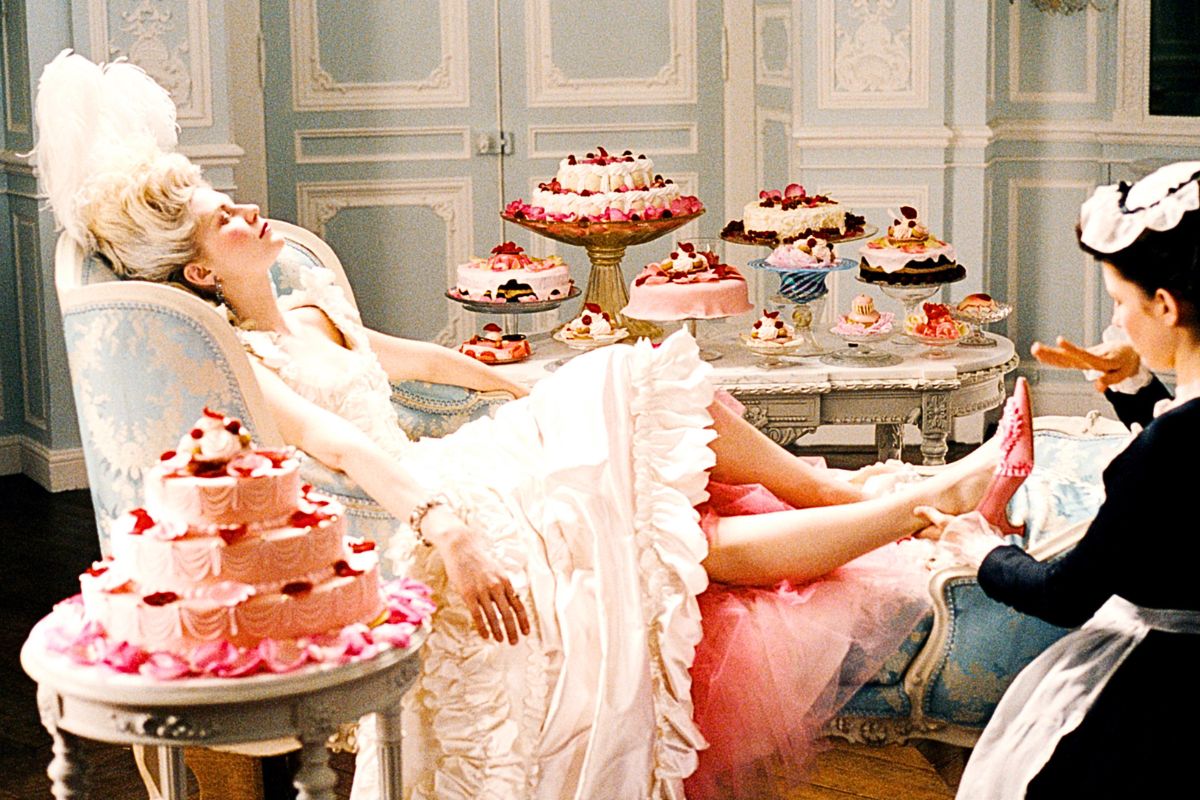
History flattened the mythical figure into a line about cake, and similarly, critics seeking a more male-centric, traditional version of the story flattened the film because they couldn’t see past its relentlessly feathery, frothy, gilded aesthetic and irreverent punk soundtrack. A montage of Marie and her crew literally eating cake inspired an abundance of sugar-inspired analogies from critics. Though Variety critic Todd McCarthy said the attractive cast was “far from unpleasant” to watch, he disparagingly dismissed the film as “no more nourishing than a bonbon.” New York Daily News critic Jack Mathews was similarly dismissive, writing: “Coppola won’t win any Oscars, but the movie is a contender for cinematography, costumes and production design, and it’s a lock for Prettiest Pastries.”
Meanwhile, Anthony Lane from The New Yorker said his desire to watch the movie was “doubled at a stroke” because it rattled French film critics. Saying she was portrayed as “the Paris Hilton of the late 18th century,” he disparaged Coppola by saying the film’s “silly fizz” made it “simpler and less creepy than her earlier projects,” while citing what he called an unembarrassed devotion to the superficial as its only virtue: “There is no morality at play here, no agony other than boredom, and, until the last half hour, not a shred of political sense. The fun dies out of the film—in fact, the film itself expires—when Coppola suddenly starts dragging in discussions of the American Revolution.”
Some critics, however, understood what Coppola was looking to accomplish. The Washington Post’s Ann Hornaday (a woman, natch) had four words for the haters: Let them eat crow. “Far from mere spectacle, Marie Antoinette is instead a slyly subversive film, seducing viewers with its endless montage of sumptuous excess, but also daring them to empathize with the girl drowning in it.” Longtime New York Times critic A.O. Scott, a man, didn’t just get Marie Antoinette; he staunchly defended it twice. In a review headlined “A Lonely Petit Four of a Queen,” he wrote: “To say that this movie is historically irresponsible or politically suspect is both to state the obvious and to miss the point.”
Earlier, in his coverage of the Cannes booing, he had defended the film while giving the criticism some context: “The applause after the press screening Wednesday morning—there was some!—was mingled with boos, perhaps from die-hard republicans (in the French rather than the American sense) offended by Sofia Coppola’s insufficiently critical view of the ancient régime in its terminal decadence,” he wrote. “The mixed response on the part of the critics may reflect a certain ambivalence, less about the movie itself than about our own implication in the rarefied society it imagines. To say it’s a lot like Hollywood is to say that it’s a lot like Cannes. Does that make us courtiers or Jacobins? Should we crown Ms. Coppola with laurels or hustle her into a tumbrel bound for the guillotine? I, for one, am happy to lose my head over Marie Antoinette.”
Women Were Never the Problem
Though Coppola would go on to become only the second woman ever to win the best director award at Cannes for The Beguiled, she initially met the mixed response to Marie Antoinette with grace, telling the press: “I think it’s better to get a reaction … than a mediocre response,” according to The Guardian. “It’s not for everybody.” But while celebrating its recent anniversary, Coppola reflected upon how sexism stood so strongly between critics and the film. “It’s hard to believe 20 years ago that the female point-of-view was so unusual,” she said during a recent Q&A.
Here’s the rub: It was and still is. Films about women, by women, for women were, and still are, in tragically short supply. Yearly studies from the USC Annenberg focus on a huge lack of female directors in Hollywood. In 2007, the year after Coppola made Marie Antoinette, only 2.7% of directors of the 100 top-grossing films were women. Disappointingly, after a few years of upswing, things are turning grim for female directors again. In 2025, just 8.1% of directors of the 100 top-grossing films of 2025 were women—a steep drop from the previous year, when 13.4% of those directors were women. Thus, Cannes has long come under fire for being the perfect microcosm of Hollywood’s “woman problem,” meaning that it features scant few female directors.
The most successful cult classics require years for their complexities and messaging to ferment into something more palatable for the masses, and this is certainly true of Marie Antoinette, who might’ve been seen today as one hell of an influencer. The notion that young viewers first discovering the film through today’s tiny, infinitely scrollable lens might watch it on larger screens and in brighter colors with louder sounds thrills Coppola. “Restoration sounds so ancient, but it looks so alive. The colors are refreshed. I’m so excited,” Coppola recently told Vogue. “There’s a generation of people who never got to see it in the theater, who’ve only watched it through clips on TikTok, never big.” She also feels even more committed to the film’s feminine POV: “It got me thinking about the early 2000s again, how women were looked at, how the tabloids treated them. It was a different time 20 years ago! I am glad [girliness] can be embraced now.”
But Marie Antoinette doesn’t just embrace girliness—it embraces the complexities girls cope with when becoming women. Though it may have been another historical liberty Coppola took, the film used motherhood to remind us of the queen’s tenderness—something critics largely overlooked. After an innocent frolic with her gal pals and daughter in the garden she had planted, she contemplates a passage from Rousseau: “If we assume man has been corrupted by an artificial civilization, what is the natural state? The state of nature from which he has been removed? Imagine wandering up and down the forest, without industry, without speech, and without home.” It reminds us of Coppola’s thesis: Who would Marie Antoinette have been without the relentless, merciless criticisms of her based on her sex? And thus, who are we?