
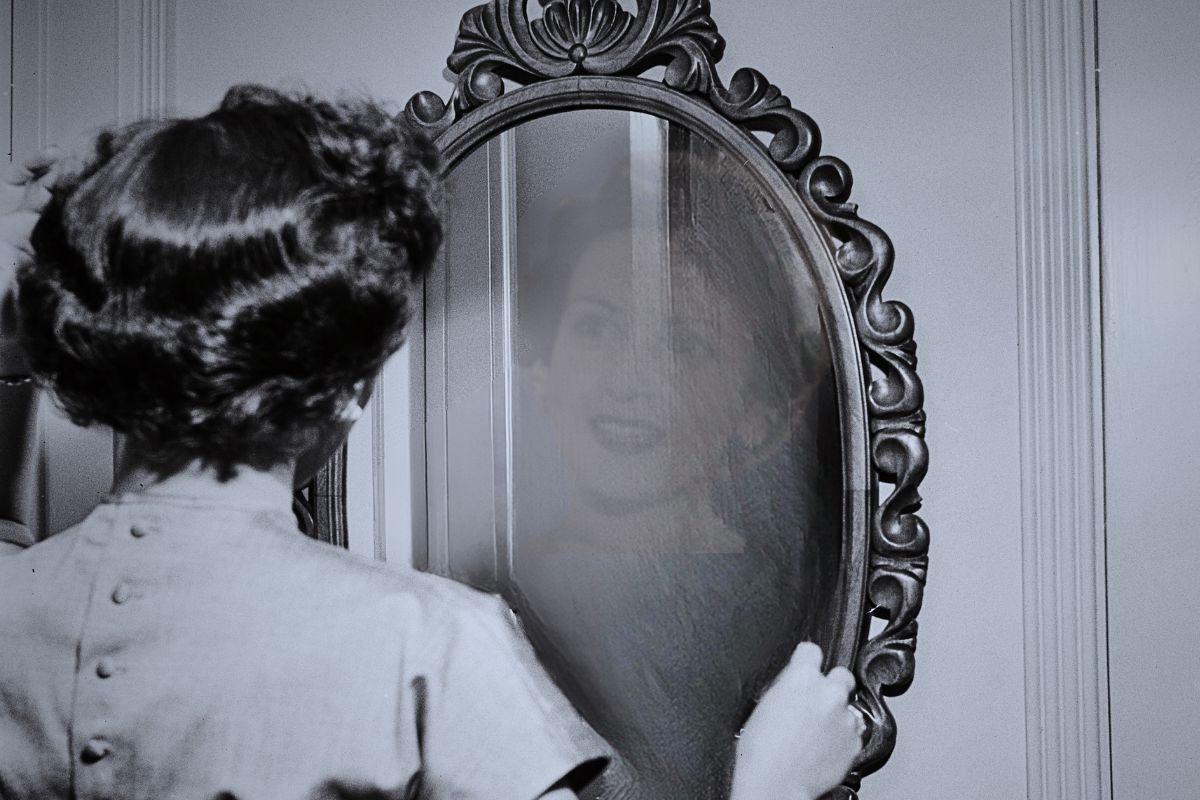
The personal cost of “having it all” before women were allowed to want anything else.
When I was 11, I watched my mother dissolve. The year was 1964, and I’d become accustomed to the sight of my mother retreating to her darkened bedroom where she would crawl beneath her bedclothes, and of her vacant eyes at the dinner table, a condition made worse by the Valium and Miltown, freely dispensed at that time to thousands of “hysterical” women.
From an early age, I sensed, but didn’t understand, my mother’s unhappiness. I cried every morning when she dropped me off at nursery school through second grade because I couldn’t trust that the mother who picked me up at the end of the day hadn’t shifted into an orbit that excluded me. I assumed her sorrow was my fault and, therefore, my responsibility to fix. I danced around her like an organ grinder’s monkey, trying to get her to smile. But I wasn’t a natural entertainer. The jar I held up to collect her unhappiness remained empty.
After a disturbing playdate with my next-door neighbor, at which my friend hid in the closet and demanded I leave, I ran home searching for my mother’s solace. The last place I looked was the bathroom, where I found her staring at herself in the mirror as if she didn’t recognize her own face or mine.
Ultimately, my mother was admitted to a psychiatric hospital. I have no memories from that period except for a dream in which I went to visit my mother, but I had to stay in the parking lot. My mother could look down at me from a window and I could look up at her, but we couldn’t touch.
Advertisement
When my mother married at 18, she worked hard at meeting the expectations of the era. By 22 she had produced two children. She got a nose job to look more like June Cleaver and Harriet Nelson, television’s housewives. Dinner was on the table every night at 6:15 when my father came home from work. She saw that my sister and I had our three glasses of milk a day, wore sensible shoes, and were chauffeured to our music, dance, and Hebrew lessons. The floor of our front hallway glistened from weekly buffing, beds sported perfect hospital corners, and the household budget was managed with the frugality determined by my father.
No one noticed her fading away.
A symptom of my mother’s depression was withdrawal from her sisters and parents and all members of her extended family—who, she felt, were complicit in keeping her stifled—so I became isolated from them as well, and any support they could’ve provided. My older sister was angry and escaped home whenever she could. My father was bewildered by his crumbling family. He was a gifted scientist who provided for us, but he had become the man of a broken house. He, too, did his own disappearing act, retreating to his study, testing hypothesis after hypothesis to explain what happened to his wife.
Amidst this isolation, I would get peeks into the homes of my friends whose mothers weren’t just a physical presence but a participatory one. They made me a bit queasy, as if they were a rebuke of my own mother. I never heard muffled sobs behind closed doors in darkened rooms. I assumed these mothers were happy.
I was most likely wrong.
Advertisement
My mother’s recovery required intensive therapy and was, in a way, as destabilizing as her descent. She finally became a college student and her single-minded drive kept her out of reach once again. Her first degree led to a master’s degree and a job as a psychiatric social worker. She began bringing home books like The Joy of Sex, Our Bodies, Ourselves, and Betty Friedan’s The Feminine Mystique. It was through Friedan that I learned the term “Housewife Syndrome” to describe the many women of the 1950s and ‘60s who’d lost all sense of purpose in their quest to be perfect wives and mothers.
When I went away to college, my mother’s recovery was still so new. Would her orbit shift once again when I wasn’t keeping watch? It didn’t, but I required constant proof that she was still strong, eventually falling into my own depression because I was unable to separate from her.
My mother never resented having children. What she rebelled against was not having choices. I went back to work after my first child but was able to opt to stay home when I had twins. Those first few months I was flooded with relief. No decisions. No balancing. No split identities. Then came the paralysis, sitting and staring at the walls or crying in my bed. My mother died from breast cancer before I became a mother, but I could still hear her. “Is this the mother you want to be for your children?” she would have said. “You need an outward-facing life.”
Advertisement
It was only at this point that the rage began to build, not for me but for my mother. Forty-three years after her death, in nearly every conversation my sister and I have, we still wrestle with our anger over how briefly my mother was able to live the life she chose. Only when I felt my own rage could I see that what I thought was sorrow was really her anger. Even in good mental health, my mother never told the full story. She’s less mystery now and more cipher, probably one I’ll never fully decode.


18 Responses
Judith, thank you for sharing what must’ve hurt to have to live through again as you wrote this. Your painful experience made me see the path my own mother diverged from.
Thank you for reading and responding Michele. I feel as if I have been writing this essay in my head for years. Glad I finally got it on paper.
Really enjoyed this Judi. Such an interesting insight. I managed to escape this and was fortunate to have a career I loved that gave me enough flexibility to be a part of my girls’ lives as they were growing up. And I tried hard to instill in my girls how important it is for them to maintain the essence of their own identities in the context of their marriages.
Thanks Kristie. There are more and more moms like you, and I hope it stays that way
I don’t remember a time that my mother didn’t work outside the home even with or because of 5 children. Both parents worked. My mom said she never had depression and claimed she didn’t remember going through menopause.
I think June Cleaver and Harriet Nelson made me think my home life was out of the norm. Now I know they were the abnormals.
I wish we could learn some of these lessons earlier. But I guess acquiring wisdom is an upside of getting older.
Somewhere along the way to becoming 84, I came out of the shell of the timid person I was and became who I wished to be. It may not seem much to another person, but I truly feel I know who I am now. Most importantly, I saw a lot of who I wished to be as I aged despite a lack of money and worked toward that goal–a mother, a writer, an avid road tripper, and an attractive woman. It’s really tough at times being older, but I feel I’ve been blessed. Because my sons and their families live in other states, I’m often lonely; however, I never let it get me down. I traveled to see them, visiting other states on my way. Life is what you make it.
Thank you for sharing your thoughts. Cracking through that shell is tough. Glad you made it.
My Mom always worked through my childhood during the 50s and 60s. First, clerking in stores. She had only a grade 10 education. In her mid 30s, she started working as a nurse’s aid in the local hospital. She was noticed for her work ethic by one of the doctors who offered her a job as his office nurse. She was thrilled. Before she could start, she found out she was pregnant at 42. She was not happy but had a baby boy when I was 12. I became his second Mom!
My Mom then took a registered nurses course and past at the top of the class. She went on to work in the hospital till she was 65 and was forced to retire due to policy. She was not happy!
My Mom was happiest when she was working or at least that is my memory of her.
What a role model your mom is. Thanks for sharing.
So beautifully penned Judith. It wasn’t until my mother was in a vegetative state that I put together she never finished her accounting degree at City College and I will never know why – was it financial, gender, academic? Mom married at 21 and often told me she was considered an old maid. She then supported both her daughters through higher education, fulfilling careers and financial independence. Our Mom’s generation seems like a collage of resilience, confusion and ultimately achieving in time through their daughters. I wonder how we have supported women that follow us especially as I see the term ‘Tradwife’ being born.
I love the phrase “collage of resilience, confusion, and ultimately achieving.” Thank you for sharing your thoughts.
Opened my eyes to a generation of women who felt lost. I just wish it could have opened my eyes without breaking my heart.
Oh, Zachary, thank you for reading. Instead of seeing a broken heart in you I see an open one.
This was so brilliantly written and so powerful and honest i had to read it twice.
Thank you Nance. You are my honesty teacher.
My mother’s story has many similarities, yet different. I wish she had had the chance to work and challenge herself. Thanks for sharing.
Thank you Barney. There are too many of us with stories like this.