I thought The Handmaid’s Tale was a worst-case fantasy. Then I heard Atwood explain the history behind every turn.
First their bank cards stopped working. Then their jobs were eliminated. Rights like owning property were repealed. In early episodes of The Handmaid’s Tale series on Hulu, main character June/Offred (Elisabeth Moss) flashes back to these warning signs of women’s rights getting stripped away one by one by the repressive “Republic of Gilead.”
But loss of all individual rights, including over their own bodies? Violent subjugation? June wasn’t expecting that. In retrospect, women realized they should’ve been paying closer attention.
My attention was roused last August when I heard author Margaret Atwood speak at a conference and drop that “everything” in her 1985 novel and its popular screen adaptation had “happened somewhere, sometime.” I read her novel 30 years ago, but I remember thinking its dystopian world was a worst-case scenario. Total fiction.
Turns out, Atwood has connected her work to reality ad nauseam in interviews. I just wasn’t paying attention, which is exactly Atwood’s point.
“We’re not living in Gilead yet, but there are Gilead-like symptoms going on,” Atwood warned in interviews years ago. Today those symptoms have reached a fever pitch. The future, Atwood said in August, will “depend on how we behave now, what actions we take.” With Handmaid’s sequel The Testaments now out on Hulu, this seemed like a good time to start paying closer attention—and thinking about what actions to take.
Handmaid’s Real-Life Inspirations
Atwood has cited specific historical inspirations for Gilead, ranging from Puritan New England to the 1979 Islamic Revolution in Iran, from Nazi eugenics to Romania’s 1966 decree banning contraception and abortion, from the 1980s Religious Right movement to Mormon polygamy. What’s really disturbing is that she seems to have forecast aspects of the future four decades ago.
At the August event, organized by Take the Lead, Atwood described waking up to the 2016 election results while the series was still filming and realizing, “We’re in a different show. Nothing had changed. The scripts were all the same, but the frame had changed. The way in which people were going to view this had radically changed. Instead of, ‘Well, at least that didn’t happen,’ people were going, ‘Here it comes.’”
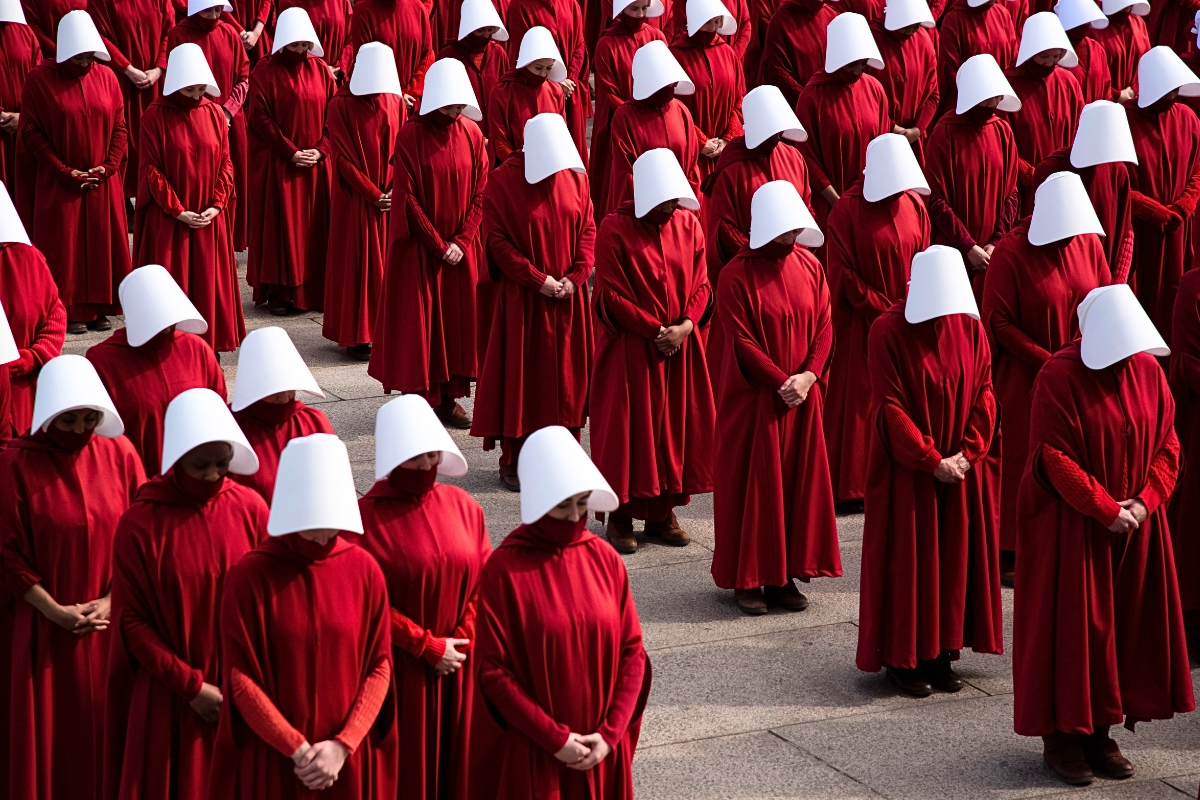
“I don’t think you’re going to get the outfits,” Atwood joked about the handmaids’ iconic blood-red uniforms and white bonnets, “but some of the rest of it has already happened.”
A Longing to Control Women
Don’t say we weren’t warned. In the series, which ran from 2017 to 2025, the “before times” are updated to reflect our times. In Gilead, humans face declining fertility due to pollution (and if you don’t think that’s a viable scenario, go watch The Plastic Detox on Netflix). Ovulating women are enslaved to male leaders and their obedient wives.
As with Atwood’s real-life inspirations, limiting women’s rights and controlling reproduction forever emerge as the answer to society’s problems. For Atwood, reproduction is “such a great power” that throughout history “people have tried to control it.” That history is still being written—according to a 2021 report from the United Nations Population Fund, nearly half of women in 57 countries lacked full autonomy over whether to have sex with their partners, use contraception, or seek healthcare.
In the U.S., we got overly complacent. The overturning of Roe v. Wade four years ago marked a before and after. Abortion restrictions across the country have undermined women’s bodily autonomy. Women in states with bans face higher maternal mortality, and research has linked bans to more unwanted or unsafe pregnancies carried to term.
“Serena Joy” and the Tradwives
In Handmaid, nobody is pure good or all evil. Gilead leaders occasionally reveal their humanity or express regret. Traumatized victims commit heinous acts of their own. A range of characters, not just the Gilead faithful, seek comfort in God. The fact that characters are morally conflicted makes them more interesting—and also more plausible, a credit to the series’ showrunners and stellar casting.
Pop star Olivia Rodrigo’s new song “Serena Joy” is named after an especially complex character played by Yvonne Strahovski. A published author and wife of a top Gilead commander, Serena helped build the system that ultimately allows men, her husband included, to sideline and punish her. She acknowledges losing her identity, along with her voice and power.
Serena’s ideas about “domestic feminism” (her book is titled A Woman’s Place) have clear shades of the tradwife movement—women who embrace traditional gender roles to focus on homemaking, child-rearing, and supporting their husbands. It’s no accident that the handmaids’ bonnets narrow their vision to only what’s right in front of them.
But a growing number of tradwives, like Serena, are changing their minds in public reckonings. “It’s honestly a miracle of God that I woke up and got out,” former tradwife influencer Bernadine Barber told The New York Times in September about filing for divorce and warning other women against spiritual manipulation and marital abuse.
Gilead Only Cares About Power
As Serena claws her way back from supporting a society so misogynistic that it cut off her finger for daring to read, she remains a true believer—in God, not Gilead. “I’m still a Christian,” Barber similarly vowed, “but I no longer believe in extreme gender roles, especially when they’re wrapped in spiritual language and used to justify, control, silence, or harm.”
In August, Atwood reiterated that the rulers of Gilead aren’t Christians. “They are people who have refashioned Christianity to suit themselves. Does that sound at all familiar?” Wisecracking Gilead architect Lawrence (Bradley Whitford) admits he had to “use religious nutjobs as a delivery system” for his plans to save humanity—but, he quips, “I underestimated their depravity.”
“Gilead only cares about power,” Lawrence warns. “Faithfulness, old-time values, homemade bread. That’s just the means to the end. Distraction. Window dressing.” The series’ haunting production design visualizes that window dressing, and the Washington Monument as a giant cross won’t be easy to forget.
Should I Stay or Should I Go?
Other acutely humbling scenes for American viewers involve Gilead refugees benevolently welcomed into Canada. Our neighbor to the north is the safe place in The Handmaid’s Tale, filmed in and around Atwood’s hometown of Toronto. In later seasons, though, even the genteel Canadians begin turning against the immigrants, who fear being rounded up and deported.
For 250 years, America’s identity has been wrapped up in our vision of ourselves as the welcoming country. “Give me your tired, your poor, / Your huddled masses…” Today, we probably all know someone who has left the country, or talked about doing so, after feeling less than welcomed for one reason or another.
In Handmaid, the three-step plan for the Gilead takeover is to attack key government buildings starting with Congress, declare martial law, then send heavily armed troops out to cities across the land. They didn’t anticipate the waves of resistance, led by one woman. “I was lucky,” June says about her acts of heroism. “Women always say that when they’ve done something extraordinary,” she’s told in response.
A Feminist “Mayday”?
The alternative to fleeing Gilead (or America) is to stay and fight, as June does. “Not fighting is what got us Gilead in the first place,” she says in the final episode. It might take more than protests in pussy hats, or even handmaid uniforms. Acts of resistance in Handmaid are severely punished, but they still keep happening—for six full seasons, in increasingly clever and collective ways.
As I watched the show, I kept flashing on Martin Niemöller’s post-WWII confessional, “First They Came,” about complicity with the Nazi regime among sectors of German society. “Then they came for me / And there was no one left / To speak out for me.”
We’re still here, and it’s time to speak out. Find your unique power and help other women do the same, to paraphrase Gloria Steinem writing about Dolly Parton.
For me, that’s pushing myself to pay closer attention.
It’s realizing that what I once thought was fiction was solidly rooted in reality.
It’s ingesting all six dystopian seasons of Handmaid.
It’s writing pieces like this one.
Maybe we’re not headed straight for Gilead, but June and friends didn’t think so either. Even true believers like Serena weren’t prepared for the horrors that unfolded. “America wasn’t Gilead until it was,” June concedes. “And then it was too f*cking late.”