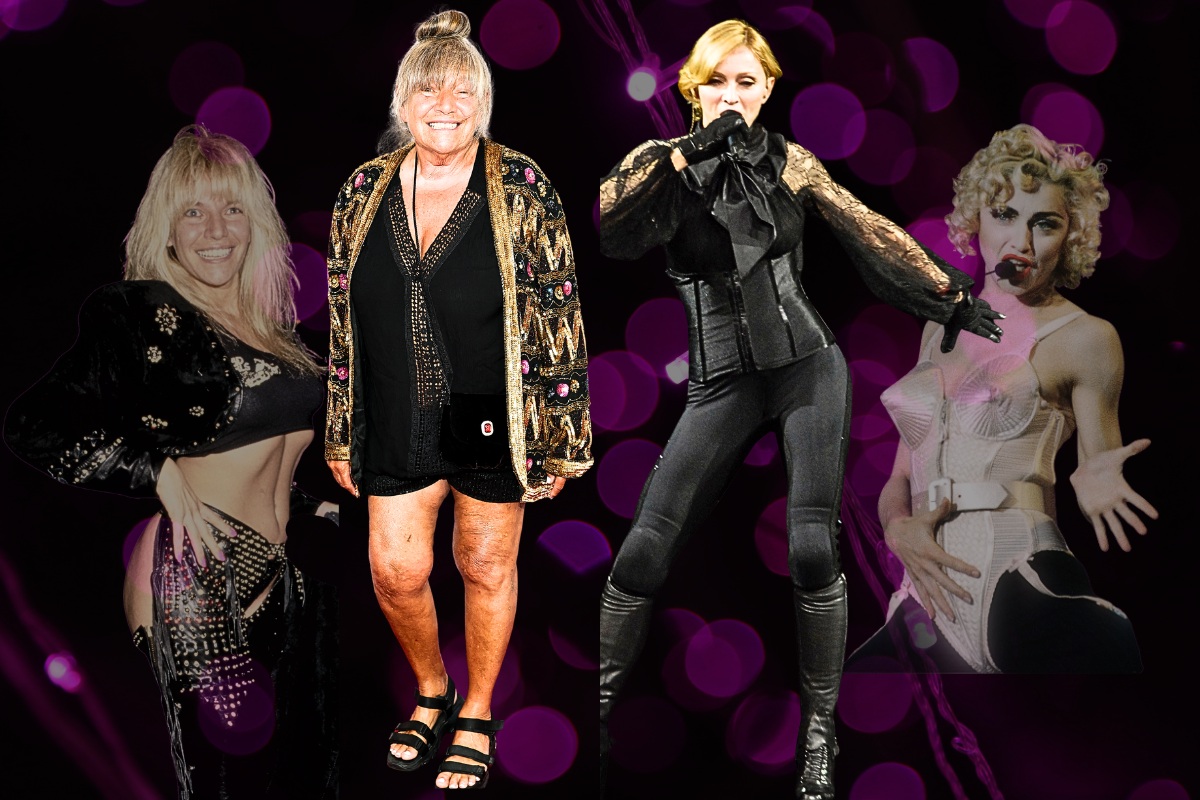
Two sex-positive icons of my youth, now 67 and 70. Watching them age sent me looking for a third option.
One day when I was little, I sat on the floor coloring while my grandmother and her friends played cards at the living room table. “Have you all seen Martha?” one friend asked the group while fanning the cards in a fancy shuffle. “She’s really let herself go.” That’s how, at age five, I realized there was a right and wrong way to get older.
Later, during my teens in the ‘80s in New York, I spent late Friday nights toggling between MTV and Channel J. One played videos of Madonna in pointed bustiers or diamonds, daring to mingle religion and sex, dancing with a handsome coterie of male dancers. The other featured Robin Byrd, a former porn star with a homespun, sex-positive call-in show, dancing with any combo of straight, queer, and transgender dancers in her signature black crocheted bikini. Both women were belles of the ball at Danceteria, the downtown club I snuck into wearing Madonna-inspired black rubber bracelets and flashing a fake ID. Yes, they were different. But they transmitted the same message right into my developing psyche: Express your sexuality; it’s good for the soul. Be free.
Years Later
In the 40-odd years since, I’ve built a career working primarily with women. I led sexual empowerment workshops throughout the 2000s. In short, I heard Madonna and Byrd’s message and I ran with it. Now Madonna has just released her latest album—along with a 10-minute film—”Confessions II,” and HBO Max is airing the Sarah Jessica Parker-produced Bang My Box: The Robin Byrd Story. Both of these icons have been pioneers of sexual freedom, strong voices in the fight for AIDS, and advocates for LGBTQ+ visibility. They’re close in age: Madonna, an internationally known and celebrated pop star, is 67, and Byrd, known to a handful who remember her impact, is 70. And together, they reveal radically different approaches to aging.
Two Paths Through Time
When I first heard about letting yourself go, I knew only that it was bad. Today, I view that sticky phrase as a trope of capitalist patriarchy. But one thing’s clear: No one would ever accuse Madonna of it. Rather than let go, she has curated every corner of her physicality. Like many, I find myself with complex and contradictory emotions around the body and femininity that Madonna has adopted. I’m impressed with her stamina, but also saddened. Her new heart-shaped visage and outsize lips sometimes remind me of the cartoon character Jessica Rabbit.
While I’m used to the shock and awe that comes from more than 40 years of watching Madonna reinvent and preserve herself, I wasn’t expecting to feel shock when I saw Robin Byrd after not seeing her for decades. It took me a few moments to reconcile the woman I remember with the one on the screen. Her signature blond locks have been replaced by a gray top knot. Once known for her self-proclaimed “bangin’ body,” she has gained weight. Although Byrd, as a minor New York celebrity, never had Madonna’s pressures to keep up with industry standards, she’s still done something radical. As a former adult performer, Byrd hasn’t preserved the image of her heyday; she’s allowed herself to look 70. While I would never say she’s let herself go, she has let her former self go, and it’s inspiring.
Then There’s My Face
When I stare at my 56-year-old face in the mirror, I can’t help thinking about Madonna and Byrd. They so embody my conflicted feelings about my own aging that I’ve come up with a new term: the Madonna-Byrd complex. When I see my eyelids and jawline submitting to gravity, I regularly feel grief for what my face used to look like, and quickly fantasize about getting the money and time to fix it, as if it’s broken. This part of me believes I need to be more like Madonna and fight it. Then comes the Robin rebuttal: Stop feeding patriarchy and looking at yourself critically, don’t fear aging, wear your years proudly—the part that wants to be free. If the Madonna-Whore complex represents how, for centuries, men have divided women into those they love and those they desire, my Madonna-Byrd complex represents dueling philosophies about how women are supposed to age: either with focused preservation or not caring much about it at all.
Of course there’s some middle ground, but the media—particularly social media—obscures it. When scrolling Instagram, Justine Bateman, filmmaker and author of Face: One Square Foot of Skin, pops up as the fearless aging warrior. Then comes Dolly Parton, who makes plastic surgery seem like a rite of passage for anyone who can afford it. My approach to aging can either be pure, with no dyes, injections, or procedures, or full of filler and vanity. Trying to escape the whole racket by using the old trope, “You just need to do what makes you feel good and healthy,” only works for a bit. The bind sucks me in.
A New Question
But after watching Bang My Box a second time, I felt a shift. Toward the end, in response to the producers’ invitation to walk naked in a shot, Byrd admits to not wanting others to see her older, heavier body. But then she catches herself. “What kind of hypocrite am I?” she asks, and obliges, baring her majestic 70-year-old self to the camera. A few moments later she reflects: “We all have a mission … mine was to make people happy, to give them the love that I wanted.”
The documentary illustrates how Byrd—dancing in the streets, taking care of her beloved and ailing husband, and remaining a staunch LGBTQ+ ally—is still clearly living out her mission and life to its fullest, spreading happiness to herself and others. Whether or not she looks young by society’s standards doesn’t alter her impact. In Madonna’s role as a pop star, by contrast, looking and acting youthful is arguably part of her mission.
I thought: What if instead of fighting aging or the patriarchy, I could connect with my mission, which is helping people experience more freedom and mastery? I decided that when I catch myself locked in the complex, I’ll ask: What’s important for me to preserve, and why?
I recently thought about letting my hair grow into its natural salt and pepper. I like the idea of lowering costs, time, and toxins without hair dye, but getting there, with messy gray roots and a mop of dueling textures (my gray is coarser), makes me anxious. When I think about leading corporate retreats on the way to gray, I know I would feel self-conscious. I want to put my energy into work, not self-acceptance—and color my roots in support of that mission.
Madonna and Byrd are still my icons. I’ll keep asking what’s worth preserving, and why—starting with my own roots.

28 Responses
I spent a year in NYC on a college exchange trip. I absolutley loved the.Robin Byrd show. Thank you for the good memory –A huge Inspiration on being a sex positive female. I think Madonna’s Narcistism is what lead her to get butt implants recently. Just sad.
I am 51 and struggling aging just recentely. What I want is to look good Healthy soft feminine. For me. I am frankly unimpressed the male soul character recently.
It is indeed a question to ponder…at the ripe old age of 62, I am still “well-preserved” (due to good genes and having a very active lifestyle most of my life). I’m not a proponent of cosmetic procedures or chemicals for looking younger. I grew out my hair to a very beautiful (I was told) platinum silver…I too was tired of the upkeep and the cost. And secretly I loved my hair. Then I was thrust into the position of looking for a job and interview after interview for jobs that I was well-qualified for never progressed past the initial screen. After several months of this, I decided to color my hair to it’s original tone. No, I haven’t gotten an offer yet, but I can say that I’ve made it past the initial screen multiple times. Coincidence?
Thanks, Blair! A few months ago, colleagues were talking about a potential hire, a very accomplished woman. One comment was that she was only “this old” and would not be retiring in the next five years. The age stated was five years younger than mine. I have no intention of retiring. Recently, I took a work-related survey that asked my age, supposedly just for data demographics. I hesitated before telling the truth. I’ve been surprised lately at how often I’ve been asked my age. My supervisor, a man my age, likely does not get asked these questions. I’m letting my hair come in naturally (as is my supervisor)and my stylist convinces me each time I go to the salon to stick with the plan. I’m staying with the plan, but I do wonder about the impact.
Great juxtaposition piece. I had never even heard of Robin Byrd until you mentioned her. I especially loved the ending.
I’d do my chin in a minute if money weren’t an issue. And I’m staying blonde, it makes me happy.
I’m more accepting of my body than I used to be, but I’m not all the way there. I guess I’m somewhere between the two camps, too.
For now, I’m still ducking when nature takes a swing.
I love you just the way you are! Beautiful, intellect, fierce and kind. Keep on growing naturally!
My vanity runs deep and I feed it accordingly. Interestingly, the recent special on TV introduced me to Robin. I guess I was abit busy then having a couple of babies and studying to become a nurse. I absolutely love her!! Anyway, what I need now are a few friends, as I have NONE, as in truly zero. Loved this article.
It’s hard to make friends as we get older, which is such a shame; at this point in life, we have so much to share!
Oh that is SO wrong – i make new friends all the time – I know Robin and she is pretty wonderful. AND I have friends who are 30 years younger and 20 years older — Im 68 – and my attitude is I have no fucks left to give – I just retired and really enjoying myself.
I actually feel sorry for Madonna because she thinks that she still needs to do all that. I just cannot imagine it. Im in the Byrd camp al the way!
Hi Leah, I love hearing this, especially the part about making new friends at 68 and having friends decades older and younger. Maybe that’s the real freedom in all of this: getting to a point where you know what works for you and stop worrying about what everyone else thinks. It sounds like retirement is agreeing with you! Thanks for being here. —susan
At 76 I am a lot heavier than I ever expected, but I do the work to stay healthy and strong and that, to me, feels the most important. Regarding hair color, I was extremely lucky to get beautiful, almost platinum blonde, white hair. Close to the color my younger self always wanted. Embrace your aging!
The to dye hair or not to dye hair comes up frequently. Do what ever makes you happy. What bothers me is many of those that have gone natural have this superior attitude about it and that their way is the only way and everyone should stop dyeing their hair. Get off your high horse. I’m glad you’re happy. Simply state your concerns with it without putting the person down. I personally do not feel any sort of injections or facial surgery is worth the risk but It’s just how I feel. I don’t offer my opinion unless asked and then I don’t put them down for considering. Being kind usually wins over being right.
I have come to this amazing(to me) concept. Part 1, I am the ONLY ONE who is in control of me. No matter the situation I have choices. Even if held at gun point I still have the choice, fight and die or give in and give up.
It is only when I surrender my choice do I feel the painful impact of others.
Which leads to part 2. Someone else’s opinion of me, my body, my clothes, my decisions….IS NONE OF MY BUSINESS!!!.
Ladies, live a life that makes you happy, feeds your soul and make you WANT to get up every day. Much love and hugs
100% – I love this!!!
Amen! Well said.
👏💯
Sandi, thanks for closing with “live a life that makes you happy, feeds your soul and make you WANT to get up every day.”
I let my hair go gray after I lost my son in 2014. I no longer cared about so many things that seemed superficial. I also gained 40 lbs. Now, in 2026, I’ve lost the weight (for vanity and health reasons) but my hair’s a gorgeous silvery streaked gray. The number of compliments I get daily is still remarkable to me. I love the freedom from expensive time-consuming hair appointments that are probably extremely toxic, also. To anyone considering dumping the dye, I strongly encourage you. The growing out period is so temporary. Get some strategic hair cuts to get rid of the mismatched ends. Ultimately, it’s worth it. The fact that it’s also a badass way to flip the finger to ridiculous youth culture trappings & attitudes is an extra bonus.
So very well said!!
Agree 100%!
Do we ever read articles like this about men? This article continues the patriarchy and keeps pitting women against each other – who looks better? etc. The female competition that we learned in our preteens continues into old age.
We don’t read articles like this about men because of patriarchy—which Blair is clearly pushing against in this great piece.
Men are too chickensh*t.
True!
Bear in mind though, that men do have angst about aging; they just won’t admit to it; they’ll just T injections, a truck/convertible sports car, and a 25 year old “soul mate;” then, juxtaposed to that, there’s the 75 pound overweight 70 year old on the beach in a Speedo. They are just forced by patriarchal standards to never admit to any aging-angst; they just act-out.
Sadly the social media-advertising-influencer industrial complex is increasingly targeting men too, with peptides, “looks-maxxing,” our own government officials like the so-called Secretary of Health and Secretary of Defense publicizing contests for pumping iron and filling FDA posts with peddlers of aforementioned peptides…I’ve seen a few men with bad hair-dye jobs too, including Alex Baldwin LoL.
I too struggle.
Growing out dyed hair makes me cringe unless we are bringing back Rosie the Riveter scarfs back for badasses and church ladies.
Do not want folks to think I am dying from cancer instead of embarrassment because my head is wrapped.
In my inner city neighborhood looking younger is one more safety measure like the other 131 actions women take daily to feel like we have control of our lives.
At the same time, I resent the chemical intrusion I started not to cover gray, but mousy no-color hair that made me look tired at 45.
At the same time, I am repelled by the nails, weaves, blown up lips, tattoos and other body altering measures other women have taken.
What does it take to look the best I can be??? Everything in time , money and sweat I can afford to focus on it (or more) to alter time or to find a way mot to hate what I see in the mirror with moderate exercise, a sometimes great and sometimes awful diet with covered or uncovered roots?
Women of a certain era can’t help but think of both of them and compare. I have always loved Robin Byrd and we’ve crossed paths at many sex-positive events in the last few decades, so I wasn’t surprised at all by her appearance in the doc. Loved her and her husband. Her honesty, always. And still, her capacity for wonder and joy. That is what is missing in Madonna. She’s always so focused on her image, she seems to have forgotten about the joy. Different missions for sure. Madonna is entertainment. Robin Byrd is a lesson in history, compassion and love. I’ll take the latter.
I have some of those same mixed feelings. I let my hair go white, but am still considering some kind of “light” facelift one day for one example.
It ain’t easy being a woman. It’s harder still to be an aging woman with a mission.
Love this.