
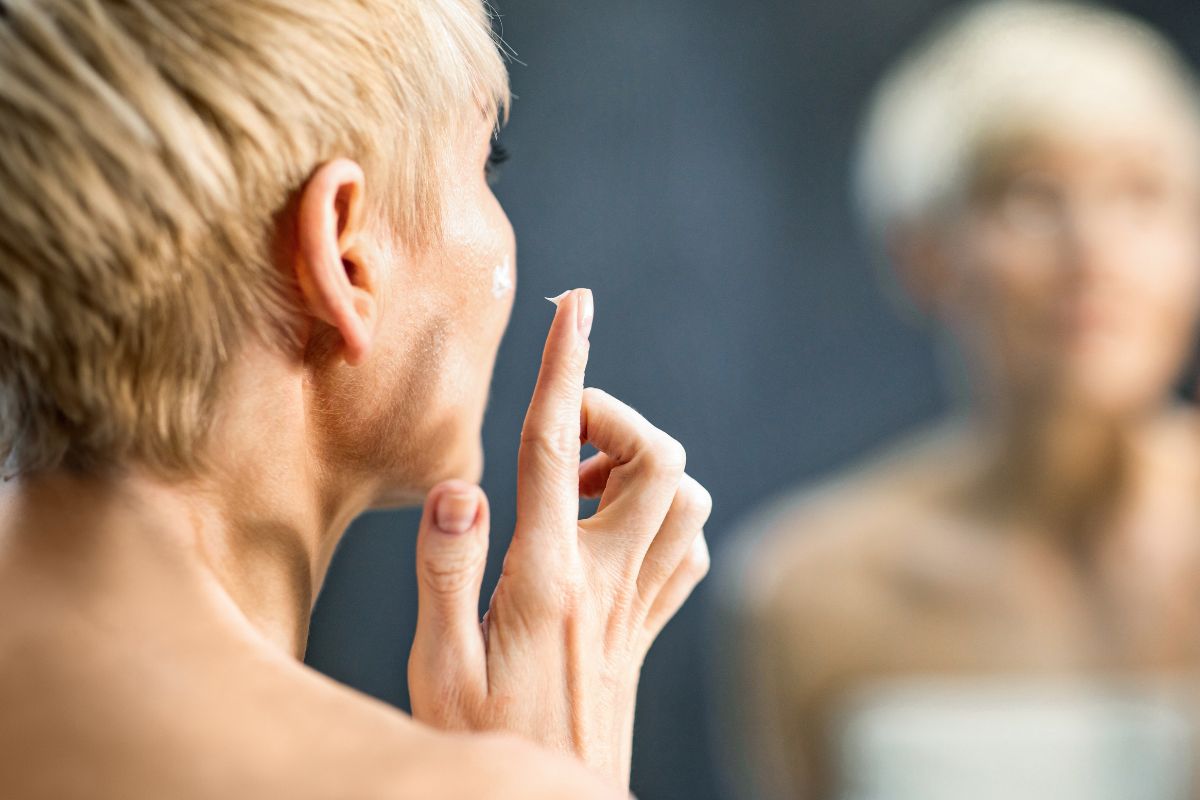
The internet says yes. Dermatologists say stay below the belt.
At this point, very little in beauty has the power to shock us. We freeze our 11 lines with botulinum toxin. Microneedle our faces until they bleed. Slather on salmon sperm serums in pursuit of glow. So when women started dabbing vaginal estrogen cream onto their crow’s feet, smile lines, and under-eye area, many of us didn’t even bat an eyelash.
We didn’t ask whether it was a good idea. We asked where to get it.
Zooming out, this booming skincare trend sparks a few questions. Can the same prescription cream used to treat vaginal dryness really smooth wrinkles, restore suppleness, and help mature complexions bounce back to life? Are other forms of estrogen a better bet? And should you try it yourself?
The Origins (and Resurgence) of Estrogen as Skincare
According to board-certified NYC cosmetic dermatologist Michele Green, MD, estrogen as skincare isn’t new. It’s simply in its latest iteration. “Many decades ago, well-known brands such as Revlon and Estée Lauder sold moisturizers containing estrogen, which were marketed for their anti-aging benefits,” she said.
But by the early 1990s, the Food and Drug Administration (FDA) began cracking down on estrogen-containing skincare products, arguing that they were unapproved drugs rather than cosmetics. So why are women taking a prescription off-label and guessing at doses for their own faces? Because the tested, approved, well-studied option—systemic hormone therapy—was made to seem dangerous to a generation by a study that has since been substantially revised, and the medical system still hasn’t fully corrected course. Women are improvising because they were failed.
Decades later, estrogen is having a renaissance. It coincided with the wider acceptance—and celebration—of hormone therapy at large (including a revision of the aforementioned study and the medical system slowly catching up with the merits—and safety—of estrogen therapy for menopause). Social media, naturally, did the rest.
Over the past two years, TikTok and Instagram transformed vaginal estrogen from a hush-hush menopause treatment into the latest skincare hack. Women claimed the prescription cream left their faces plumper, firmer, and less crepey. And in many cases, they didn’t go rogue. Some OB-GYNs encouraged it.
One of the highest-profile endorsements came from Dr. Mary Claire Haver, a board-certified OB-GYN and leading menopause expert. “You can take your vaginal estrogen cream, mix it in with some moisturizer, and put it on your face,” she told Katie Couric in one interview. (Notably, she said she personally uses compounded estriol rather than vaginal estrogen, the latter of which typically contains the more potent form of estradiol.)
Unsurprisingly, beauty startups and telehealth companies have been getting in on the action. “Those serving menopausal women have since built entire facial estrogen product lines, positioning them as a more purpose-built alternative to using vaginal formulations off-label,” said Dr. Green. Still, some women insist on letting their vaginal estrogen do double duty.
How Estrogen Can Benefit Your Skin
Estrogen helps keep your skin—on your face, your nether regions, and elsewhere—nourished, firm, and resilient. When this hormone begins to decline during perimenopause—and basically falls off a cliff in your 50s—you can kiss that structure, thickness, and moisture goodbye. Unless, that is, you replenish stores through exogenous therapy.
Per Dr. Green, estrogen has a stimulatory effect on fibroblasts: the cells that produce collagen and elastic tissue. More collagen means firmer, thicker, more supple skin (read: fewer opportunities for gravity to do its thing). “Additionally, estrogen boosts hyaluronic acid production in the dermis, which may explain the improved hydration and plumpness reported by women using estrogen treatments,” she said. “These benefits are especially important for peri/menopausal women, who face thinning and dry skin.”
If you’re just hearing about estrogen’s skin benefits now, don’t assume you’ve missed the boat. While starting earlier may help preserve collagen and skin thickness over time, that doesn’t mean estrogen suddenly stops working after menopause.
Dr. Green cited one small 2007 study, which found that 16 weeks of topical estradiol therapy significantly increased epidermal thickness and dermal collagen in postmenopausal women. “A woman in her 60s or 70s with relatively sun-protected skin can still see meaningful fibroblast activation and collagen gains,” she said. However, your starting point matters. If you’ve spent decades baking in the sun without SPF, your results are likely to be more modest. “UV exposure fragments collagen, disrupting fibroblasts’ ability to respond to estrogen and rendering them less responsive to signaling,” Dr. Green explained.
Is Vaginal Estrogen as Skincare a Good Idea?
As is the case with most TikTok trends, this one warrants a deeper dive. While topical estrogen at large remains promising for women in midlife, promising doesn’t mean proven—and vaginal estrogen especially needs an asterisk next to it.
“It’s important to note that vaginal estrogen creams were never formulated, tested, or dosed for facial use. Using them that way means guessing at both the amount applied and how much reaches the bloodstream,” Dr. Green said. Simply put, women are experimenting with a prescription medication in a way it was never intended to be used. Vaginal estrogen for facial application is considered off-label—meaning it’s not approved by the FDA. And while many women—some physicians among them—swear by it, the American Academy of Dermatology (AAD) doesn’t recognize it as an established treatment for facial wrinkles or dryness, added Dr. Green.
Annette Czernik, MD, FAAD, a board-certified dermatologist in Wilton, Connecticut, said that quality studies are needed to determine whether it’s truly effective for facial skin, how much is absorbed there, and whether long-term use could increase the risk of side effects or hormone exposure. “Until those questions are answered, it’s difficult to recommend vaginal estrogen cream for cosmetic use based on scientific evidence alone,” she said.
To date, studies of topical estrogen formulations have generally found minimal adverse effects yet some level of systemic absorption and hormonal activity. Still, these findings can’t automatically be applied to vaginal estrogen used on the face. It’s also worth noting that some doctors are cautious about prescribing estrogen—particularly for women with certain personal or family histories of hormone-sensitive cancers.
What Works
Though estrogen as skincare is trending, it’s probably wise to tackle your complexion concerns with tried-and-true standards. “Retinoids remain the gold standard for boosting collagen and improving fine lines, while sunscreen is still the single most effective way to prevent premature aging,” said Dr. Czernik. And a plush moisturizer—ideally one enriched with hydrating hyaluronic acid, barrier-supporting ceramides, or lush shea butter or oils—should be your twice-daily go-to for keeping dryness at bay.
While your friend or a stranger on your feed might say that vaginal estrogen is working wonders for their skin, anecdotal reports aren’t interchangeable with clinical evidence. And if you’re getting served ads for compounded estrogen to smooth and pamper your face, consider consulting a dermatologist IRL before adding it to your cart.
If you can’t easily access a dermatologist or OB-GYN, the FOMO isn’t necessarily warranted: topical estrogen is far less vetted than the products lining your local drugstore shelves—or perhaps your own bathroom counter.
All said, both dermatologists advised using your vaginal estrogen below the belt only. One day, it very well may be a universal staple in dermatologists’ anti-aging toolkits.
But until then, your face and your vagina should stick to different protocols.
**************
MEDICAL ADVICE DISCLAIMER
DISCLAIMER: This website does not provide medical advice. For health or wellness-related content, SFD Media LLC emphasizes that information about medicines, treatments, and therapeutic goods (including text, graphics, and images) is provided for general information only. No material on this site is intended to substitute for professional medical advice, diagnosis, or treatment. Users are advised to independently evaluate and verify the accuracy, reliability, and suitability of the information before relying on it. You should not rely on the content as a substitute for professional medical advice. Consult with a physician or other healthcare professional for any health concerns or questions you may have. SFD Media LLC is not responsible for any action taken based on the information provided on this website. The use of any information provided on this website is solely at your own risk.



One Response
Also, as I once used Medy- progesterone as my progesterone was almost gone and estrogen excessive, Nov 2022, I had an acute saddle-Cor pulmonary embolism. Cardiologist questioned use of hormones, later I tested positive for Factor 5 Leiden Gene. So I am predisposed to forming clots. On the blood thinner Xarelto life-time, hormones a no go, risk for bleeding is too high. So find out first are supplemented hormones ok for you.