
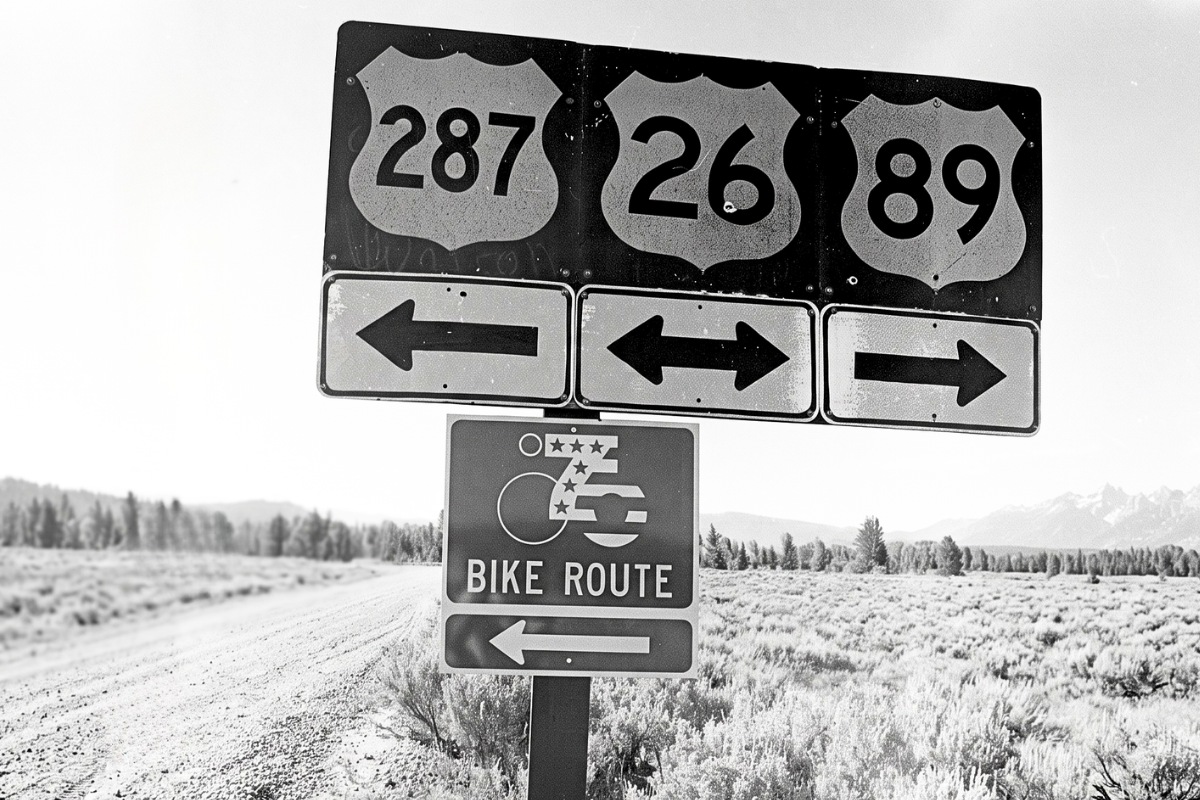
What an 81-day ride across America in the summer of 1976 taught me about endurance, identity, and time.
Some of my closest friends have no idea what I did in the summer of 1976. For decades, I kept it to myself; not out of humility, but because it felt like a one-off miracle. If I found it impossible to believe, how could I expect others to? Keeping that magic alive with the nine others who shared it was all I needed.
But with America’s 250th birthday this year, it’s time to break my silence: That Bicentennial summer, I bicycled across the United States on an 81-day, coast-to-coast adventure known as Bikecentennial 76.
This pride isn’t a simple throwback; it’s a reckoning. The trip’s physical, mental, and social challenges tested every ounce of my being and forged my character.
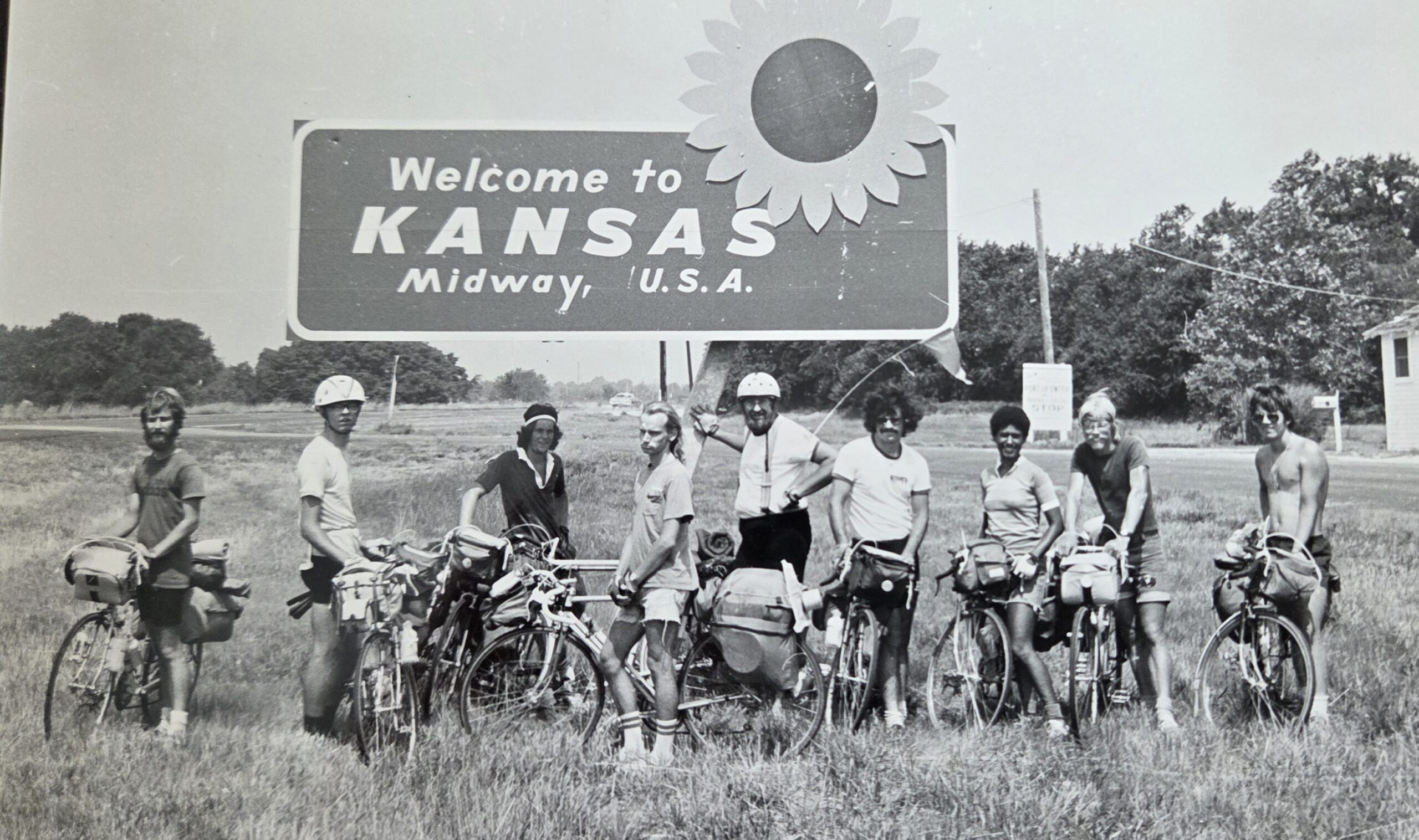
It began on a humid June morning. My parents drove me and my brand-new, 10-speed Fuji from our home in Columbia, MD, to a campground near Williamsburg, VA. They took one look at the group I’d been assigned to cross the continent with—nine hairy, raggedy guys aged 17 to 23, and a 33-year-old, full-bellied leader—and pulled me aside.
“You’re sure you want to do this?”
I was 22, fresh out of college, and unsure of almost everything. But I knew one thing: Going back home wasn’t an option. An 11-week, 4,250-mile road trip beckoned, and I wasn’t a quitter. Looking back now at 72, I’m amazed by my own pluck, and equally stunned by how little I understood about the strength I already carried.
I’d rowed crew in college, moving in precise, grueling synchrony with an eight-woman crew. I spoke Italian and had traveled Europe. Yet, holding a fresh journalism degree, I felt utterly unequipped to be a writer, convinced I lacked “experience.” Today, I have to laugh, and cry a little, at that girl. How many of us fail to recognize what we already contain? The bike ride, I see now, was my first draft.
The Trying Twenties on Two Wheels
Gail Sheehy’s trailblazing Passages, published that very summer, offered the language I was living but couldn’t yet verbalize. Her concept of the “Trying Twenties” captured my generation’s reality: the exhilarating, terrifying business of shaping a dream while battling the persistent fear of being unmasked as a fake. Stepping onto that endless ribbon of asphalt gave me a hard road, but it also gave me daily, undeniable proof that I could cover the distance.
The TransAmerica Bicycle Trail wound through rural back roads, forcing an intense intimacy with a landscape heavy with historical ghosts. As a biracial woman, the daughter of an Italian mother and an African American WWII lieutenant who met in Italy, I glided through Virginia, taking Revolutionary and Civil War battlefields in stride. Progress was inevitable, I believed. Wasn’t I living proof of that?
Yet, I had no idea we were pedaling through the Virginia farmlands that formed the beating heart of Alex Haley’s groundbreaking epic, Roots: The Saga of an American Family. Published two months after our trip, the book would shatter and rewrite the myths America told about its own origin.
By day five, we were grinding up a 2,800-foot climb of the Blue Ridge Mountains in brutal heat, sustaining ourselves on water and salt pills through a 12-hour day. The body is vastly more resourceful than the mind believes. It doesn’t care about your doubts. Just pedal, or when needed, walk the bike. And crest the mountain.
Later, our route cut through the Trail of Tears. Back then, I just bicycled through, consumed by the immediate demands of survival. Now, with a lifetime of context, and the stirring of ancestral ties, I finally understand the complex, sacred, blood-soaked ground I was crossing.
Any concern that I couldn’t keep up with the men vanished in those first weeks. It helped that The Hite Report was sending shockwaves through the culture, giving women radical permission to claim their own bodies. On the road, I was proving that philosophy with my own muscles, learning that autonomy is forged through endurance, one pedal stroke at a time.
Our group leader, Thom MacLean, whom we nicknamed “Fearless,” often anchored himself to the slowest rider of the day. He taught us to value the journey over the destination. Decades later, I realize this was the ultimate writer’s lesson.
In Pueblo, CO, the mental challenge shifted, and was promptly punctuated by pure comedy. After celebrating my 23rd birthday in mid-July at a Mexican restaurant, a few of us got lost on the way back to camp and opted to sleep under the stars in a town park. I had just dozed off when the automatic sprinklers erupted, drenching us. We bolted up, moved to dry ground, and were promptly soaked a second time by another cycle of sprinklers. Laughing at the absurdity, we finally retreated to the sanctuary of a church parking lot across the street.
We scaled Hoosier Pass, the trip’s highest elevation at 11,542 feet, on day 45. Unlike the steep, suffocating climbs of the East, the Rockies offered gradual inclines, majestic aspens, and crisp, alpine breezes. Then came Wyoming. Headwinds slapped us in the face at noon, like clockwork, for days. But the first glimpse of the snow-capped Tetons made every ounce of that agony worth it.
On our final, 81st day, we raced our bikes to the Oregon coast, celebrating with bubbly, beer, and a congratulatory cake sent by Bikecentennial. We had fulfilled our goal to ride from ocean to ocean. But more importantly, we did it as one intact team from start to finish. No other group we knew had managed that.
Fifty Years Down the Road
Over the years, we stayed in touch, occasionally visiting each other at bike events or family gatherings. Forty-one years later, in 2017, nine of us converged for a reunion in Durango, CO, spouses and grown children in tow. Decades had passed, but our connection hadn’t. We lost Fearless a few years ago, leaving an empty bicycle seat in our hearts. Some of us are already talking about a reunion next year.
Fifty years later, I think about that 22-year-old girl rolling through Virginia battlefields, certain that the tides of progress only move forward. I’ve since learned that history doesn’t correct itself just because time passes. Patterns we think we’ve outgrown can return, wearing different clothes. Things can get worse.
Yet, none of that erases the joy that summer continues to give me: the climbs, the headwinds, the landscape, and that unexpected water park. All of it. Ten raggedy optimists crossing an entire country together, including a 22-year-old girl who believed the road only went forward. Some roads take 50 years to fully travel.


10 Responses
This is beautiful. Thank you for writing it.
A wonderful story. I also rode the entire trail in 1976. Oregon to VA. A 23 year old 95lb directional dyslexic nearsighted little Chicana girl who was told I was not strong enough. I made it the entire way and yes, I also learned so much about this vast nation. Back then when folks could sit down and talk about their differences. The poverty, racism, beauty, danger all of it changed me in a way that I still can not believe.
That journey is an amazing accomplishment for anyone. A pilgrimage of sorts. Really something to be proud of.
Great article! Sounds like a great adventure and wonderful life experience!
Giannella…this is fantastic. You are so accomplished
Kat
Incredible, Gianella! So, you’ve ALWAYS been a traveller. : )
Quite an inspirational and thought-provoking read.
Cheers to the adventurer (adventuress?) that you were and still are!
I absolutely love this article.
Wonderful article–what an adventure! I liked the tie-in with books from that period too.
Well done Giannella! I love the style of this piece. I remember when you accomplished this feat and how I had a hard time believing it could be done. A few years later I did my own coast-to-coast bike trip. I was 25 at the time, and have always considered it a turning point in my life. Your article evokes many memories of that summer.
I love this so much. I wish I was 22 again so I could do this, too. I loved my bike, no destination unreachable. My unreachable barely left my back door, comparatively. I’m glad you decided to share the story; it will touch many fearless hearts in this group.