
Trauma bonds, male vulnerability, and the man on probation who taught me the difference.
My partner Benjamin is a swarthy Frenchman, seven years younger, who lived 6,000 miles away and was on probation for carjacking when I met him.
This is also the healthiest relationship I’ve ever been in.
I never chose the “nice” guy. Here’s why.
I’ve had a history of toxic relationships—drama, chaos, shouting matches that we hoped the neighbors would pretend they hadn’t heard. I repeatedly chose men who weren’t over their ex, not that into me, too young to have a real future with, or just plain immature.
I mistook distance for safety. I mistook arrogance for power. I mistook intensity for intimacy. And I wanted to stand next to that fire.
Then, I studied attachment repair science with Daniel P. Brown, Ph.D., a clinical professor of psychology at Harvard for 48 years, who taught me that a trauma bond is when the source of fear is also the source of love.
It’s not easy to break a trauma bond because we don’t want to let go of the love, even when it’s tainted by fear. Anyone who grew up in an environment where the source of fear was also the source of love tends to be attracted to that in adulthood.
By Brown’s definition, every relationship I’d been in, up until I met Benjamin, had been a trauma bond to one degree or another.
I know exactly how it feels to try to leave a man over and over and keep getting sucked back in. To be too ashamed to tell my family and friends what the relationship is really like. To feel like I need to check his phone or emails in order to learn who he really is.
But this isn’t just about my personal drama. This dynamic is in our collective culture, in our psychology, and in our bedrooms.
It was hard to step out of that, and to find a man who I was attracted to who was also safe. I watched women around me marry men they thought would be good fathers or good providers. Men who they knew wouldn’t physically abuse them or cheat on them. As if that was enough.
I didn’t want to settle. But I also didn’t want to be alone.
Then I met Benjamin. He was crazy about me. Although his profile screams danger, he showed up in a way that made me feel safe. He was consistent and reliable over the three years we dated long distance between Los Angeles and Paris. We had vulnerable conversations over those years, which he showed up for. When I finally moved in with him, it wasn’t into his apartment. We found a new place that would be ours. And we didn’t marry. We entered a domestic partnership called PACS, which gives us all the rights of a married couple without the transactional history of marriage. Benjamin now works in real estate and meditates every morning. He’s still not the nicest guy you’ll ever meet. But he is the most honest.
He recently read a story I’d written that mentioned a threesome I had with two men before I met him. He called me from work.
“What is this about you and two men?” he asked.
“Are you mad at me?” I said.
“I just have to digest this,” he said.
When he came home from work that day we sat down to talk.
“I know it’s stupid. But it’s like Robert De Niro said, ‘My wife doesn’t give blow jobs, that’s the same mouth she kisses our children with.’”
This Madonna-Whore complex wasn’t going to fly and he knew it but he was letting me see his struggle. He was feeling something he couldn’t name, and while he knew he shouldn’t be feeling it and couldn’t defend it, he had to acknowledge it. He was being sincere. He was trusting that I could accept him, warts and all. And that meant he didn’t have to hide from me.
“Okay,” I said.
“I know it’s stupid,” he repeated.
And I realized right then that men might be feeling that same inner conflict that women do. I’m caught between being true to myself and my gender and being true to my love for him. He’s also caught.
Men often get the message that they can’t share feelings, that they can’t have feelings, and that if they do, they’re weak. So being “nice” often means pretending. Hiding. And in fact there’s nothing nice about that. Not for them and not for us.
Instead of feeling seen they feel rejected. Instead of healthy expressions of masculinity we get aggression and arrogance from a wounded place.
That space between him being who he is and me being who I am is what draws us together. And if I make the mistake of asking him to be more like me, I’m asking him not only to hide, but also not to be a man.
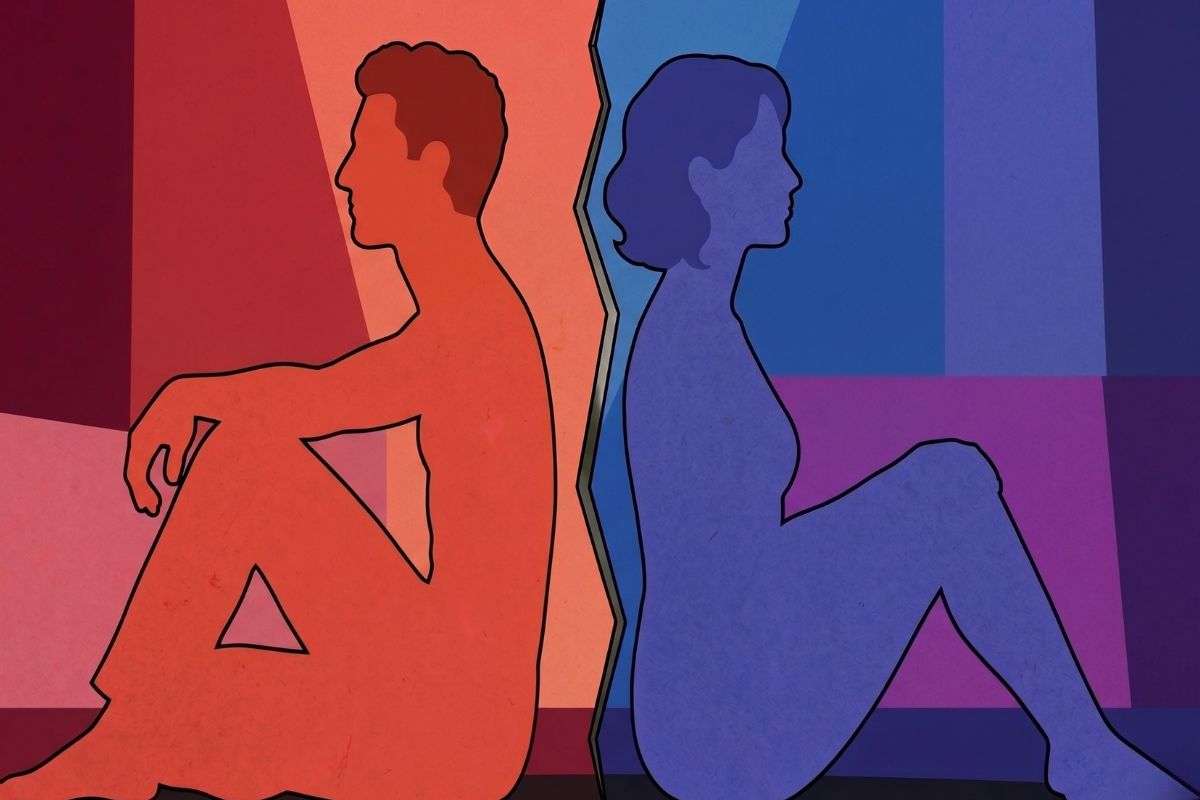
His gender has had an undeniable upper hand for all of existence and some men have abused that power—and continue to abuse it. Women are understandably afraid of abuse. Men are afraid of being seen as abusive, and at the same time of being seen as weak. So we’re both running scared. And that’s what makes a trauma bond a trauma bond.
I recently read bell hooks’ All About Love and was struck by this line: “There is no love without justice.” And it got me thinking.
Maybe the last battle of the sexual revolution will be fought not in the boardroom but in the bedroom.
Editor’s note: This article was edited and updated on June 26, 2026.



6 Responses
How I wish my partner was more vulnerable!!He started therapy recently and I see him struggling with letting go of the conundrum of “hard not soft” that so many men were taught
Hi Vanessa thanks for your thoughts. It’s a huge step that he’s showing up for therapy. And how amazing that you have the awareness to see him struggling and allow him his struggle.
This is beyond bizarre and I’ll try to forget I read it.
I couldn’t agree more!
How real is this!
He could be she.
Gender could be identity. Boardroom to bedroom, yeah, where power is tempered with love and security.
Wouldn’t it be wonderful to see, hear and know that in a sacred relationship!
Namaste.
Well you make a good point, as we all have masculine and feminine, or “go” and “flow” aspects inside us. When we cultivate that awareness we have the ability to choose which aspect we want to animate in a given moment. And that, well that is where power is tempered as you say, and that is where power and justice can coexist. Namaste.