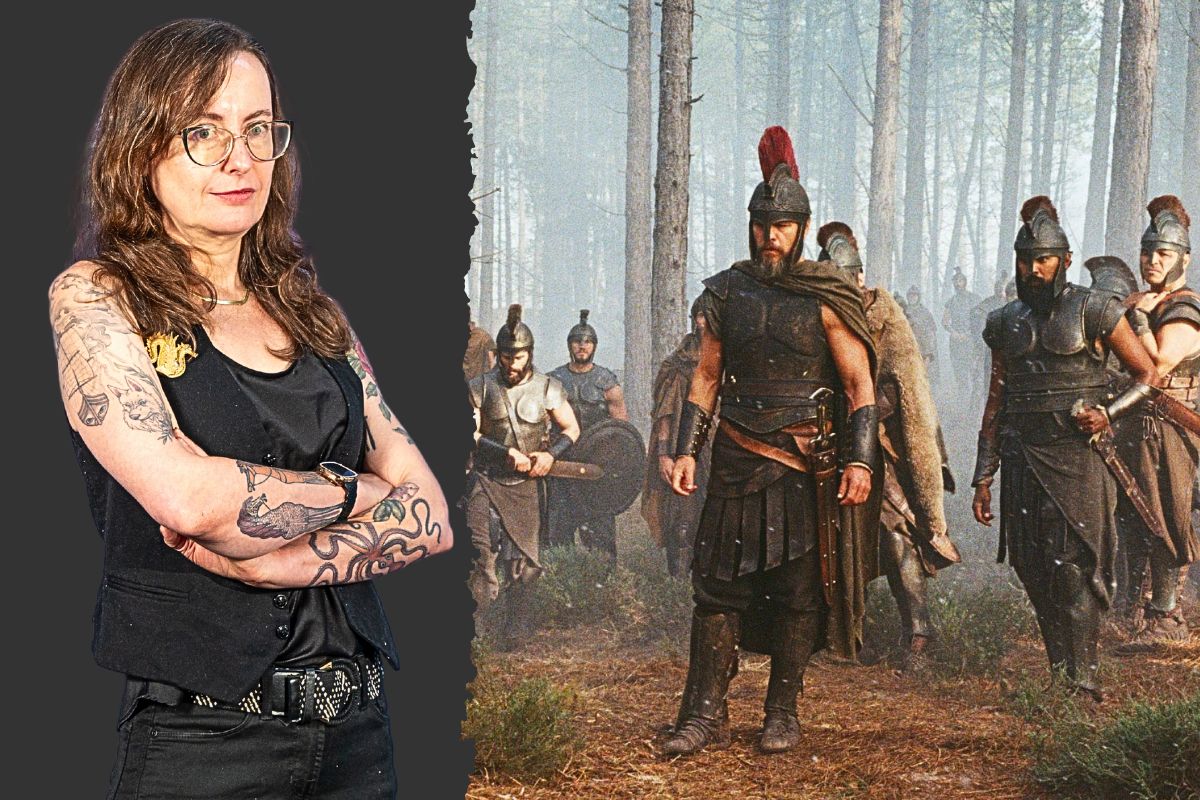
A woman translated it. A man filmed it. The culture war that followed says less about Homer than about who still gets to decide whose story counts.
Why would a University of Pennsylvania classics professor need a dedicated “misogynistic trolling” button on her website? In Emily Wilson’s case, it’s because she dared to translate Homer’s epic poem The Odyssey, becoming the first woman to do so in English and helping inspire Christopher Nolan’s new $250 million film.
Yes, you read that right. The written versions of the nearly 3,000-year-old Greek saga that English speakers have received and retold for hundreds of years were all rendered by men. That should be the headline. Instead, what everyone wants to talk about is whether Wilson’s gender impacted her retelling of The Odyssey, and perhaps colored Nolan’s three-hour IMAX extravaganza, accused of “wokeism.”
In fact, Wilson’s work, Nolan’s film—and the culture war that’s erupted around both—reveal how the ideas of the ancients are so tightly woven into our identity and society today that people still care very much how they’re worded and represented.
They also offer a case study of how contentious cultural representations of women’s bodies, power, and agency continue to be.
Apparently, 3,000 years isn’t enough to warrant change.
Welcome to Odysseygate
You remember Barbenheimer? Well, welcome to the summer of Odysseygate. Even before The Odyssey movie’s July 17 release, the internet was aquiver over perceived inaccuracies in wardrobe, story, characters, and casting. (A black Helen of Troy?! A trans actor and a rapper?!) The use of modern American English (“dad,” the F-word) and a lack of Greek actors also ruffled a few feathers.
Academics chuckled in return at the sudden obsession with an epic poem most haven’t read, not to mention mild confusion between fiction, mythology, and history. They questioned why the loudest critics—mostly white men—feel such entitlement over ancient myths and civilization.
But if you consider their traditional exclusivity over Western cultural heritage, it adds up that men might feel the most threatened by reinterpretations of inherited gender and racial identities or new conceptions of “greatness,” as Wilson has alluded to in interviews.
When you’re a supporting character on the hero’s journey, you have less to lose in a retelling.
The Words She Translated Differently
Wilson’s translation has earned renewed scrutiny—and a spot on the bestseller list—after Nolan cited it as one of his inspirations. But it’s been catching controversy since its 2017 publication. Why? For starters, she’s written in unusually accessible English and used Shakespearean iambic pentameter to naturally capture the rhythm of the original Greek poetry. She’s not the first translator to do this, but she’s apparently the first in the modern era, and her phrasing is straightforward and immersive. It’s been called “a radically contemporary voice” for Homer.
Wilson also reevaluated the derogatory portrayals of women characteristic of previous translations. While English readers are accustomed to slurs like “slut,” “whore,” and “nymph” for the saga’s female characters, Wilson determined that some of these interpretations weren’t strictly faithful to Homeric phrasing and carry derogatory connotations in English not intended in the original. “This ancient poem isn’t interested in scolding women for their sexuality, but in the establishment of honor in the elite household,” she told Vulture.
Elsewhere, she has criticized a tendency “to simplify the text’s ethical and narrative complexities” by depicting Odysseus as a modern-day hero while downplaying the significance and sympathy given to other characters’ perspectives. Since it’s all ancient Greek to me, I’m inclined to take the expert’s word on this. Should we be talking about what previous renditions had to do with the gender of their male translators? It feels radical to think not just about a new telling or perspective—already seen, for example, in works that focus on The Odyssey’s women, like Margaret Atwood’s The Penelopiad, Madeline Miller’s Circe, Claire North’s Ithaca, and Natalie Haynes’ A Thousand Ships—but about what we may have been missing in the original.
What Nolan Kept, and What He Cut
And then there’s the movie. The online hostility hasn’t hurt The Odyssey’s box office appeal; it may even have helped. The film rocketed to a global $263.7 million on opening weekend, a career best for the director. The screening I attended was packed, and nearby showings were sold out.
Reviews have been generally positive, with a few notable exceptions—including by Wilson herself, who called it “a combination of grandiosity and superficiality,” a “confused” vision with “underdeveloped” characters. “I would be ashamed to have written any part of this script,” she said.
Nolan’s Odysseus (Matt Damon) is a flawed war hero, a cunning leader who nonetheless makes mistakes, gets lost, and feels guilty for the damage his warriors have caused and the basic social rules they’ve disrupted. This is an Odysseus for a war-weary generation, though the film also revels in the violence of its impressive action sequences.
Nolan’s Women
In my opinion, concerns about a “feminist” retelling were overstated. As with his previous films, Nolan’s focus is on a “complicated” man (the much-discussed word in Wilson’s opening line). And, like most of his other works, it doesn’t pass the simple Bechdel Test (minimum standards for female characters). The majority of scenes feature Damon and his warriors. Women still aren’t the stars of this male-centered tale, but they’re not pure villains or victims either. “In this world, a man does what he chooses,” Anne Hathaway’s Penelope says in the film. “I do what I can.”
As Hathaway put it in an interview, Nolan removes some traditional blame from female characters. Odysseus and his men are responsible for their own missteps, and sexuality isn’t a driving force in this telling. Nolan’s Sirens only remind men of their own aspirations and shortcomings. His Circe (Samantha Morton) turns warriors into pigs, but she offers a reasonable excuse and quickly reverses the spell. Nolan’s Calypso (Charlize Theron) cares for Odysseus, but he numbs his own mind to avoid confronting the past.
Whose Experience Counts
According to Wilson, Homer was very specifically concerned with female agency and power—“anxious” about it, even. She’s pointed to multiple scenes in the original where female characters, not just goddesses, are seen as more powerful than Odysseus and therefore frightening. In Nolan’s version, though, the female characters mostly function to heal, protect, and guide the male protagonists. They wield power, but largely within human limits—even Zendaya’s Athena seems more reactive than proactive.
In the movie’s most outwardly feminist moment, Penelope angrily reminds her son that although he’s the intended heir, she’s been sitting on the throne for Odysseus’ 20-year absence. “My knowledge? My years of experience? That’s all nothing compared with the bristles on your chin,” she snaps. Every woman who’s been the one with the knowledge and the experience knows exactly what she means.
The Power of Storytelling
For Nolan, Homer’s female characters are “deceptively simple. Each era has really been able to interpret those characters according to the interests at the time and then the values at the time.” It’s a key point: All great works merit renditions, and “all translations are interpretations,” as Wilson put it, also reminding us that Homer’s epic is itself an adaptation of existing myths and “many generations of storytelling.” No two of the dozens of English translations of The Odyssey are exactly alike, just like no two staged versions of Shakespeare are the same.
Odysseygate is a misplaced controversy, but this summer’s cultural phenomenon reminds us that stories matter. Words matter. Representation matters. Wilson’s work especially stands on its own as a radical rethinking of a classically male-centered tale. She and Nolan offer variations grounded in the subtleties of the original, but the potential impact of their work extends far beyond the bookshelf or the movie screen.
After 3,000 years, The Odyssey belongs to all of us. Whose version of the tale we accept as the canon may ultimately come down to who is doing the reading or the watching.


7 Responses
I have read, and re-read many different interpretations of Homer’s Odyssey. They all have relevant points of merit. I like this interpretation. I like that someone made a good movie that will hopefully spark some interest in either history, mythology, or Greece in a young person. Women did in that time what women have always done. Survived in a male dominated world using whatever means necessary. When I was about seven or eight I discovered Greek mythology, classical Greek history and philosophy. I am still enamored of these subjects in my later years. I thought Penelope was one of the smartest women I had ever heard of. Still do. That scares the crap out of our fat, white, misogynists. You go girl.
Hi Robyn, I love that Penelope stayed with you all these years. That was one of the things that struck me so deeply in Emily Wilson’s translation: how much intelligence and agency were always there in these women, even within a world built by and for men. And I’m with you on the movie. If it sends even a few people back to Homer, Greek mythology, or history for the first time, that’s a pretty wonderful thing. Thanks so much for being here. —susan
Many characters referred to his cleverness, but I waited and waited for a moment where Damon’s Odysseus lived up to his own legend. I never saw it. I suppose there’s a conversation to be had around a culture dependent on the gods for motivation versus a man creating his own opportunities being considered “clever”… I left the theater asking my husband if we really needed a film about the Odyssey. I was disappointed in Nolan.
Hi Cheralee, That’s such an interesting point about his cleverness. We’re told repeatedly that Odysseus is clever, but being told and actually seeing it are two very different things. And your question about how much agency belongs to the man versus the gods may be the more interesting conversation. I suspect we’ll be arguing about this movie for a while, which may be one thing Nolan got right? Thanks for sharing. —susan
“My knowledge? My years of experience? That’s all nothing compared with the bristles on your chin,” the truth of this line feels like a gut punch
I must say that when the word “Dad” was used I laughed at the inaccuracy.
Hollywood needs to stop remaking movies and rewriting our fairytale s.
Period. I so wanted to see it until I found out it was just a woke movie about nothing just erasing greatness with stupidity..