
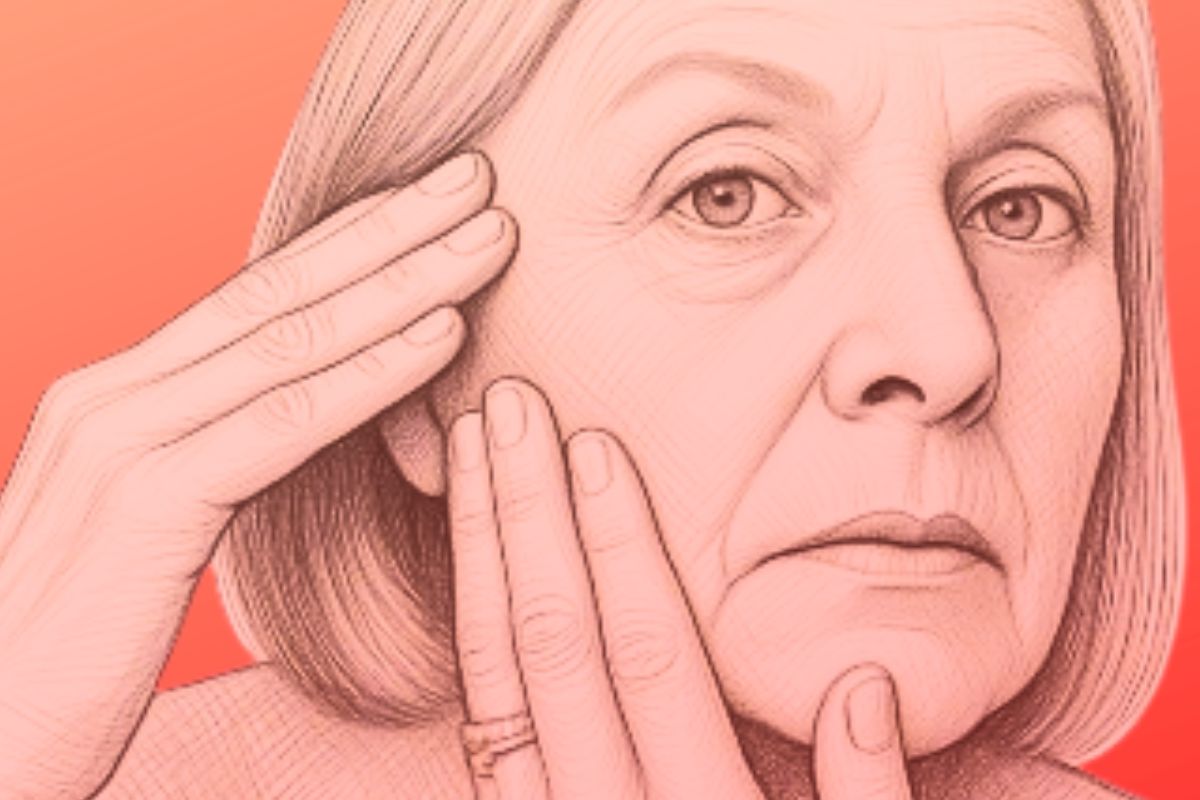
Stress, trauma, and grief don’t just live in the mind. Here’s how they can show up in the mirror.
Makeup free, expression neutral, lighting stark, the block of iPhone selfies that I’d taken as part of a skincare product trial laid bare all the drama of my life so far.
Anyone who’s stood in front of a mirror, gua sha tool in hand, knows the ritual of trying to undo the activations etched into her face. My own routine hones in on the “11s” between my eyebrows, pushes against the marionette lines around my mouth, and frets along the jawline.
Smile lines and crow’s feet get hyped for a life well lived and emotions well expressed. But the angst and worry that our faces contort into while sleeping knit themselves into grooves between our features, long after our brains bounce back and our limbs stretch out in the morning. My own anxieties show up like a thumbprint, making my face even more distinct from others than in my youth. A perpetual glare imprints into creases at the browbone. Frowning manifests in twin divots dimpling just below the corners of the mouth. Lately, I wake to feel the center of my face crimping into a pinch, as if to corral the ugly racing thoughts of the 3 a.m. hour. In harsh daylight, I see the little lines around my mouth respond accordingly.
After five decades or more of lived experience, the daily tendency to smirk, squint, wince, grimace, or cackle becomes a default representation of personality, with remnants that show up as permanent fixtures. Less cheerful are the places where trauma, mental illness, and their attendant monsters lurk. Every day, women posting #cortisolface videos on TikTok and asking for remedies on Reddit document the visible marks of grief, toxic relationships, chronic stress, and what their faces look like on the other side.
What Your Nervous System Does to Your Skin
The link between stress and skin aging is well established. In a study of 60 dermatologists and 60 psychologists published in the Journal of the American Academy of Dermatology (JAAD), 69.2% agreed that psychological stress has a significant impact on skin aging, and attributed those effects to the clinical pathways of stress hormones, inflammation, and overactive immune systems.
In an eight-year study, that same report also found that an unresolved acute inflammatory response can accelerate skin aging. The residue of capital-T trauma is familiar to anyone who’s witnessed or endured periods of grief, abuse, or devastating loss: sallow complexion, dark under-eye circles, sunken hollows. We gauge the heaviness of what ails others through other outward measures like posture, grooming, and weight changes. But the trauma in the face is the most haunting.
From a clinical perspective, the skin’s reaction to stress comes from constant communication with the nervous system, said Dr. Keira Barr, MD, a dual board-certified and trauma-informed dermatologist and psychodermatologist. She added that when our sympathetic nervous system is activated with a fight-or-flight response, our bodies scan the environment for danger. Our brow may furrow and our jaw may clench as our eyes focus on locating a threat. That stance contributes to tensed neck muscles and shrugging shoulders, resulting in a global tension that the musculature of the face holds onto in its hypervigilant state. Factor in the cortisol release that accompanies chronic activation of the stress response, and you’re left with a breakdown in collagen.
“When we’re constantly on high alert, the muscles stay in a state of tension themselves,” Barr said. “Persistent tension can contribute to deepening of the lines or wrinkles.”
The JAAD longitudinal research tracked this progression directly—each subject’s unique pattern of persistent facial wrinkling without expression at year eight was predicted by the pattern of expression lines observed with a smiling expression at baseline. The formal science validated the casual conclusion we’ve all witnessed: Repeated skin flexure during facial expression causes persistent wrinkles.
“Our skin tells our story,” Barr said, adding that small actions can create a cellular and physiological shift, and how the nervous system performs when we’re experiencing traumatic stress affects the aging process. But, she added, our lived experience can accelerate or slow down some of those markers.
In Barr’s practice at the Center for Mind-Skin Medicine, supporting the nervous system, emotional patterns, and the body’s cues of safety and threat are essential to her skin-healing approach. The science of interoception—the brain’s sensing and interpretation of internal bodily signals—helps to shape emotion, perception, and the meaning we make of our experiences. She works with clients on using breath, movement, and body-based language, which can help to build a felt sense of safety and connection.
“What’s showing up on the surface isn’t a metric of your worthiness,” Barr said. “It’s an invitation to get really curious about what’s been going on in your life and how I may be able to support it.”
Barr said one of the simplest and most effective actions is using the sense of touch. She will encourage a woman in a state of inflammatory signaling to literally touch herself—face, heart center, or arm—to let the warmth and resonance of her own hands soothe the nervous system.
The Grief that Keeps on Giving
Living through trauma delivers another blow. Beyond the emotional toll, the face in the mirror can become unrecognizable, triggering guilt for even caring about appearances at a time like this.
Somatic trauma therapist Chloë Bean, LMFT, sees women in various stages of grief who worry that they don’t look “put together.” Yet holding back tears for fear of puffy eyes and a swollen face means the body retains unprocessed trauma for years.
For women experiencing inflammation in their faces from chronic stress, Bean advises them to notice how their faces and jaws hold tension throughout the day. Her suggestion is to soften the facial muscles. Drop your shoulders down. Relax your tongue. Close your eyes.
“Part of the work is allowing the body to fold forward,” Bean recommends. “Let gravity relax, and then there’s that full release.”
When thoughts spiral and the mind works overtime, that release is easier said than done, but the short- and long-term effects are worth it. As in the JAAD study, Bean has seen how stress ages the body by pushing it into survival mode and delaying cell regeneration.
“There’s so much pressure on the face,” Bean added. “It can feel like a mask.”
Today, a handful of larger-than-life ladies have opted not to freeze their faces into a smooth, youthful stupor. Actresses like Charlize Theron, Andie MacDowell, and Justine Bateman have faces that work for what their professions demand: expressing the range of human emotions and the storytelling that helps us to make sense of the world and our place in it.
The lines etched into my own face are as familiar to me as the persistent memories and thoughts running grooves into my brain. Connecting the dots between my own emotional battles, the facial muscles I’m chronically activating and the resulting dynamic and static wrinkles looks like vanity. But it also looks like I’ve cared. Like I’ve worried, deliberated, strategized, second-guessed, empathized, and rationalized.
It looks like this face has handled some stuff.
**************
MEDICAL ADVICE DISCLAIMER
DISCLAIMER: This website does not provide medical advice. For health or wellness-related content, SFD Media LLC emphasizes that information about medicines, treatments, and therapeutic goods (including text, graphics, and images) is provided for general information only. No material on this site is intended to substitute for professional medical advice, diagnosis, or treatment. Users are advised to independently evaluate and verify the accuracy, reliability, and suitability of the information before relying on it. You should not rely on the content as a substitute for professional medical advice. Consult with a physician or other health care professional for any health concerns or questions you may have. SFD Media LLC is not responsible for any action taken based on the information provided on this website. The use of any information provided on this website is solely at your own risk.



5 Responses
It is like you were sitting beside me as I gaze into my mirror wondering who that old exhausted woman is staring back at me. Now do any of the potions help reduce, renew, and repair? Trying to remember to relax those muscles.
Oh, I know that woman in the mirror. Some days I look at her and wonder when exactly she showed up. I do think some of the potions help, but I’m becoming more convinced that what we carry around in our heads has a way of showing up on our faces too. And yes, chin out, drop the shoulders, relax the forehead. I’m reminding myself as I type this. Thanks for sharing —susan
My grandmother who lived to be 94 said of her wrinkles, “I earned every one of them.”
This one speaks directly to my 64 year old face. While I have not lived severe trauma or abuse, I have lived. No one goes unscathed with this many trips around the sun. Throughout the day I can feel my face tightening/grimacing, especially while driving lol. I shake it loose (literally), let it down and keep on keeping on.
Hi Margo, You got it. “I have lived.” That really says it, doesn’t it? None of us gets this far without carrying some of it on our faces. And now I’m going to catch myself grimacing in the car and think of you shaking it loose. Keep on keeping on. As always, thanks for being here. —susan