
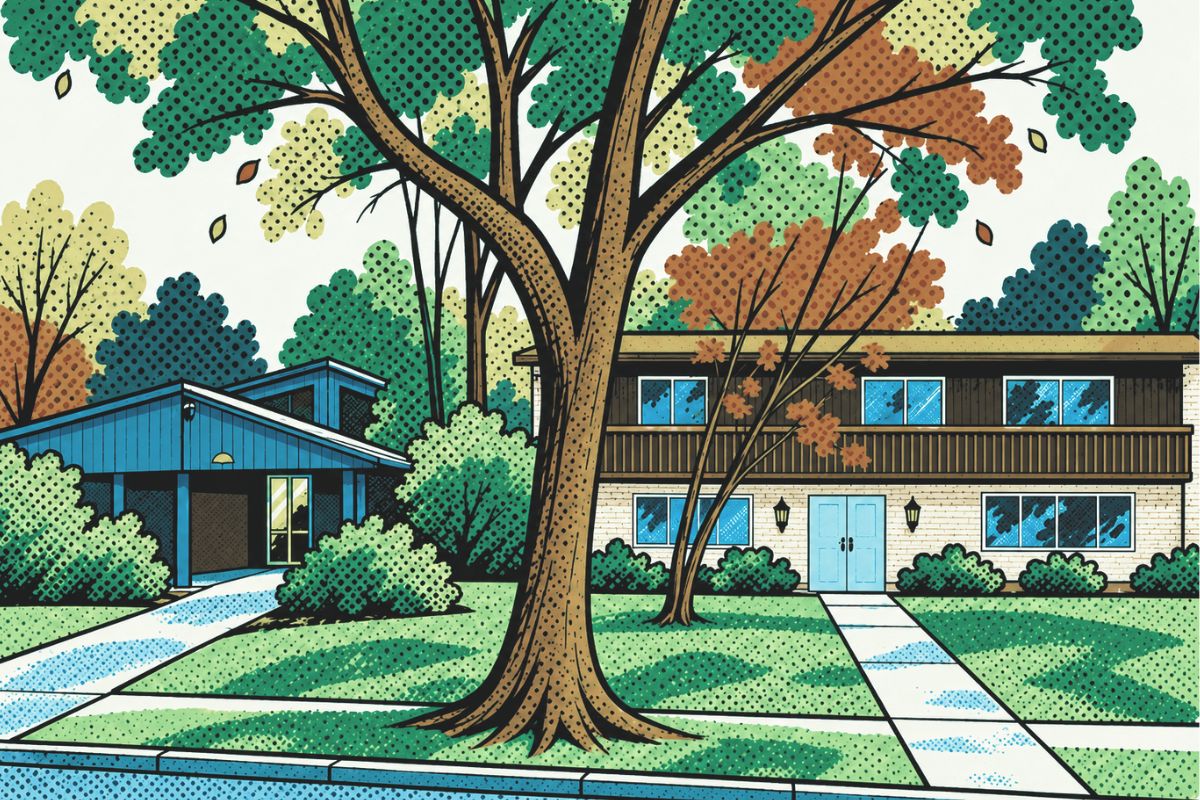
She kept her family home for 36 years. It took a blackout—and the neighbor next door—to help her finally come home.
When my laptop informed me I had no Wi-Fi, I checked my phone: dead despite being plugged in all night. Across the room, the refrigerator’s steady hum evaporated into silence. Downstairs, I flipped the breakers off and on. Nothing.
A sudden, surreal dread hit me. After 36 years of devotion, was this house about to betray me just as I was finally moving back in? I grabbed my dead electronics and headed for the car. That was when my crisis collided with my next-door neighbor, Karen.
“Is your power out, too?” I asked, trying to contain my anxiety.
“Yeah,” she said, her blue and purple hair catching the morning light. “The electric company is working on a transformer. It’ll be back on this afternoon.” I would learn later she hasn’t seen her natural hair color since 2004. Then she added, “It completely ruined my kiln run.”
“You’re a potter?” I asked.
“No,” she smiled. “A glass artist.”
That single exchange shifted a landscape I thought I knew. For decades, our homes had existed in parallel isolation. Her parents had bought the house next door in 1987—the same dark year I was burying both of mine. Karen was six then. A child moved in 40 feet from where I grew up, and I never knew it. Consumed with grief, estate decisions, and the slow liquidation of my parents’ belongings, I never registered that an entire family’s life had started next door.
Seventeen years before that grief hit, my family had celebrated every stage of building our custom, split-foyer home. On weekends, we’d drive an hour from Washington, D.C., in my parents’ white Chevy Bel Air to witness its progress, watching it rise from groundbreaking to a furnished home in 18 months. With five bedrooms, three baths, and a wrap-around deck, the house became the pride and anchor of my youth.
When my parents died, my two younger brothers wanted their cash inheritance, but I couldn’t bear to sell. Living in a New York City studio rental with a career that was taking off, I mortgaged the house to buy out my brothers, figuring I’d sell once my sentimental attachment waned. It never did. Since 1990, I carefully vetted tenants and managed the property from afar, compressing my relationship with the house into frantic weekends between renters. I lived in an endless rush of updating kitchen counters and bathrooms and repairing the roof before the next family arrived. It was exhausting, but my deep attachment to my family home kept me going.
When my longtime tenants bought a home of their own last year, I knew this was my moment to test what returning, a month at a time, might feel like. Those slow, uninterrupted weeks immersed me in the community’s everyday dramas, like the power outage.
A few days after the blackout, I visited Karen’s studio. The power failure had killed her kiln mid-melt, she told me, freezing her chosen palette of green, vanilla, and black glass inside its pot. Under normal circumstances, she would have pulled the molten glass into long sticks, cutting them into the colorful discs called murrine that form the signature foundation for her exquisite fused glass artwork.
Karen had purchased the house from her two older brothers after her mother passed away in 2013. “Neither of them had an interest in owning it,” she recalled. “I couldn’t let it pass from the family.” Words I might have used myself 36 years ago if I’d had the language for it then. She retrofitted a workspace between the garage and the main house, where a half-dozen kilns and heavy-duty machinery fill a space softened by racks of glass sheets. Samples of her finished pieces—a swirling mix of bright organic cellular patterns and rigid geometric forms—poke out between works in progress.
Standing in her workshop, I thought about how I had carved out a career living in a tiny West Village studio, a space that required frequent exoduses from New York to offset the city’s frantic pace. Meanwhile, Karen had evolved from a software developer with a passion for parasailing into a professional fused glass artist whose artwork is collected nationwide.
For Karen, her inherited home was the grounding center of both her life and her art. For me, my home had been about providing a sanctuary for others while I chased the world outside.
Yet, looking closer at those finished pieces, our world didn’t feel so far apart. Karen’s artwork catapulted my memory back to a 1992 trip to Venice, where I splurged on an antique millefiori Venetian trade bead necklace in an upscale boutique. My most expensive jewelry purchase at the time, it remains my most treasured after all these years. I had never understood how those dense, ceramic-like mosaic beads were made until I stood in Karen’s studio, watching the exact same centuries-old glass-making tradition come to life.
Now, back inside my own walls, I look at the space around me with the same sense of newfound appreciation. At more than 2,600 square feet, my house is way too large for a single person, or so a nagging voice inside my head sometimes insists. Yet nothing thrills me more now than roaming from one empty room to the next, gazing out at the thick woods my parents planted 50 years ago. One day, I spotted a deer peering into my sliding glass door, as if asking, “Is anyone home?” Karen told me about a family of foxes that lives nearby, and most nights I hear a toad serenading the entire street.
I asked one of my brothers if he’d like to move in with me. “No,” he said, before I’d even finished the sentence. A friend who dropped by quipped, “You could devote an entire room to each of your hobbies.”
I just might. I could lay down Marley flooring in one room for a private dance studio, set up a quiet writing library in another, and finally have the space to bring in a baby grand piano to practice.
Standing at night in a house built for a family I no longer have, I think about the 6-year-old who moved in next door the same year I was learning to bury my parents. It took 36 years, a canceled kiln run, and a dead phone for me to finally get to know her. As I look out into the quiet woods, I realize I no longer need to hold the house as a sanctuary for strangers. It can finally be a sanctuary for me.