
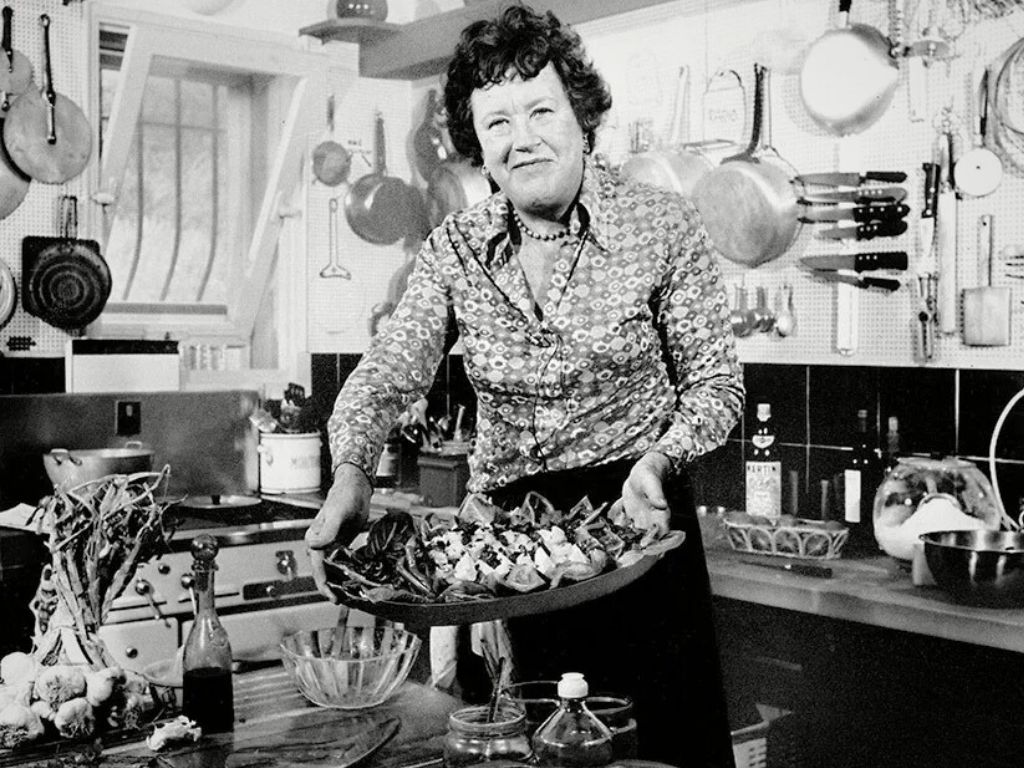
Julia Child didn’t teach us to cook. She taught us that hunger isn’t a character flaw, pleasure isn’t a luxury, and shrinking yourself was never on the menu.
Julia Child was the original disruptor before tech bros invented the word and then immediately ruined it. During a time when women were expected to perform modesty in every direction, especially with their appetite, she showed up like a culinary Godzilla and said, “Actually … I’ll be using all the butter.”
She wielded a whisk like she was swatting away societal expectations, modeling a version of womanhood that didn’t disappear at the table but commanded it.
Today women are still surrounded by wellness trends with the lifespan and taste of houseplants. The entire industry is built on convincing women to eat like a woodland creature preparing for hibernation and feel morally superior about it.
Child would have no part of that.
She’d be a menace.
She’d be a miracle.
She’d be the only influencer worth listening to.
When Butter Declares War on the $27 Smoothie
Imagine Child surrounded by today’s wellness culture. The spectacle would be glorious and possibly illegal.
At Goop HQ she’d last approximately nine minutes. Someone would hand her a jade egg or an elixir of moon-cleansed chlorophyll, and she’d laugh so explosively every crystal would crack.
“Activated charcoal?” she’d boom. “For what purpose, dear? Are you a grill?”
She’d be swiftly escorted out for disrupting the sacred silence required to discuss one’s pelvic bowl alignment.
Then she’d march into Erewhon, not in anger but as someone who once field-dressed a duck on camera. She’d request the manager to inquire—politely, earnestly—why the $27 smoothie contained no butter, sugar, or trace evidence of pleasure. “What is the point of a beverage,” she’d trill, “that only tastes like a tax write-off?”
Influencers would gather at a safe distance as she livestreamed a three-course lunch: Provençal onion tart, coq au vin, and a chocolate mousse so decadent it came with its own adult content warning. Halfway through she’d drop a chicken on the floor. And whereas modern creators would call FEMA, Child would rinse it, shrug, and continue cooking without missing a beat.
The livestream chat would combust:
“Icon.”
“I’m calling the USDA.”
“OMG is she drinking during lunch?!”
“Yes, darling, I’ve had two martinis,” she’d reply, “and I’ll have another if the algorithm keeps whining.”
She’d go viral simply by admitting she serves Goldfish crackers at Thanksgiving and refusing to treat coconut water as a personality. And somewhere between the martinis and the mousse, she’d accidentally demonstrate her greatest trick: making reinvention look easy.
Mastering the Art of the Midlife Plot Twist
Child is the patron saint of “starting whenever the hell you want.” She married Paul—a sturdy 5’10” to her regal 6’2”—at 34, which in the 1940s was basically declaring yourself a bohemian spinster. At 37, she enrolled at Le Cordon Bleu, a school so intense it can make a perfectly competent adult question whether they’ve ever correctly identified garlic.
She spent nine years perfecting Mastering the Art of French Cooking, publishing it at 49. By 51, she launched The French Chef, effectively inventing the modern cooking show. While her peers were being nudged toward gentle hobbies, Child was wielding copper cookware like a victorious Amazon.
She didn’t worry about being behind.
She showed up when she was good and ready.
And she changed everything.
A Recipe for Taking Up Space (and Seconds)
Long before social media tried to sell empowerment through $92 serums, Child practiced it with an unembarrassed appetite. She rejected the era’s suggestion that lunch should resemble anemic lawn clippings and be eaten with the furtive shame of someone who “went rogue” and ate bread.
Watching her cook was watching someone fully comfortable in her own body: laughing, tasting, reaching, stirring, living. There were no demure pinches of salt, delivered like she was diffusing a bomb. No plating meals in tiny, tragic portions designed to fit inside a Barbie Dreamhouse refrigerator. No pretending that hair, food, or joy must be aesthetically filtered.
In a world that wanted women to shrink, she demonstrated the power of taking up space on the plate, in the kitchen, in your own damn life.
A World That Wants Women Hungry
Child didn’t simply cook. She flambéd the entire cultural script.
She wasn’t political. She wasn’t performative. She didn’t negotiate. She rejected the belief system that food must be earned, hunger is suspicious, and indulgence must be punished with Pilates done with the grim determination of someone filing taxes.
Towering, exuberant, utterly unbothered—she modeled a womanhood built on humor, confidence, and a fully lived life. She simply, unapologetically ate. And in doing so, she exposed how much of society depends on women keeping themselves small—by ounces, by inches, by appetite.
One joyful woman with a hot pan and no shame, and suddenly the patriarchy looked as brittle as a rice cake pretending to be dessert.
It wasn’t a crisis.
It was a long-overdue correction.
Her Legacy: More Pleasure, Less Punishment
Child’s influence endures because she taught a whole generation of women—our generation, the one that has lived through SnackWell’s, Atkins, SlimFast, and whatever “Ozempic chic” is becoming—to ask why the world is so desperate to keep us hungry.
(Hint: It’s not for our health.)
She didn’t encourage reckless eating. She encouraged joyful, intentional, flavorful living. Choices that fill you up instead of making you feel like a woman who’s supposed to be grateful for leftover crumbs thrown our way and lawn clippings posing as lunch.
Because hunger isn’t a flaw.
Pleasure isn’t a luxury—it’s a right.
And women deserve satisfaction, not surveillance.
So the next time wellness culture tries to edit your menu, your body, or your seat at the table, remember Child’s booming reassurance: “People who love to eat are always the best people.”
She taught us to eat like we matter.
To live like we matter.
And to remind the world—firmly, loudly, deliciously—that we matter.
Because we do.



29 Responses
I remember watching her when I was MUCH younger. I will never forget her booming voice. She was so full of life and joy ! Give me ALL the bread and butter !!!
Well put Abby, excellent piece of writing. Bring on the bread and the martini!
So great and humbling to see you here, Sheila! Thanks so much for reading. We miss you guys 🙂
Hooray! It’s nice to hear someone push back against the thinness war of low cal, low fat and factually low pleasure. Child was an icon and we’re lucky to have had her in our lives. Thank you for reminding us what a wonderful women’s warrior she is. Now let’s all watch the old SNL skits of her and start our own Beef Bourguignon!
She’s amazing because she spans generations. Those of us who grew up with her might not have realized how iconic she truly was. But today—with the very culture you mention in your comment—it makes you appreciate her even more. The younger generation of women can look back and see that no, you don’t have to be waif thin, perfectly coiffed, or afraid to take up space. Two cheers to Julia!
Wonderful Article!! Thank you!
Julia is my (SHE)RO). She lives on in many of us!!!
While visiting my grandparents as a child in the 1960’s, I discovered Julia Child on a tiny TV screen in my grandmother’s attic hide-a-way. It was grainy and the screen rolled, but I could not quit watching her towering presence on the screen. She was so different than the perfect women normally presented on the small screen! And the foods she cooked! Ohh! Nothing like the cheap casseroles my mother cooked.
As a mature woman, I now own a considerable collection of cookbooks, including all of Julia’s cookbooks, well-worn from exploring delicious recipes. I still watch her on streaming TV in the afternoons when I need inspiration for dinner. I was vindicated for always using butter when it was finally admitted that margarine is nutritionally the same as butter.
Thank you Julia for showing us how to live life with gusto and a belly laugh!
What a wonderful memory—and comment. Thanks for being a part of our PROVOKED community.
This was just fabulous…. entertaining and a joy to read!! It makes me want to go back and watch some of her shows… great writing and capturing how she impacted us as women! NOW GO FORTH AND EAT!
Thank you! That means a lot, and I’m humbled to even write about her. I’m so glad it’s having an impact on so many other strong women, and reminding us all to, “Go forth and eat!”
I love this article so much! As the parent of a kiddo with an eating disorder .. the culture we live in today is terrible!! I love everything about this article – enjoying food, keep the butter, TAKE UP SPACE. Julia Child had it right and thank you for bringing this to light today. EDs in women in midlife are significantly on the rise too.
I’m so glad this resonated with you. And while eating disorders are complex issues, I do hope that your daughter can find similar role models to counter the current culture that asks so much of women—even at such a young age, although as you pointed out, they’re equal-opportunity diseases. We all need more Julia in our lives. 🙂
love this. and yes, #*(&%^& grocery stores and their endless moving things.
I’m loving all of these articles–so inspirational even at my age! Some came before me, some after…but they all have such valuable lessons to offer. I’m recommending Provoked to my daughter!
Exactly! It’s so encouraging to know that not only do we have strong women to look to from the past, but also inspiration from those coming after us. That’s our goal with PROVOKED—for women, of every age, to know there’s no limit to what they can do.
Thanks for another delightful read, Abby. When I think of Julia Child, the word “joy” always comes to me. And your piece reminds me of the last sentence in Mary Oliver’s poem “Don’t Hesitate:”Joy is not made to be a crumb.
I always love your comments Linda, and that Oliver line is perfect.
Thank you for calling out the myth of “mixed greens”. They’re nothing more than weeds someone yanked out of the yard and threw in a bowl.
Of course, the entire article was stellar, and reminded us of what can be done if we live our own lives.
Thrown. Sorry. Please edit if possible
Someone save me from myself!
You’re perfect for this article!
There’s nothing wrong with a good salad—I’m a fan myself—but it shouldn’t be your personality or the only thing on the plate. Live your life, honor your appetite (for everything), and never forget to laugh—as I did reading your sequence of comments here. 🙂
Loved the article! I remember watching her years ago. Now I’m going to go find her on Youtube!
My spirit animal! Loved this so much.
“Yes, darling, I’ve had two martinis” love your writing!
It’s so great to see you here, of all places. 🙂 Thanks for the support as always.
OMG thank you so much for this! I’ve been channeling Saint Julia for the last 30 years! It’s so nice to see someone put the “why” into words. And the photo is priceless!
I raise my virtual martini glass to you!