In a world engineered for distraction, living with intention isn’t a lifestyle choice. It’s resistance.
Is your Instagram feed all Bridgerton, all the time?
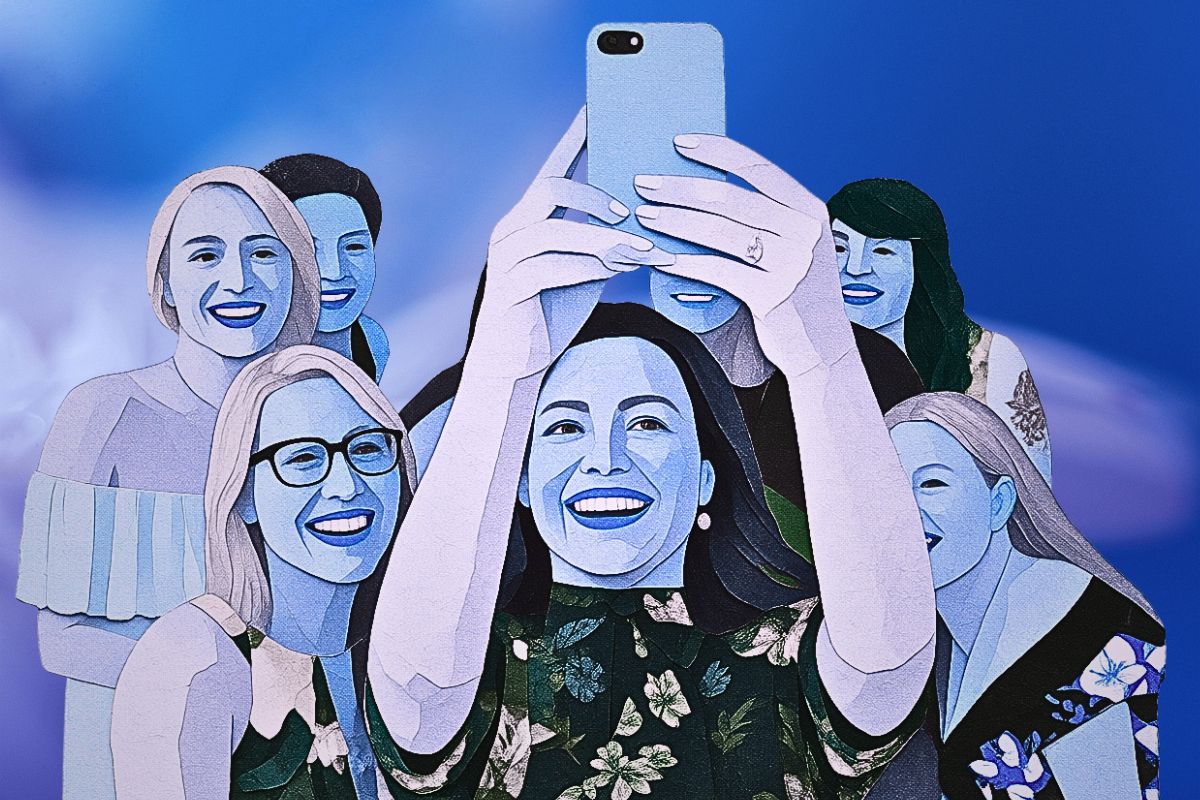
Well, of course it is. The algorithms have made it so. Social media companies profit off their “free” platforms by making us the product. Our attention is their currency.
The more we engage with their content—the longer we scroll, the faster we click, the more rabbit holes we dive down—the more they earn. Our tech-necks are proof of a job well done. Our inability to focus is a feather in their caps.
When the world is designed to keep us scrolling, the truly radical act is to stop and think for ourselves.
In a culture driven by speed, social sameness, and algorithmic provocation, choosing to live artfully, with intention and discernment, isn’t indulgence. It’s resistance. It’s the new turn on, tune in, drop out.
Women raised pre-internet have an advantage here—we remember what it is to think for ourselves. But in an age of digital slop, what does it mean to author your life instead of passively consuming it?
Our Brains, Ourselves
“Brainrot” is real when we’re constantly connected, bombarded with information and irresistibly inspired by likes and follows. To take back our brains, do we have to go offline entirely?
Not necessarily. If the culture is engineered for distraction, then self-cultivation must start with self-control. Choosing what to consume, when and how, isn’t opting out. It’s leaning in—to yourself. The online world allows for far more personalization than the mass media monoculture of yore, you just have to approach it with intention.
When you bypass “recommended” content, block over-sharers, replace doom-scrolling with the positive-seeking “bloomscrolling,” or commit to consuming long-form content in full, no interruptions, you curate your own online environment. You take back your attention span.
Artful living interrupts the cycle. It gently fills in the rabbit holes.
Don’t Take the Bait
And the digital sphere could use more gentleness. When Oxford chose “rage bait” as their word of the year last year, they knew what they were doing. Want to get people to click more? Lure them in with deliberately outrageous, frustrating, or offensive content.
The algorithms dangle the bait by amplifying misinformation and conspiracy theories, Oxford explained, in a practice called “rage farming.” Take one guess who the sheep are on that farm.
The paradox is that we’re outraged, but we don’t quite know why. We disagree because our tribes and echo chambers say so. Hang on, let me Google it. Claude will know the answer. “Never have so many people had so much access to so much knowledge and yet have been so resistant to learning anything,” Tom Nichols wrote in The Death of Expertise.
The antidote? Study. Learn. Gather knowledge. Develop skills. Read fiction. Engage in meandering conversations. Be open to other people’s opinions. And admit when you’re wrong or don’t know the answer. Intelligent conversation is artful living. Believing in facts and trusting the experts? Downright countercultural.
Write Like You Mean It
The other day I came across a Reddit thread that started: “Serious question. Why do people over the age of 40 use so many periods when writing things online?” Here’s my question: When did good grammar, spelling, and punctuation become so triggering?
My index finger still twitches at the memory of early-era texting, back when you had to repeatedly punch each number on the flip phone to get to the right letter. No nostalgia here—I’d much rather text on my sleek iPhone—but artful living means caring about form, not just format.
The medium doesn’t have to be the entire message. Living artfully is sending a friend a thoughtfully crafted email, or maybe even a handwritten note. It’s keeping a journal or travelogue for nobody’s eyes but your own. It’s leaving that great Gen Z burden, a voicemail, for a friend you’ve been thinking about.
And, yes, it’s showing you cared enough to proofread, even in a text.
Resist the Performance
On Spain’s Mallorca island, there’s a gorgeous little cove known as Caló des Moro. After influencers started posting pictures from its pristine Mediterranean perch, the cove was inundated with thousands of visitors a day. There they stood, selfie sticks poised, waiting for their turn to catch their “individual” shot. Local authorities had to intervene.
It’s time for a self-intervention. The attention economy thrives on our narcissism. Deep down, we know it’s true—even if we don’t want to admit it. The feed rewards performance and self-display. It injects us with emotional spikes.
The opposite of narcissism is empathy. It’s generosity. Serving others is an exercise in gratitude and an investment in real-life community. It turns FOMO into JOMO (the joy of missing out) and replaces outrage with “helper’s high.” Living artfully means seeking deeper fulfillment beyond the superficial spikes. It means thinking about people other than yourself.
Cultivate Your Garden
When Voltaire famously wrote “We must cultivate our garden” in 1759, he wasn’t foretelling FarmVille. But he was onto something—the gratification that comes from nurturing our own corners of the world and those we share them with (what people now delightfully call “neighboring”).
Living artfully is cultivating self, and cultivation takes time. It requires stillness and discernment. It means doing things at your own pace, far from the madding crowd. It means taking what you enjoy from social media, then moving on.
We can be part of the world without posting every thought. We can shape our own tastes and edit our own rooms, wardrobes, and libraries. We can value our own experiences, realizations, memories, and relationships without the approval of others. No, it’s not easy in an age of connection, passivity, sameness, and self-absorption, at a time when we need tutorials on how to be bored. But it’s worth it.
Because right now, the most radical thing a woman can do is care.

5 Responses
I had never her of JOMO before this but I am stealing it!! I enjoyed this article immensely. Anyone who knows me well, knows how this hit for me, for all the right reasons. I am the weirdo who never had Facebook and does not doom scroll. I am fed up and I wish this could be shared everywhere. Thank you.
I so agree.
I am reclusive by nature anyway, and am also still recovering and rebuilding from a nervous system collapse I experienced last November so I already embody the JOMO lol but I also had never heard of it and I LOVE it!
I tried for a hot second to maintain a FB, Twitter, Instagram, etc. since it seemed to be the thing to do. It was a really hot second lol; it didn’t take me long to abandon all of the platforms.
I followed my feeling – everyone does use FB now and it’s the way to keep up but when I noticed that getting on it made me feel stressed, I just stopped getting on it except to check something specific and I make sure I don’t fall down the scrolling rabbit hole.
I abandoned everything else. Too many words to look at lol. Just looking at a Twitter screen makes me feel too busy. Same with Instagram and I don’t care if Jesus Christ himself is on them, I don’t like them and don’t use them.
I noticed that Youtube is where I was finding community that felt good and that actually filled my cup so I stick with that. I use their posting option to post helpful things that might be of use to someone other than myself. And that’s it.
I don’t feel the need to update people on my life, if they are that curious they can just ask me? Is how I feel? It can’t possibly be that fascinating.
I am busy enough just navigating daily life, I am not going to kill myself documenting it.
I’m pretty sure you are my soul mate lol
I love “missing out”!
This is much needed right now. So much anger and hate out there fueled, in part, by what social media feeds us. My mother is a passionate 83-year-old who cries easily for the troubles of the world. She’s insanely intelligent but her generation trusted the media so certainly everything she reads is true. I have shared PROVOKED with my strong mother, for so many reasons. This article will be a good one, too. Thank you.
Hi Kira, You’ve identified exactly why we built PROVOKED—for the women your mother’s generation trusted media to be, and for the daughters who are watching that trust get tested daily. Tell her we see her, and that we’re glad you’ve shared us with her. —Susan
I did. And we thank you for building this community.