
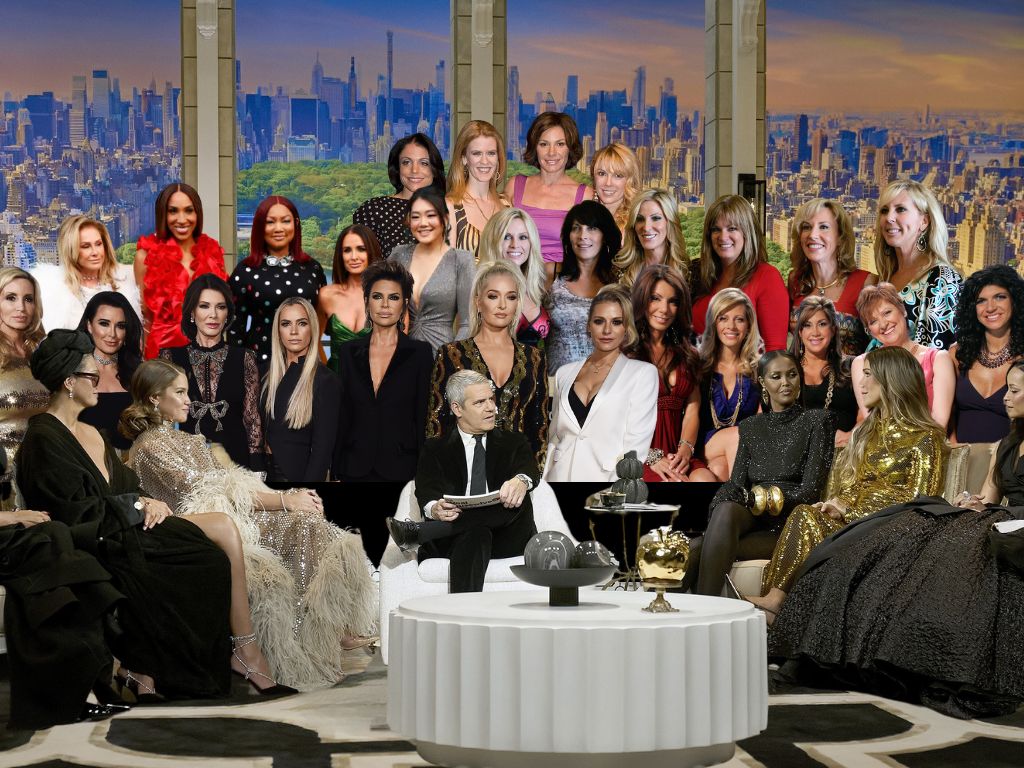
The Real Housewives franchise just turned 20. How has it impacted how women define themselves?
As a Gen Xer, “housewife” isn’t a word I ever wanted to define me. Thus, it’s deliciously ironic how, for the past almost 20 years, spending time with The Real Housewives of Salt Lake City, Potomac, New Jersey, Miami, New York, Beverly Hills, and now, the brand new reboot of Ladies of London, has been my favorite way to decompress. The world is full of women and gay men like me who revel in watching these psychosocial experiments and their complex, multidimensional portrayals of female friendships. Every so often, someone will tell me they find them to be trashy, messy, regressive, and exploitative, and, if you view the phenomenon granularly, that perception is understandable. But when you zoom out, these shows have made an indelible impact on culture, how women our age are perceived by it, and perhaps even how we perceive ourselves.
It makes all the sense in the world that latter-day boomers and early Gen X women (like us) were the first chosen to participate in this quasi-midlife-ish version of The Real World. We were born and bred to understand the assignment, having come of age during the heyday of soaps, after they transitioned from dish soap content vehicles for literal housewives to straight-up entertainment. We raced home from school to watch Luke and Laura’s General Hospital wedding and stayed up on school nights to see drinks thrown, and bitch slaps dealt by gorgeous women in a full beat, shoulder pads, and stilettos on Dallas and Dynasty. Like so many, I gathered with my friends to watch actress Marcia Cross become the twisted Kimberly Shaw on Melrose Place and, 10 years later, put my kid to bed early to catch her as the piously twisted Bree Van de Kamp on Desperate Housewives.
These Are the Soaps of Our Lives
The Real Housewives franchise is, essentially, a family of soaps, and, as soaps do, they’re centered around women and the interpersonal dramas around female friendships. Here’s the formula: Assemble a telegenic complex amalgam of anointed female archetypes. Then turn the cameras on them as they deal with real life, douse them with alcohol, throw them into social situations with prodding producers, and watch as they support or judge each other, shit-talk behind their backs, and then confront each other about these behaviors in person.
Isn’t that novel? In person! If you think about it, our generation was the last to know how to do that. In this era of low-lift connectivity where parasocial social media birthday wishes are supposed to keep us tethered instead of a phone call or text, Real Housewives preserves the age-old ritual of interpersonal confrontation as we did during the before-phone times—a lost art in a culture of unceremonious blocking and ghosting. This in-person bit, to me, is part of the appeal. Confrontation may be an eroding skill in our society, but here it’s part of the job description.
After a whole season of face-to-facing each other and their issues, Real Housewives reunions are every bit the staged confrontations that WWE cage matches are, where beefs are duked out subject to cheers and jeers in the arena of public opinion. But here’s the thing: These shows normalize female anger and acknowledge that female friendship breakups can hurt as much, if not more, than romantic breakups. Watching them reminds us how important it is to have constructive conversations with people instead of leaning on meme exchanges and letting issues between you fester. Watching these shows has allowed me to consider how I can better negotiate my boundaries—even if it’s without the benefit of an Angie K.-esque scroll of grievances.
Aspiration or Cautionary Tales?
Men tell women who they are all the time, and the Housewives franchise, in a way, is no different. “Long Live the Housewives,” Louis Staples’ recent, reverent Housewife commemoration piece for The Cut, shared his take on how the franchise has changed how our culture sees and embraces women approaching and in midlife. “I’m still fascinated by this Venn diagram of relatability and escapism that the franchise presents,” wrote Staples, adding the central question of these shows is: “It’s giving viewers a complex, ever-changing answer to the same central question: What is an aspirational life for a woman?”
As a woman, I find it fascinating that these shows were initially conceived by a man (TV producer Scott Dunlop), grown into a monolith by Andy Cohen, a gay man, and yet another gay man, Staples, is posing this question. That considered, shouldn’t the central question be: What’s an aspirational life for a woman, and according to whom?
Though these shows feature plenty of aspirational women over 50 like Jennifer Tilly, Kathy Hilton, Bozoma St. John, Jenna Lyons, and Rachel Zoe as they tackle what it means to be our age in full opulent splendor, I can tell you with vehement certainty that aspiration in terms of wealth has little to do with the appeal for me. When aspiration gets out of hand for these women, they’ve dealt with consequences like lawsuits, jail time, tax fraud, insurance fraud, and embezzlement. Yet, since the franchise’s inception, socioeconomic disparities between cast members have driven plenty of fodder for its frisson. Who can’t relate to a little socioeconomic disparity among friends?
Whether you watch them or not, the Real Housewives are etched into our cultural canon for all eternity. Taken as theater, they garner significant street cred: Acclaimed female actors over 50 like Elizabeth McGovern, Sarah Paulson, Julia Roberts, Meryl Streep—even Michelle Obama—are vocal about their love for the Housewives. Even straight men, like multi-Emmy award winner John Oliver, are obsessed; Oliver once enthusiastically told Stephen Colbert Salt Lake was “a rich text.” Indeed, just by living a produced life, the Housewives have given us some of the most quotable, memeable moments in our culture. Who could forget how Congressman Robert Garcia quoted Salt Lake’s Heather Gay by saying, “Receipts! Proof! Timeline! Screenshots!” during a hearing?
To put yourself out there like a Real Housewife takes a certain level of chutzpah, guts, and main character energy we could all benefit from co-opting. In a world designed to erase us, we need to absorb as much of that energy as we can get. A certain level of pageantry is part of the job: As Housewives grow wealthier and “looksmaxx,” we witness a reflection of how ageism is real, and depending on the geographic area and industry, so many of us have to face down the option of shaving a few years off our faces and resumes to stay employable.
Yet, even Housewives aren’t immune to aging out of their gig. Bravo launched a brand new Housewives franchise, this time in Rhode Island. Kelsey is barely 30 and has been in a non-monogamous partnership with a much older man who lives in another state for half of the year since she was 19 years old. That’s about half my age. Thankfully, she’s friends with Liz, the only cast member in her 50s. None of us would likely ever meet in the wild, but somewhere between Rhode Island and my cable box, we can meet in the middle.



6 Responses
I noticed that not one of the Black housewives were in the picture why is that?
Brynn Whitfield, Ubah Hassan, and Sai De Silva are all in the front row of the photo.
I have never watched these shows. I guess I am more a PBS type. I read the article to see what other women watch. I remember my mother watching All My Children while she ironed in our living room. Housewives sounds so divorced from my life…I can barely imagine.
Ugh. Stupidest lowest common denominator anti-women stuff ever. Want to really support women? Show real women. No surgery/million $ homes/designer clothes/shoes/handbags, etc. They aren’t housewives. They are overly perfected puppets.
Very well said
Love this! I saw a meme recently about a woman who said she regulates her nervous system by watching these shows. Same, girl, same. I also love how the “housewives” on RHOBH are mostly divorced women in their 50s with successful careers. Not so housewifey after all – and even more relatable as someone in the same boat. But that’s about where the relatability ends! As a veteran journalist and author, I am not too high brow to proclaim my addiction to these shows so it gave me comfort to see even the queen Michelle Obama likes them, as well. Such a fun article!