
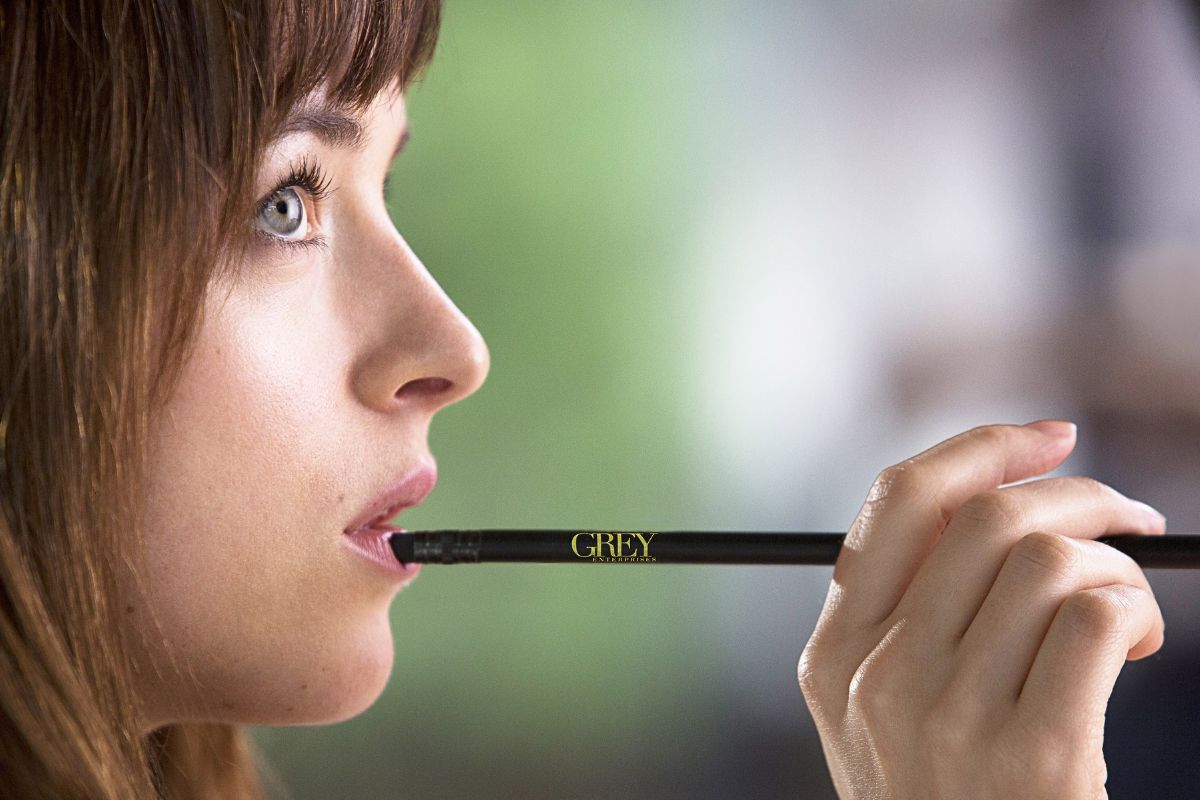
Years of eye-rolling. One therapy session. Why a badly written novel became permission for 150 million women.
Not very long ago, my therapy session unexpectedly took a left turn into Fifty Shades of Grey. I was describing a time 15 years ago, when the book came out, when I got stuck in a conversation with colleagues about Christian and Ana’s steamy adventures. My co-workers were flushed, their voices escalating as they described the sexual boost the book provided. I’m no prude, but I still bowed out as fast as politeness allowed.
“But why?” my therapist prodded.
“Because the writing is so bad,” I said promptly, my boilerplate, somewhat snooty response for the past decade and a half.
“It’s actually pretty good,” she told me. “It’s more about relationships. How they come to understand and complement each other. You should read it.” It was, she said, a counterpunch to the anti-sex programming our culture promotes.
Here was someone I trusted with the contents of my brain, telling me the book wasn’t just acceptable, but worthwhile. Was it possible I’d missed its appeal all along?
The Joys of (Reading) Sex
While I enjoy smut, erotica, whatever you want to call it as much as anyone, my tastes were shaped by the kind of books my feminist, Ms.-subscribing mother kept on the shelf. By contrast, I also learned things at my friend’s house, but those came via her dad’s secret stash of Playboys.
By contrast, my home was sex-positive—open and forthright to a fault—long before the term existed; back then, most people would’ve probably cast serious side-eye at such open access to sexual literature. I freely helped myself to Anaïs Nin, Erica Jong—whatever caught my eye. When, in the eighth grade, I first encountered the term “blowjob” while reading (It, by Stephen King), Mom gave me a clear, level explanation.
With that background, I was bewildered by the wildfire appeal of Fifty Shades and its brand of BDSM-lite. The book felt ubiquitous. Women weren’t reading this with a flashlight. They were carrying copies on the train and scheduling it for their book clubs. Rather than hiding their interest, they were proudly flaunting it. Like my colleagues, women not only read the book, they bonded over it.
This particular erotic title seemed mainstream. But why was everyone getting all hot and bothered over a book that started its life as Twilight fan fic? Why didn’t anyone care that the writing was so thin and clichéd, propelling it to sales of over 150 million copies—numbers only dreamed of by Nin and Jong? Beyond that, why were they acting like a sexy book was a revelation?
The (Missing) Joys of Sex
What I failed to understand was that for a lot of women, it was a revelation. In 2011, we were at a crossroads: careers, children, marriage, all demanding time and energy. The invisible labor was real, but not so much the orgasms. The millennials, then in their 20s, didn’t share our generational point of view. Perhaps they identified more closely with Ms. Steele, but they also had come of age in a more permissive and accepting culture than Gen X and older.
Our generation was taught that good girls didn’t seek out sex, dress provocatively (lest we “ask for it”), express desire, or insist on sexual pleasure. Despite the boomer legacy of second-wave feminism, we were still restricted by archaic cultural norms—all the more complicated because the “new” feminism urged women to expand and explore, but by the 1990s, much of our thinking was already shaped by those earlier messages.
The stretch marks of that growth are clear for our generation. We tend to regard both its biology and psychology as something to mask or avoid, like douching or shying away from ownership of our own wants and needs. Though I’m grateful to my mom for helping me avoid much of this, I’m certainly not altogether immune. I’ve refrained from saying what I really want a partner to do for me. I’ve avoided buying certain bras for fear of my nipples making their presence known. Our lives are filled with decisions and responsibilities; why is it surprising, then, that it’s so hot to relinquish that burden?
For many women who previously believed that nice girls don’t lust, this book was a seismic shift. Fifty Shades gave permission to explore, in a way they may not have realized they lacked. It depicted BDSM, normalizing a kink that speaks to many women’s desire to release control. The story captured all that in language that felt liberating and candid, employing strong, forthright wording instead of the euphemistic coyness of “quivering loins” and “heaving bosoms” that so often appears in romance novels and the like. Then there was the relationship itself, the one that, as my therapist pointed out, grows from an increasingly complex framework that shifts and evolves as each partner wields and concedes power.
The Joys of (Owning) Sex
The truth is that sexual awareness and confidence aren’t always easy. So I read the book, cover to cover. And while I may not be a full-on Fifty Shades convert, I’m also not as vocal a critic. Yes, the excessive use of “crap,” “wow,” and “jeez” raised my writer’s hackles, and the constant barrage of simultaneous orgasms raised my eye-rolling tendencies. But it’s still a frank examination of sexual politics, including the place for fantasy in romantic relationships. And it encouraged women to talk freely and openly about what we’d previously regarded as embarrassing or guilt-inducing.
For all its flaws, it clearly hit on something much deeper. The fact that it took a book this clumsy to give millions of women permission says less about the book and more about how much shame we were still carrying.


4 Responses
I appreciate your giving context for the phenomena. What you wrote makes excellent sense. Thank you!
In my case the poor writing was a huge reason to give up the series partway through book 2, but it was more the poor understanding of BDSM that put me off. I hadn’t yet discovered that I was asexual – zero to rare sexual attraction but with an active libido – and though I had not yet become active in ‘the kink scene’ I had done serious reading, as that was the one thing my sexuality seemed to hinge on. Since then I have made my self-discovery and also found my circle of safe kinksters, and we all agree the 50 Shades was really only a step above bodice rippers, and totally unrealistic, but if it brought someone into learning about serious kink play they would discover a whole new world. 😉
Agreed— you never know what might lead someone into new adventures, right?
For so many women of my age, boomers, being sexually neutral, pretty but not too provocative was the goal in order to be socially attractive BUT myself and my peers cheated and pursued more erotic encounters secretly, ashamedly. I never looked at the appeal of fifty shades of grey in a social context. – this was a very valid viewpoint – thank you for bringing it to light
Thank you, I’m glad this resonated!