After 50, being bad at something isn’t a problem. It’s the point.
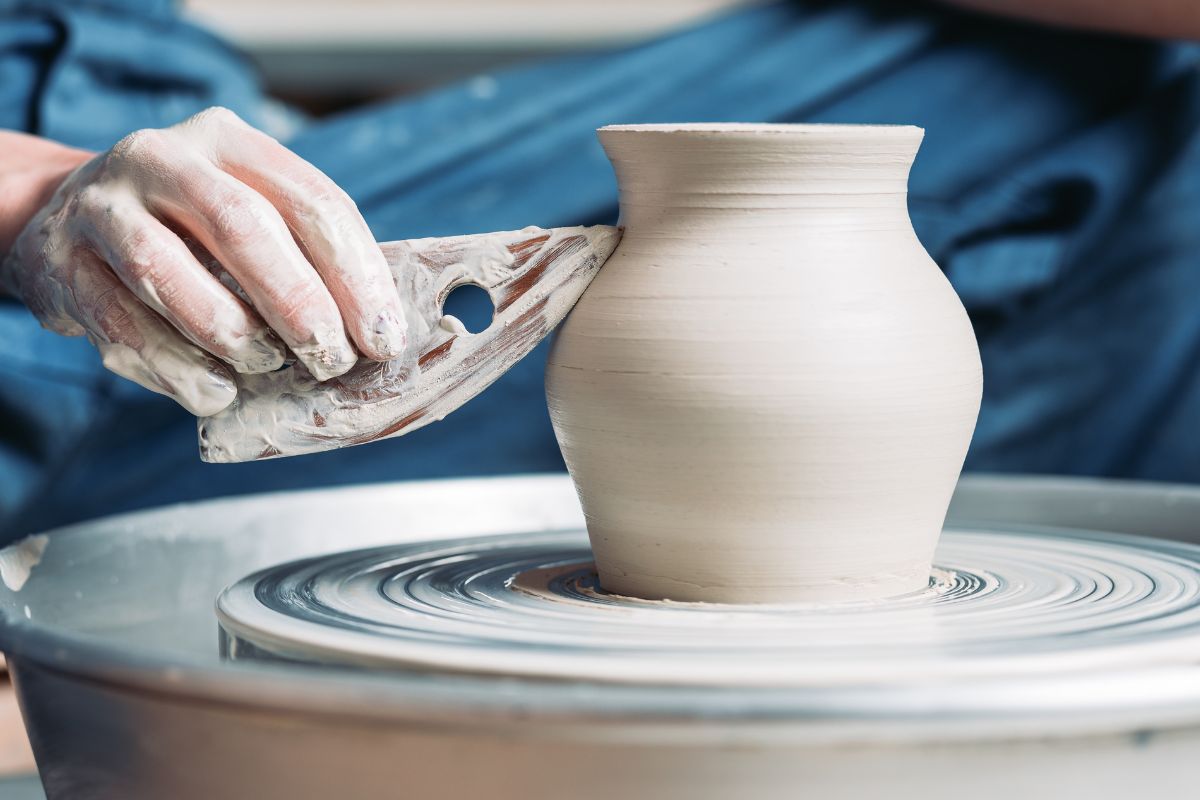
I started making pottery on a wheel because it was always something that I’d wanted to try. My abilities were anything but dignified, and that’s what kept drawing me back.
Advertisement
It was the experience of failing in spectacular fashion—with my whole body.
The wheel doesn’t care about your resume. It doesn’t know that in certain rooms your judgment is sought after, or that you’ve spent decades developing authority and composure—basic badassery. The clay only shows you whether or not your hands know what they’re doing. Mine often did not.
I still show up to find new ways to make bad pots. Lopsided walls. Bases too thick, then too thin. A form that looks promising until it collapses. There are many ways to ruin a pot before you make one that you’re willing to bring home.
When you’re young, being bad at things is expected. Learning is built into the rhythm of your life. After 50, especially for women, the script changes. You’re supposed to know what you’re doing. The world expects this from us, hell, we expect it of ourselves. We’re rewarded for competence, polish, and the ability to make hard things look easy. It’s tempting at this point to confuse usefulness with identity. We’re in danger of arranging our lives around what we do well and avoiding anything that might expose a crack in the facade.
The studio interrupts that script for me.
Advertisement
As a psychologist, I know that the quick flash of “I could make that” isn’t my confidence. It’s a defense against the vulnerability of being new—inexperience. Clinically, the closest term is intolerance of uncertainty, often expressed through experiential avoidance and overcontrol. When women spend decades being rewarded for competence, beginner status starts to feel too risky. Fear of failure shifts into avoidance. Curiosity gives way to self-protection. The self narrows around what’s tried and true. From the outside, this can look like maturity, but on the inside it’s about keeping up appearances.
I see versions of this every week in women who are high-functioning and very practiced at overfunctioning. They’re increasingly cut off from spontaneity, desire, and risk. They’re not falling apart. They’re functioning beautifully. Neuropsychologist Rachel Wu reminds us that when we become experts in our lane, we lose the cognitive and emotional resilience that comes from being truly bad at something new. Lives built entirely around fluency eventually start to feel more managed than lived.
Advertisement
Which is one reason the wheel matters. It doesn’t know the story we’ve been told, and there’s no elegant way to fake your way through the wheel. Either you can center the clay, or you can’t. The wall holds, or it collapses in on itself. The feedback is immediate, and vanity is useless. I listened to the instructor with the attention I would’ve given in school. Then I started mentally pleading with the clay as if that would change anything.
Weirdly, that’s what made it so freeing. I wasn’t there for a second career or a midlife hobby. I was there for the risk of being unskilled, for the chance to stop being the authority. Each class kept me asking the same question: Am I willing to be awkward, to be uncertain, to let go of the outcome, and to come back next week? That’s not a small question in midlife. And it’s not about pottery.
It’s about expanding. Becoming.
We know that novelty, learning, and purpose matter as we age. But I’m less interested in using science to persuade women to take a class than I am in naming what happens when we avoid beginner status for too long. We don’t just stop learning new skills. We start defending an edited version of ourselves. We live in that space, almost like a doll confined to its original box. We lose the opportunity to get messy.
I’m not done becoming.
Advertisement
This is the real case for being bad at something. Not because it “keeps you young.” This isn’t about optimizing aging, being interesting at dinner parties, or even coping with empty nesting. Being bad at something returns you to a state of development, honesty, and exploration. It reminds you that life continues to be under construction. It gives you a place where expansion is more important than being complete. Your effort is all over your hands, your apron.
And sometimes even in your hair.


5 Responses
“I’m still growing” is wonderfully freeing from the responsibilities of being expected to know how to fix everything says this formerly overburdened eldest daughter.
Yes, I is Sonya. Thanks for being here. —susan
Searching for local art classes right now!
Hi Gina, this made me giggle just a bit. Last summer I enrolled in an art class – a tree drawing class to be specific. I thought, How hard can this be? LOLS. It was really hard. I was so disoriented, and so bad compared to others in the group. I learned a lot about myself during those 6 weeks. —susan
I recently started dancing with silk fans as a way of continuing with circus arts while waiting for my shoulder to heal, and participated in a show. I got a comment from an old friend that I’m more coordinated on the trapeze, but still fun to watch. (I’m not that great at that either, but have a lot more experience with it.) My teacher was offended on my behalf, but I told her that it’s true and I was not insulted. I’m still learning not just the silk fans and how to modify for my lack of mobility, but also how to dance in an ensemble, which I haven’t done since childhood. I’m 77 and still growing!