
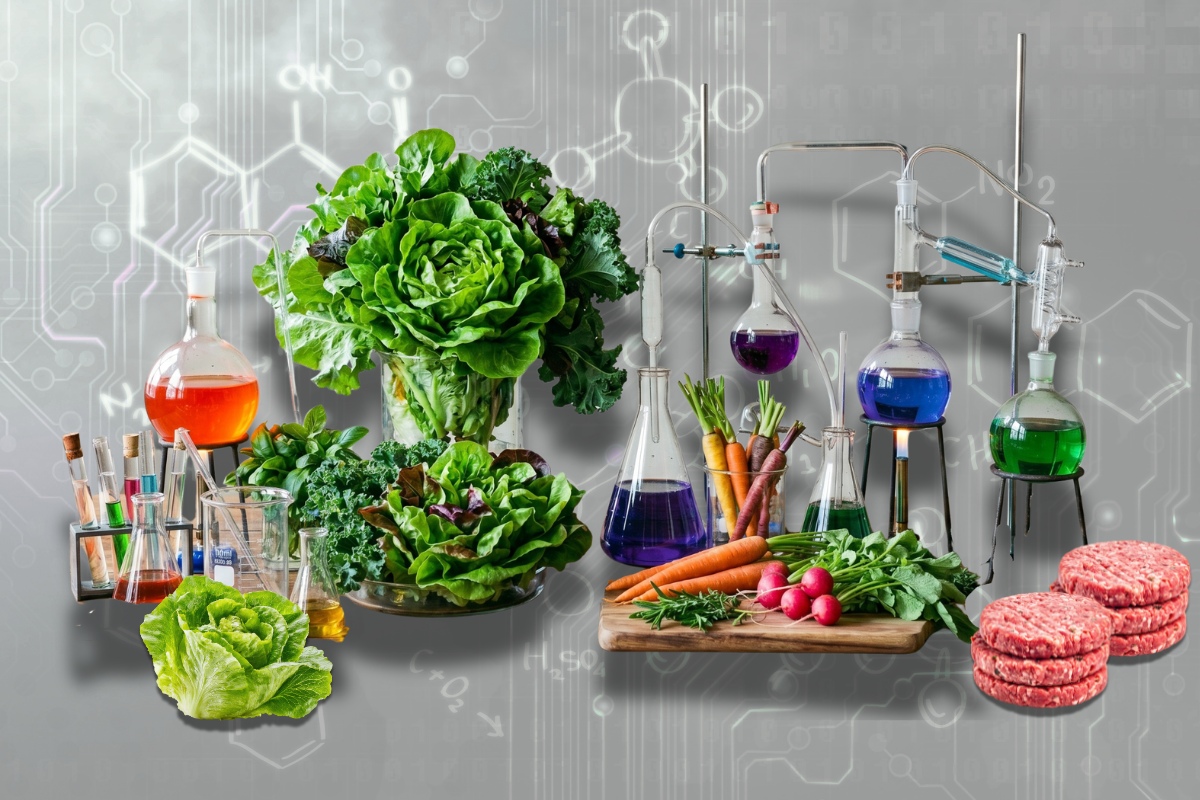
Lab-grown chicken, synthetic protein, 15 kinds of “milk.” The food industry has spent decades selling us more choices—and leaving us more confused.
I ran into the market thinking I’d be quick. Next thing I knew I was standing at the dairy case agonizing over plant-based milks. Headlines about eating more plants lobbied for my attention. So, I’m doing that! Out with cow milk and in with almond milk, cashew, walnut, oat, flax … How are we supposed to choose? Not to mention the alarming ingredients—things I can’t conjure up at home, including guar gum, sunflower lecithin, and gellan gum.
Stories fueled by endless marketing dollars tout the benefits of plant-based eating. The benefits we’re told include improved animal welfare, climate wins, and overall sustainability. But what about our health? I’m still standing next to the cold case, so I scroll on my phone to look up those additives. Recent studies suggest that guar gum, often added to improve mouthfeel and appearance, may negatively affect gut health by altering the microbiome and increasing colonic inflammation.
Proof that food today is almost beyond comprehension. Not only are we required to do complicated climate calculations in our heads, but we’re also researching unknown ingredients, and reading up on plastics. And it’s not only the dairy aisle. There are dozens of future foods clamoring for our wallets that include cell-cultured chicken and mozzarella, and egg protein made via precision fermentation. Even my beloved coffee is getting swapped with alternatives. Someone is winning at the supermarket. It’s not us.
And it’s been coming at us for 40 years.
Once I hit menopause, everyone said to eat more protein. Initially, I turned to protein powders until I found protein formulated unexpectedly into popcorn, ramen, and soda. Not only was this confusing to see, it made me doubt what I knew. Would protein in popcorn actually help? Women still do the lion’s share of shopping, and our age group spends more time and money doing it. When marketers bombard shoppers with misleading claims, we’re their target. We’re also the ones who can walk away and hurt them where it counts: profits.
The Promise Was Convenience. The Product Was Confusion.
When food scientists first began tinkering with what we ate, it was to make our food supply convenient and easy. Our busy lives needed shortcuts. No more chopping, cooking, and cleaning. But food companies needed profitability in a commodity business, so they formulated with cheaper ingredients—like additives that gave products a longer shelf life and better flavor. Artificial colors flooded in because we needed fun food. Marketers learned that kids, and the moms who shopped for them, were highly susceptible to influence. Hello Doritos, Oreos, and Trix. That was our generation. We were the test market.
Now the pendulum is swinging back. Today, we’re learning that ultra-processed foods (UPF) aren’t good for anyone, but these products are embedded in our lives. How do we break up with them? These “new foods” may promise do-good altruism, but they don’t answer our fundamental question: Will they help us live longer and healthier lives?
The Lab-Grown Promise
Thirteen years ago, Dutch scientist Mark Post grilled up the world’s first “beef” burger on live TV. He took muscle cells from a cow, put them in bioreactors, fed them liquid nutrients, and multiplied them into a “beef” patty. The cow lived. The investors arrived. Hundreds of synthetic biology startups opened for business, promising to remake food without animals or environmental damage.
The science is legit. It’s called synthetic biology, a hybrid field combining engineering and biology. Some of our most common drugs—from insulin to cancer-fighting compounds to the recent vaccines—are made by programming DNA in microbes, turning them into cellular factories. Synthetic biology has been quietly used for decades to make ingredients including vitamins, sweeteners, and preservatives like citric acid.
It’s not sold yet, but one day you may pull a frozen package of chicken from the freezer section, made like Mark Post’s famous burger and combined with oils, spices, and plant-based proteins, with a label that reads: “cell-cultured chicken.” While this “chicken” may be similar cellularly to real chicken, it will have been made using a complex set of processing steps that won’t be identified on a label.
What We Lose In Processing
Here’s a framework to consider: Hold up a chickpea and a chip made of chickpeas and think about what happened to create a crunchy, salty, savory chip. This is a question Dr. Josephine Connolly-Schoonen, Ph.D., director of the Department of Family Population and Preventive Medicine at Stony Brook Medicine in New York, poses to her patients. “It had to be heated, which denatures proteins, and our immune system recognizes it as foreign.” Our bodies are made to break down food—not food that’s already broken down. When we turn whole foods into puffs or chips, we lose the integrity of plant fibers.
For example, Beyond Meat, known for its plant-based alternatives, launched a sparkling beverage that uses “hydrolyzed pea protein,” which claims to be more bioavailable to humans. However, those peas go through eight different steps to get from the field to the drink. Whether sci-fi proteins are readily utilized by my menopause-shifting body is still in question. My two cents? It’s Beyond UPF.
What’s Actually on the Label
There are a couple ways to choose what you eat. The gold standard is to stick to the perimeter of the supermarket. A rule of thumb from Dr. Connolly-Schoonen is this: “Look for less than 5 grams of added sugar; look for less than 200 mg of sodium; and if it has more than 3 grams of fat per 100 calories, look for the source of fat.”
Dr. Robert Lustig, a physician and author of Metabolical: The Lure and the Lies of Processed Food, Nutrition, and Modern Medicine, said that there’s nothing wrong with a prepared salad from McDonald’s, but everything wrong with the dressing. If sugar is in the first three ingredients, it’s a dessert. The suffix “-ose” is code for sugar, too. And if it lists “mono- and diglycerides” (often labeled as E471 in Europe, but spelled out in the U.S.), it’s an emulsifier that holds fat and water together. This enables UPF to live on the shelf—and it’s what’s in that McDonald’s salad dressing. Steer clear.
You Don’t Have to Buy the Story
In her newly revised book What to Eat Now, nutrition guru and author Marion Nestle sums up the bewilderment behind “quick” stops to the grocery store: “The most profitable supermarket foods aren’t necessarily best for your health; the conflict between health and business goals is the root of confusion about food choices.” When we walk down the aisle weighing competing priorities—wellness guilt, climate guilt, or simply trying to put together a quick, delicious dinner—no one is winning.
So, can we make it healthy or not? Remember to put yourself first. You don’t have to reject everything that’s new, and you don’t have to keep eating what you know. Read the labels, look up the words you don’t understand, and don’t let wellness and climate guilt take over.
And if you want extra credit, find a new vegetable you don’t know and add it to your cart.
**************
MEDICAL ADVICE DISCLAIMER
DISCLAIMER: This website does not provide medical advice. For health or wellness-related content, SFD Media LLC emphasizes that information about medicines, treatments, and therapeutic goods (including text, graphics, and images) is provided for general information only. No material on this site is intended to substitute for professional medical advice, diagnosis, or treatment. Users are advised to independently evaluate and verify the accuracy, reliability, and suitability of the information before relying on it. You should not rely on the content as a substitute for professional medical advice. Consult with a physician or other health care professional for any health concerns or questions you may have. SFD Media LLC is not responsible for any action taken based on the information provided on this website. The use of any information provided on this website is solely at your own risk.



2 Responses
I agree that this has affected our relationships. Do we hesitate or not invite people to do anything with us involving food if they eat differently? Are people not inviting me for the same reason? Do we have fewer potlucks? I think it all has an impact on social interactions that include food. Maybe by design.
Our food choices have started to be akin to religions. Can a vegan dine with a pescatarian? Do we invite that couple we just met over for dinner? We aldways ask what their dietary preferences and needs are. There are allergies to consider, of course. What proteins do they favor? Will they enjoy arugula from our garden or not? Do veggies need to be organic? These days we weigh friendships on the scale of whether or not we enjoy similar diets and cuisines.