She made human connection out of a trip to the bank. Most days, I’d rather not leave the house.
My mother refused to wear a watch.
Not because she couldn’t afford one. A watch would have robbed her of an excuse to talk to people. She liked stopping a stranger in the grocery aisle to ask the time. It embarrassed me when I was young, the way she’d bump into someone in the Campbell’s soup aisle and strike up a whole conversation over the fact that she never wore a watch. I didn’t understand it. I used to think she talked to everyone because she was chatty. I know now she needed those conversations.
My father was a good man and a silent one, a commercial fisherman who left before dawn and came home after dark. She needed more conversation than one quiet marriage could give her, so she found it everywhere else.
She refused the ATM card too, when they came around, sometime in the late ’70s. Part of that refusal was suspicion. She didn’t like a machine handing out her money, which in hindsight was its own kind of foresight about where we were all headed. But the real reason was simpler. She liked going into the bank. Not the drive-through. She would park the car, get out, and go inside. There was Martha, her favorite teller, and Frank, the manager who had helped my parents with their first mortgage. She knew the other people waiting in line, too. Going in meant she got to check on all of them—the money was almost beside the point.
Her favorite job, the one she was proudest of, was working the election board. She sat at the Wanamassa Firehouse behind a folding table and a book so large and heavy she could barely lift it, checking names as the whole town came through to vote. That was where she caught up on a year of everyone’s life. Who’d married, who’d died, whose kid was in trouble. That job was so vital to her that even when she was sick with cancer in her last year, she still showed up.
She built connection into life’s errands.
Designed Out
I’ve been thinking about her since I read a piece in The Atlantic a couple of months ago that I still can’t shake. We talk to each other less than we used to. None of it was a shock. More people eat alone, work alone, shop alone, and entertain themselves alone. COVID accelerated a lot of it.
But what struck me wasn’t the research. It was how completely we’ve removed the thing my mother spent her life protecting.
We’ve designed human contact out of everyday life.
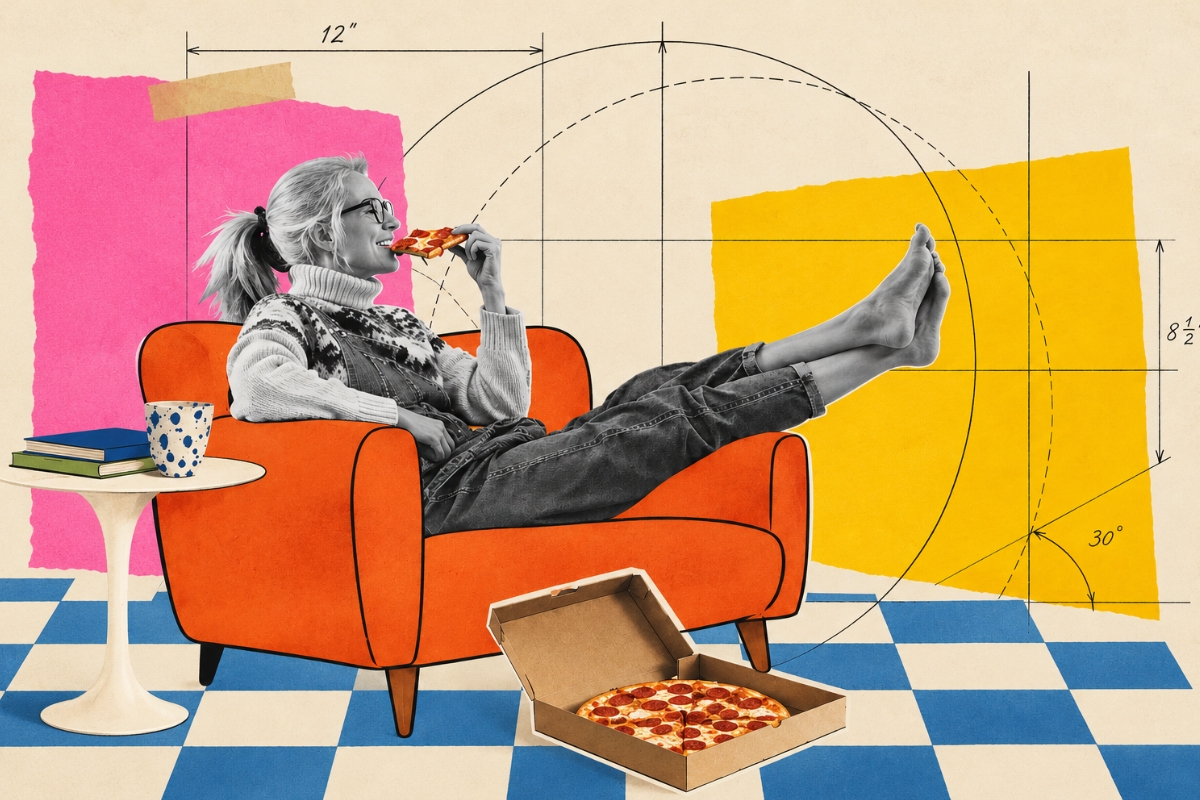
Last week, I ordered a pizza at lunchtime. My usual, because I’m a creature of habit, a 12-inch Quattro Formaggi from Flora’s. The app told me exactly when it would arrive. When the driver pulled up, he placed it on the ground outside my door, took a photograph to prove delivery, climbed back into his car, and drove away. We never exchanged a word. My lunch break from working alone was picking food up off the welcome mat, delivered by a man whose face I never saw.
Groceries appear at the doorstep. Banking happens on a screen. Self-checkout replaces the cashier. Customer service is completely automated (and frustrating as hell), and we text instead of calling and stream instead of gathering. Every bit of friction gets designed out of our experiences, and then we’re shocked to realize we feel disconnected.
My mother would have hated the pizza delivery, although she probably would have invited the driver in and found out where his children went to school.
The Backup System
Looking back, I don’t think my mother was simply sociable. I think she spent a lifetime building redundancy into her life without ever knowing that’s what she was doing. Redundancy is an engineering term, so stay with me a moment while I go back to my roots. You build backup into a system because eventually something fails. A cable snaps, a pump quits, and another system quietly takes over so the whole thing doesn’t go down.
My mother wasn’t thinking about engineering. But she instinctively knew not to let one relationship, one friend, one neighbor, or one routine carry the whole weight of her life. She collected people everywhere she went, through the ordinary moments most of us now treat as inconveniences.
We published a story recently about one of our writers who moved to Mexico and accidentally joined what she called a “girl gang.” The women kept running into one another. They walked together, checked in on each other, and solved problems together. Friendship wasn’t scheduled three weeks in advance. Life did the scheduling.
My mother would have understood that in her bones.
Who Ends Up Alone
Then there are the women my age who are on their own, whether their partner left, died, or was never in the picture to begin with. Their kids live three time zones away, if they had kids at all, and the friends they used to count on have either moved to Florida or stopped calling back.
Of the roughly 16 million Americans 65 and up who live alone, about 10.4 million of them are women. We outlive the men, so we end up alone. That’s just the arithmetic. But living alone and feeling lonely aren’t necessarily the same thing. You can be perfectly content in an empty house and miserable in a full one. What matters is whether everyday life still puts people in your path. My mother’s life did that for her every single day.
We tend to assume old age is the lonely part of life. It isn’t. In a Gallup survey, a quarter of American men ages 15 to 34 said they had felt lonely a lot of the previous day.
My own son’s job went remote during COVID and never came back to the office. There are good reasons for flexible work, especially for parents juggling jobs, children, and the extraordinary cost of simply keeping a household running, but something is lost when going to work no longer means seeing the same people every day. I know my son misses bagel Tuesdays and Ping-Pong Thursdays along with all the conversations he didn’t plan to have.
Only one in four young adults say they talk with their neighbors regularly, down from 51% in 2012. These are also the people who will be looking after us as we age. If we’re raising generations who rarely talk to their neighbors, what happens when we’re the neighbors who need checking on?
And Then There’s Me
I have a husband of more than 40 years, children and grandchildren I’m extraordinarily close to and lucky enough to have nearby, friends I love, and a team I talk to all day.
My mother married a man who was gone from dawn to dark. I married one who was gone for half our marriage, often working in another country. I’ve spent a great deal of my adult life on my own.
By any measure, I’m surrounded. And yet there are days when I feel isolated.
Writing is a lonely profession. It’s me, my screen, and my inner thoughts, trying to coax the muse onto my shoulder long enough to find the right words before the deadline. A lot of us do some version of this, working from home offices and kitchen tables.
But that’s only half the story. Truth is, I’d rather not go anywhere. I like my routines. I like the convenience of ordering what I need without getting dressed and driving somewhere. I like having the world come to me. Which is a strange thing to admit, because I run a company built on connection and reaching women, on the belief that none of us should feel alone. I spend all day trying to close the exact distance I keep choosing for myself.
Some days the most talking I do is to the dog. She’s good company.
In my mother’s last years, she sat and talked to the television. Argued with it and answered it. A woman who could befriend anyone in a checkout line was reduced to a one-way conversation with a screen that couldn’t answer back. I keep coming back to that and to how much effort she put into the simple business of knowing people and being known by them.
She’d have said the answer was obvious. Go into the bank. Ask somebody the time. Bump into a stranger on purpose.
My mother never had to think about any of this. I think about it constantly.
And then my lunch shows up.