
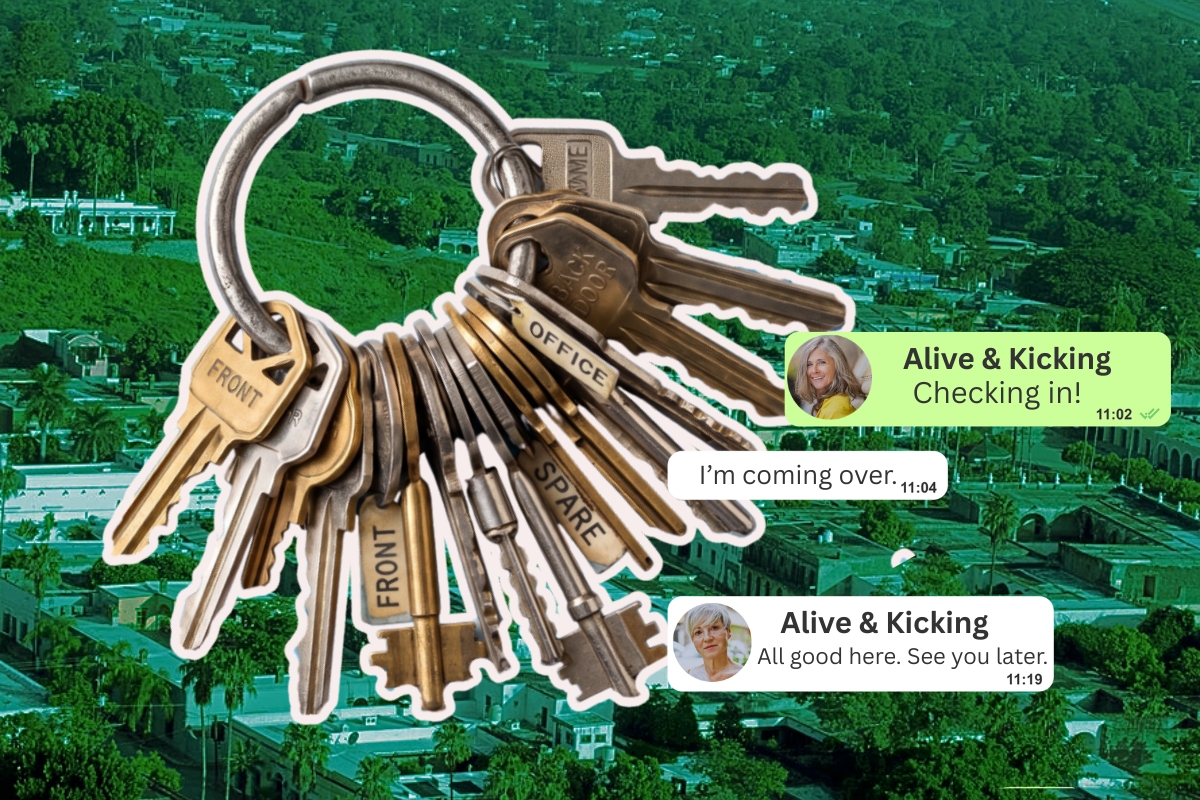
Hip surgeries, rescued dogs, and proof-of-life check-ins: This is what growing older looks like when women refuse to do it alone.
After 10 years of wandering through Mexico, I settled into a small rural town with my recently adopted senior dog, seeking a mild climate for her old bones (and mine) and some peace and quiet.
Instead, I accidentally joined a girl gang that showed me growing older alone doesn’t have to mean being alone at all.
In our neighborhood, phones start pinging early every morning.
“Good morning!”
“Buenos días.”
“Hello!”
A group of women from all walks of life who retired in Mexico ended up in the same neighborhood and informally created a sisterhood. They look out for one another, and one way they do this is with a WhatsApp group they named “Staying Alive” (which has recently been renamed the slightly more optimistic “Alive & Kicking”).
Every morning, as each retiree wakes up and starts her day, she has to let everyone else know that she is, in fact, alive. Forget to send a message, and you may find several senior women in slippers letting themselves into your house to make sure you’re not lying unconscious on the kitchen floor. Nothing too morbid. They don’t take themselves too seriously, but they do all have each other’s house keys and emergency contacts.
Nobody formally joins this community. You get adopted into it during a dog walk, a medical emergency, or an invitation to play Mexican Train dominoes with a glass of wine.
That’s more or less what happened to me.
There’s Something About Mexico
The group began with Lourdes, a recently retired Mexican woman who moved from a large city to this small town. She noticed that the streets in her new neighborhood needed work and decided to start talking to the women she met while walking their dogs in the morning.
What turned out to be a futile endeavor—the municipality had little interest in her quest to fix the streets—led Lourdes to notice something more important. As she got to know her neighbors, she realized that most of them were women living alone. She had heard of elderly foreigners dying alone in their homes and not being found for a while. Her mission was to make sure that never happened in her neighborhood.
Bringing people together came naturally to Lourdes because in Mexico, families often care for older relatives at home. Retirement facilities are uncommon and far less central to aging than in Canada or the U.S. Lourdes simply extended that cultural instinct to the women living around her.
That’s when the morning WhatsApp check-in was born.
When I heard about this group, I realized that Lourdes had quietly named a fear many of us carry (but never say out loud): “What happens if no one notices we need help … or worse?”
Beyond the daily check, the group of about a dozen women regularly gathers for lunch to chat about one another’s lives and discuss their next adventures. No politics or religion involved.
Throughout the neighborhood, smaller friendship groups formed over the years. I instantly bonded with my retired neighbor across the street, Isabelle, a fellow Canadian. She started inviting me to dinners, outings, and events. That’s how I met the rest of the ladies. We get together and cook in Isabelle’s fabulous chef’s kitchen, have pool parties at Lourdes’, take each other to doctor’s appointments, plan trips together, care for each other’s dogs, and have regular game nights. I’m not retired yet, so I can’t keep up with their busy social calendar, but they keep inviting me anyway.
These women come from all over the world. Their lives and backgrounds are very different, but most came to Mexico for similar reasons.
As she approached retirement, Isabelle researched places with a good climate, a reasonable cost of living, and positive relationships between locals and newcomers.
Sally Beth feels that Mexican culture itself helped create the group. She said she barely knew her neighbors in the U.S. and often felt socially isolated.
“Being here in Mexico is like opening the windows and shouting, ‘Hello! Good morning!’” she said. “Everyone you meet on the street says hello, even if they don’t know you, and I love it.”
Not long after informally being adopted into the sisterhood, I was added to a WhatsApp group called “Sally’s Angels,” created to ensure Sally Beth was never alone before, during, and after her hip replacement surgery. Someone stayed with her dogs overnight. Lourdes drove her to the hospital. I was there in her room right after her surgery. Isabelle brought her food. Other women checked in, ran errands, and kept her company. Sally Beth said she realized in that moment that she had found her people.
As Isabelle said, “I know, without a doubt, that any one of them would come running—well, perhaps trotting or walking briskly—if I ever needed help. I would do exactly the same for them.”
Independent, Not Isolated
Outside of Mexico, it’s common for seniors to move to retirement facilities, where much of their freedom and independence is compromised. This improvised neighborly sisterhood that I’ve stumbled upon gives the women the chance to live independently without feeling isolated.
They don’t want or need constant supervision. They simply want someone to notice if they fail to send a “Good morning” before breakfast or answer the phone when they need a Band-Aid at 10 p.m.
What I discovered in this neighborhood was a group of women who don’t need rescuing.
The Fear We Don’t Say Out Loud
After months of observing this casual yet well-organized group of retired women, I realized how full and socially connected their lives were. I also realized that most aren’t waiting for a romantic partner to complete them. Only a few have partners, and the others rarely talk about wanting one.
They have friends.
They have potluck dinners.
They have dogs.
These women know that they’re safe and looked after by each other.
Like a lot of women, I grew up with the concept that marriage was the safest route to a secure old age, and for years, I carried a quiet fear of growing old alone. But life doesn’t always end up that way. Marriages end. Partners die. People leave. Some of us are (unreasonably) left feeling like failures for not having successfully “bagged a man for life.”
Guilty.
Life among these women has eased that fear for me. I’ve seen what happens when women build a support system based not on obligation but on friendship, house keys, rescued dogs, and WhatsApp notifications.
I’ve found my tribe. Now I’m just waiting until I’m old enough to be added to the morning mortality check-in group.


24 Responses
Love this so much! Love that you’ve found your tribe and don’t have the pressure of ‘bagging a man’ 🙃❤️
Thanks, Alexa! ❤️ No more pressure 🙃, and I’m totally feeling at home with this sisterhood.
Can you provide the name of this town?
TX. Sounds like a dream set-up. I have always wanted to move to Mexico, but realize, as a 74 or old woman with little family, that it just might be possible, after reading your article.
Hi Susan, there are many improvised senior communities like this throughout Mexico.
Thanks for reading!
Beautifully written ! Love that this exists!!
Hope to get to know all these beautiful souls when I visit 🙂
Can’t wait for your visit, Nancy! 🙂
What a nice story. I live in a senior apartment complex and when I moved in I didn’t know anyone. I have met three other mature women, and we get together once a month for a potluck and conversation. We are all good friends, and we help each other when in need.
Love this type of sisterhood, Carmen.
Thanks for reading!
What a beautiful story. Thank you.
Thanks for reading, Kathy!
A couple of decades ago my gals and I informally organized who we’d live near, how we’d live side by side, giving each other space and yet a network. Freedom with connections. The group ebbs and shifts as some find later loves and move. Yet the core pact remains: everyone is welcome and no one will be left out. Sisterhood at its best
Freedom with connections…Love this, Keri!
Thanks for reading.
Where is this place? I am wanting to make an extended trip into Mexico and am wondering about safety.
Hi Kim, there are many communities similar to this throughout Mexico.
You can join Facebook groups where foreigners travel and live in Mexico to get information about the places you plan to visit.
I hope to find a community like this someday, it sounds like a dream!
You can try to find or maybe choose to build this type of community yourself, Jill.
Thanks for reading!
Lovely and beautifully written!!!!
Thank you, Sue! I’m so glad you found your way across Mexico and into this wonderful sisterhood. You fit right in from the start.
Wow. We’ve done this on a smaller scale in my region of New Mexico. I have more than a dozen women with whom I swap gratitudes and good mornings everyday. Lovely article. Thank you.
Beautiful article, I liked it a lot! Reflects a lot the life of the retired women in the area, and how the Mexicans try to welcome and infuse the new arrivals with our way of living!
Specially in this days that the world is so divided we have to be kind to one another and learn to exist together regardless of where we were born.
Thank you, Lourdes, for creating this amazing sisterhood. Your generosity and instinct to care for the people around you reflect what I have come to love most about Mexican culture. You remind us what can happen when people choose inclusivity and kindness over division. The world needs more people like you.
I loved your article!!
I am currently based in Guadalajara, but very close to Lourdes and feel also very close to all you gals in the Tribe!
You certenly have a beautiful group like a real Family… and I’m so glad I am close to you all !
Hugs!!
Elena
Elena, you may not live in our community, but you are very much part of this sisterhood. Every time you visit, you bring something special that makes our group feel even more genuine and complete.