
When the women in your friend group are suddenly, quietly smaller—and nobody’s talking about it—something shifts. A dietitian names the feeling.
There’s a woman I know who has spent her entire adult life fighting the same battle. She gets up early to exercise, skips the bread basket at restaurants, journals her meals, plans her week, and genuinely tries to lose weight. It has felt that way for years, like her body simply decided this was where it wanted to stay, no matter what she did. That woman could be any of us who’ve spent years losing and regaining the same 10, 20, or 30 pounds.
And then, almost overnight, everything around her shifted. Her friend group is transforming. Women who spent decades bonding over shared struggles and shared frustration are suddenly, visibly, dramatically smaller. Some of them have access to a tool that made the impossible possible. Some of them don’t, and the ones who don’t are left holding a feeling nobody is naming out loud.
That feeling is GLP-1 envy, and as a dietitian who has spent decades sitting across from women navigating their bodies and their self-image, I can tell you it’s not really about the weight. It’s about ease. It’s about the exhaustion of trying hard in a world that suddenly seems to have handed everyone else a shortcut. And underneath it all is something that predates Ozempic: women’s bodies as social currency, and the silence around the latest rewrite of that script.
Women’s bodies have never just been their own. They’ve always been subject to a verdict—too big, too thin, too soft, too muscular, whichever shape happens to be culturally acceptable at any given moment. We lived through the era of painfully thin models and the messages that took up permanent residence in our heads, messages so powerful they shaped how an entire generation viewed food, weight, and self-worth.
We watched curvy have its moment in the early 2010s, though curvy came with its own impossible standard: the right curves in the right places, flat and toned everywhere else. If only we’d been born in the Renaissance, when a fuller figure wasn’t just tolerated but painted, sculpted, and admired. We’ve been told what we should want our bodies to look like for our entire lives—by magazines, by culture, by the people around us—and then we were blamed for internalizing those messages.
And now there is a new script: a medication that could help—but only if you qualify, requiring a BMI of 30 or higher, or 27 with a weight-related condition. Cash-pay prescriptions and telehealth, however, have made it available to anyone who can afford it. GLP-1s are the latest chapter in that story, though far from the first.
The Book Club That Looks Different
The women at the center of this story aren’t obese. They’re the ones who’ve always been, as one of my clients put it, “almost there,” perhaps carrying an extra 15 or 20 pounds that no amount of discipline seems to budge.
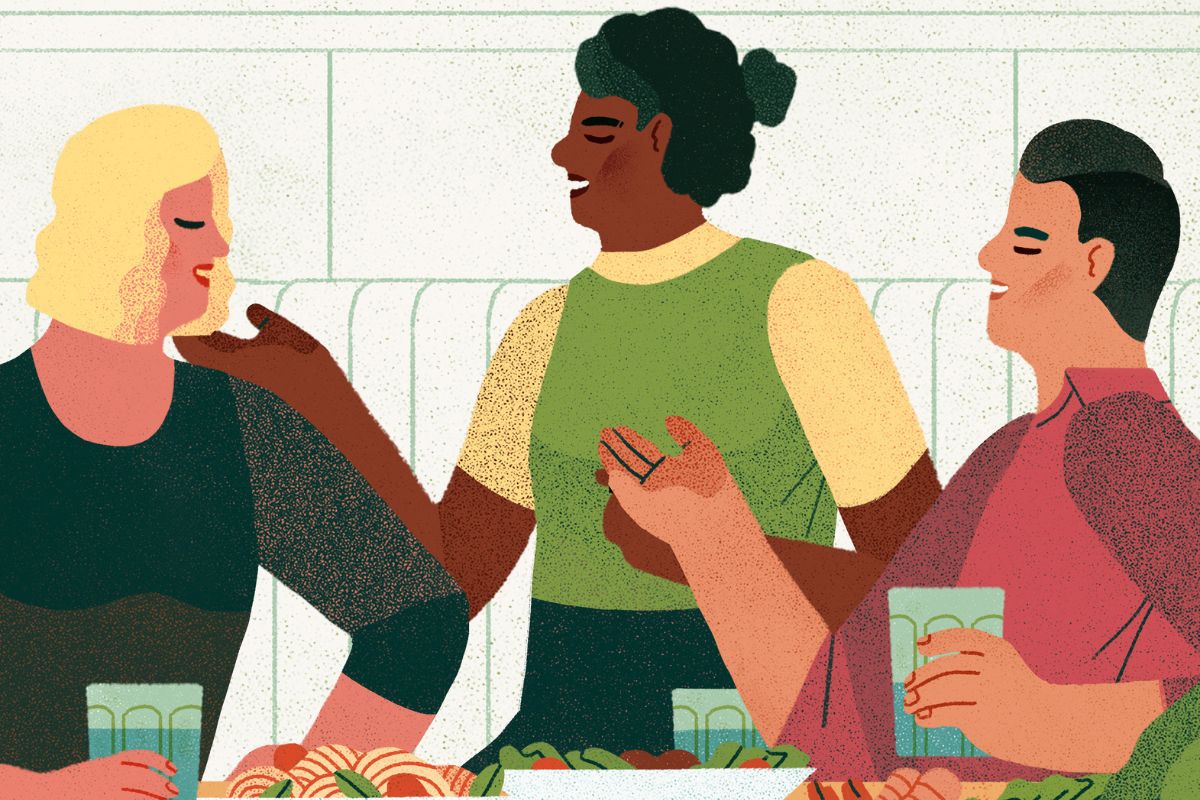
Consider a monthly book club that looks the way it always has: the same women, the same living room, the same easy rhythm of conversation, except that the coffee table looks different now and nobody has said a word about why. Even the woman who was always the slim one, the one who never had to join the commiserating, is quieter than usual. The chips and dip have been replaced with vegetables and hummus, pastries have given way to cut fruit, and where there used to be a generous spread there now sits a single, token tray of cookies that nobody seems to be moving toward. Wine still gets poured, but sparkling water has joined it. One of the women, the one whose weight hasn’t changed, reaches for a cookie and pauses, waiting to see if anyone else will make the move first. Nobody does. And so she withdraws her hand, not because she didn’t want it, but because wanting it suddenly felt like something she was doing alone.
It’s about watching the language of female friendship shift mid-conversation from “I’ve been so good this week” to “I can barely finish what’s on my plate.” It’s about the women who are on these medications and not saying so, leaving the friends who used to share everything wondering what else has quietly changed between them. Some deflect questions about their weight loss with “I just stopped eating as much,” which is technically true but not the whole story. And the friends who sense that something has shifted but can’t confirm it are left holding a suspicion that quietly wedges itself between people who were once completely at ease with each other.
Not Competition, Just a New Equation
The friend on GLP-1s isn’t your competition. Her body, her lab values, her relationship with food and her own reflection—none of it’s yours, and neither is her relationship with what she lost. The women who’ve spent years making careful choices feel like every pound shed was earned. What GLP-1s have introduced is a question few are willing to ask: Does it feel the same when the medication did the heavy lifting? But that question is GLP-1 shaming, dressed up as curiosity. Women on these drugs still have to change their habits, still have to do the work, and still have to live in their bodies every single day. Ownership is a complicated thing, and the women watching from the outside aren’t wrong to notice that something about the equation has shifted, even if their impression of what that process requires isn’t entirely fair.
A smaller size isn’t the same as peace with your body, and watching someone else get there faster doesn’t mean they’ve arrived somewhere you should’ve been. Nobody just arrives. Eating well, moving, and staying connected to what you need are active, ongoing choices, and the work doesn’t end when the number on the scale changes. It evolves.
The Honest Question
So, when it’s time for book club again, she sits down at the same table, with the same women, some of whom are visibly smaller and still not saying why. And when the snack table appears, she finds herself doing what she’s been doing lately—watching before reaching, measuring herself against women who used to share conversation and cookies without a second thought. This time, instead of scanning the table to see who’s watching, she asks herself an honest question: What do I really want, and what am I willing to do about it? Not what her friends are doing, not what a medication might make possible, but what’s true for her body, her labs, her life.
Committing to your body isn’t a decision you make once and file away. It’s an ongoing negotiation, and the only way to do it honestly is to learn the difference between what you can’t change and what you’re choosing, on some level, not to. That distinction is uncomfortable, and most of us would rather stay focused on what someone else has than wrestle with the choices available to us. But it’s also where the real clarity lives, and where we stop chasing someone else’s finish line and start moving toward our own.
At the end of the evening, as women pull on their coats and reach for their keys, our woman touches her friend’s arm.
“Hey,” she says, her voice easy but direct, “have you been taking one of those GLP-1s?”
Her friend pauses, then smiles in a way that says everything.
“Yeah,” the friend says quietly. “For a few months now, but I plan on going off soon.”
Then the friend turns it around. “Would you ever try it?”
She reaches for a cookie and shrugs.
**************
MEDICAL ADVICE DISCLAIMER
DISCLAIMER: This website does not provide medical advice. For health or wellness-related content, SFD Media LLC emphasizes that information about medicines, treatments, and therapeutic goods (including text, graphics, and images) is provided for general information only. No material on this site is intended to substitute for professional medical advice, diagnosis, or treatment. Users are advised to independently evaluate and verify the accuracy, reliability, and suitability of the information before relying on it. You should not rely on the content as a substitute for professional medical advice. Consult with a physician or other health care professional for any health concerns or questions you may have. SFD Media LLC is not responsible for any action taken based on the information provided on this website. The use of any information provided on this website is solely at your own risk.


11 Responses
I do not understand the stigma some want to attach to GLP-1 meds. No one bats an eyelash if you take something for high blood pressure or cholesterol, and why would anybody think it needs to be disclosed to anyone else? If a friend asks I think you should be honest, but otherwise it’s not anyone’s business!
GLP drugs can be a life saver! I myself used monjaro and it really does something to your mind to take the food noise away. Now my Daughter is using it and has lost 20lbs so far and she is just starting her journey. It certainly makes a person not think about mindless eating.
Sending best wishes to those who are using GLP-1. Recently read it fights against cancer inaddition to helping people lose weight. I’ve never been on any of the weight loss treatments, surgeries, diets, or fast. Try to maintain a steady weight and flexible body. Envy is useless, do something for yourself instead of ruminating over someone else’s struggle.
This is so true. Not sure why the commenter above is angry about this because it is a thing and your article is spot on.
Your article is EXCELLENT!!!!! Your writing is stellar. I devoured this piece.
The way you describe all the nuances between women’s friendships is spot-on.
All the layers of emotions around this topic, you explore so thoroughly.
I learned a lot! Thank you for sharing your wisdom!
GLPs have been found to do a lot of harm, including leading to blindness. For those like me who lost almost 100 pounds the old-fashioned way (cutting out the crap) they are a real copout.
I love the spunk of your magazine. But articles like this make me want to unsubscribe. “Half your friend group is suddenly, quietly smaller—and nobody’s saying the word out loud. ” This “you” doesn’t include me, as I do not have a single friend who is taking GLP whatever it is. It’s just not a thing where I live.
Please do not overgeneralize in your articles.
It’s a literary device called writing in second person. High School grammar.
Perhaps you should unsubscribe If you find that concept too challenging,
I was thinking. My friends have not hidden it from me. If they are really your friend we discuss. There are five of us that still get together from high school and there are no secrets, we all discuss what we are taking and what is going on. And some are on the GLP1 and others are trying different things. As friends we discuss what we think works and what doesn’t. Isn’t that how friends interact? It is how we have all interacted. That’s what friends are for.
Hi Marcia, Susan, Editor-in-Chief here, Thank you for this — and for the “spunk,” comment. Here’s our take on this… that “you” is doing deliberate work. When we write “half your friend group is suddenly smaller,” we’re not claiming it’s true everywhere; we’re naming a thing a lot of our readers are watching happen in real time and not saying out loud. For me, more than half my friend group has been on a GLP-1. For you it isn’t a thing where you live, and honestly, that’s its own interesting data point, because where you are clearly looks different from where a lot of this is unfolding. The rhetorical “you” is a tool we’ll keep using when we want to put a reader inside a moment. But your pushback is fair, and I’d rather have a subscriber who speaks up and engages. So thanks for being part of our community. —susan
There’s a weird feeling when you’re the one not on a GLP-1, and yet you’ve lost weight for whatever reason. You immediately want to defensively say – no, i’m not taking the shot, even though no one asked. But the question hangs there anyway.