Fifteen years ago, they did this to Jane Lynch. Monday, they did it to Mariska Hargitay.
There’s a certain kind of cringe that arrives when you’re watching a woman you genuinely admire be given the wrong assignment—and then, because she’s a professional, watching her give that assignment every last ounce of energy she has.
That was Mariska Hargitay at the Emmys.
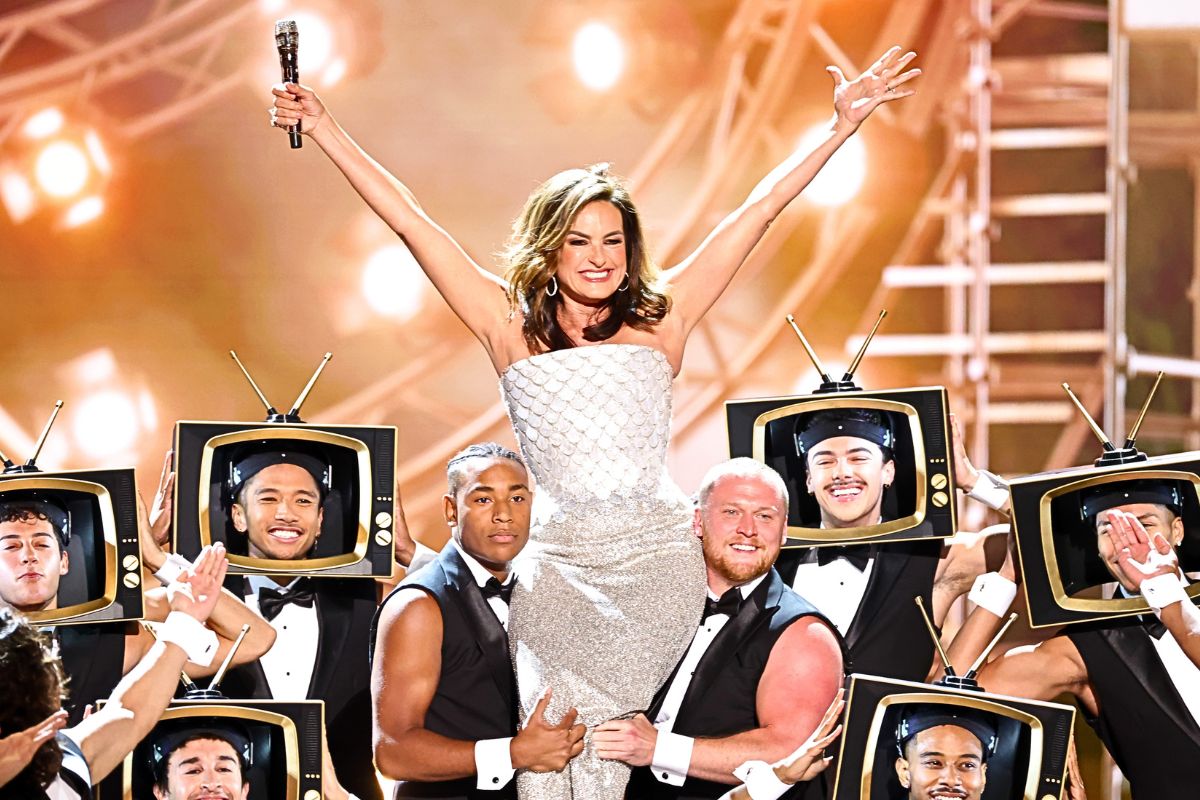
She looked gorgeous in every one of her 13 costume changes, as exhausting as that sounds. She sang and she danced. She carried a sparkly microphone and led us through “I Love TV Screens,” an overly enthusiastic rewrite of “I Love Rock ’n’ Roll.” Hargitay didn’t phone it in. If anything, that was the problem: she committed so completely that there was no place for the audience to look away.
I was cringing and rooting for her in equal measure.
There were parts of the show that made Hargitay look like she had been dropped into an episode of Glee in 2010. But I don’t think the takeaway is that Mariska Hargitay can’t host.
The takeaway is that the Emmys didn’t understand what they had in Mariska Hargitay.
A Woman of Authority
For more than 25 years, Hargitay has played Olivia Benson on Law & Order: SVU, a character whose power lies in her calm, her intelligence, her decency, and her ability to make someone in pain feel seen. Hargitay’s fame is built on trust, not jazz hands and musical theater energy.
She has the confidence of a woman who has survived Hollywood, a punishing television schedule, public scrutiny, motherhood, advocacy, and the strange reality of becoming permanently associated with one of television’s most indelible characters.
And at 62, she had every right to stand at the center of television’s biggest night without having to prove anything.
Hargitay was the first woman to host the Primetime Emmys in 15 years. She also arrived at the telecast after winning two Creative Arts Emmys for her deeply personal documentary, My Mom Jayne: A Film by Mariska Hargitay. Her mother was none other than Jayne Mansfield.
This wasn’t an unknown quantity who needed a big entrance.
She had already brought one with her.
They’ve Done This Before
The Emmys billed Hargitay as the first woman to host in 15 years. The last one was Jane Lynch in 2011.
Lynch didn’t bomb either. They opened her with a musical number stuffed with cameos, in which she sang that television was a vast wonderland and waltzed onto the sets of Mad Men and The Big Bang Theory. She called it, on the air, stupid and schlocky and overly long.
The reviews split exactly the way Monday’s did. Critics liked her and not the show. Rotten Tomatoes’ critics’ consensus on that show still reads that Lynch was an affable emcee during an otherwise overproduced Emmys, with every inspired moment weighed down by clunky gags.
A few days later, Lynch said that if she had to decide right then, she wouldn’t host again. She also said she’d had a great time and hadn’t felt that creative and alive in a long time.
Then 15 years passed before another woman hosted.
Lynch came out of The Second City. Hargitay trained with the Groundlings. Two women who can actually do comedy, handed the same musical number and the same pile of cameos, 15 years apart. Both got reviewed gently and produced badly.
Maybe the problem isn’t women hosting the Emmys. Maybe someone should stop writing them opening numbers.
The Women Who Moved Us
What made the Hargitay spectacle feel even stranger was that some of the most authentic, memorable moments of the night came from women who weren’t trying nearly so hard to make a moment.
Sally Field, 79, walked to the microphone after winning Outstanding Lead Actress in a Limited or Anthology Series or Movie for Remarkably Bright Creatures and blurted out, “This wasn’t supposed to happen!”
This is Sally Field. Two Oscars. Decades of television. She has been doing this for 62 years, as she reminded us in her speech. And she looked genuinely stunned.
Then she started thanking the people who had gotten her there: the author, the director, her co-star Lewis Pullman, Alfred Molina, who voiced the octopus, the cinematographer. “I would not be up here,” she said of Pullman.
There was something lovely about it. No declaration of endurance. No speech about still being here. She talked about the work and the people who made it with her.
Allison Janney, 66, had much the same effect when she won Supporting Actress in a Drama Series for The Diplomat. Janney now has eight acting Emmys, tying the record for the most acting Emmys held by a woman. And still, she looked shocked when they called her name.
And then there was Rhea Seehorn, 54, finally winning her first Emmy after years of extraordinary work and repeated losses for Better Call Saul. She was delightful as she politely refused to surrender the microphone, even as the little warning bells rang.
She had waited a very long time for that room. She was going to enjoy standing in the middle of it.
They Already Had the Show
They had Sally Field, Allison Janney, and Rhea Seehorn. And they had Mariska Hargitay.
For nearly three decades, we have watched this woman play Olivia Benson. She didn’t arrive needing an introduction, much less a reinvention. She arrived with something considerably harder to manufacture: authority.
Yet somebody apparently looked at all of that and thought: sparkly microphone.
Hosting isn’t playing Olivia Benson, and nobody wanted Hargitay standing behind a lectern for three hours. But there was a lot of territory between that and “I Love TV Screens.”
The show had an admired television icon with intelligence, authority, and a rich history in the medium. It could have let her be dry and elegant. It could have given her smart writing and a few intimate moments with the room. It could have trusted her.
Instead, it seemed determined to turn her into an Emmy host rather than build the Emmys around the woman they had hired.
She looked like a very good sport doing everything that had been asked of her.
It was the waste of her.
Nobody needed to make those women bigger. Their histories walked onto the stage with them.
So did Mariska Hargitay’s.