I thought getting older would make saying no easier. Saying it was never the hard part.
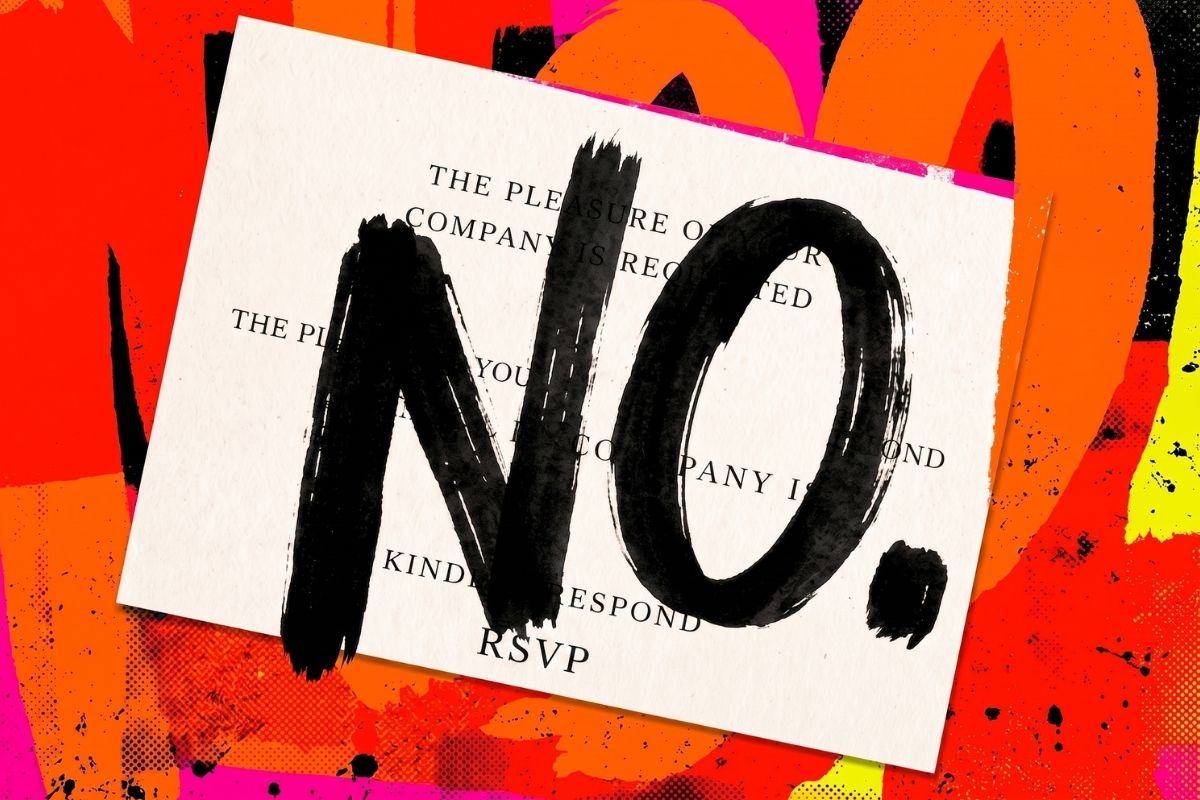
When my sister-friend sent me the link, my response was simply, “THE HELLER!”
You’ve probably seen it in the same place I did. Social media, home of every catchphrase worth stealing.
It felt good. I have boundaries; hear me roar. Boundaries have become a costume. Somewhere between manifesting our best life and self-care Sunday, everybody started wearing one. Printed on a tote bag, engraved on a mug, quoted in a caption under a photo of someone drinking water alone on a beach. I have this exact picture taped above my desk. Trust me, I’m not above it.
Dr. Gayle MacBride, a licensed psychologist and co-founder of Veritas Psychology Partners, told me naming a boundary is easy. Enforcing one when someone else’s disappointment costs you your peace is not, even when the boundary is as small as staying home. Only the first one is cute enough for a tote bag. I found this out for real on a random Sunday.
One of our church members texted to ask if I was headed to service. “Absolutely not,” I typed back, no hedge, no cushion. She LOL’d. I told her I was exhausted, and even the Lord rested on the seventh day. She LOL’d again, then added the quiet warning dressed up as a joke: “Now you know folks are gonna be wondering where you are.” “Let ’em wonder,” I said. “The answer is no, not today.”
As the wife of a pastor, there’s a version of me people expect on Sunday mornings, dressed a certain way, in the right pew, playing holy hostess when the visiting dignitaries show up. Most weeks, I show up for that version willingly. I like church most weeks. But liking it and being allowed to skip it are two very different sermons. A man in that pew could skip a Sunday and nobody would blink. They’d assume he was decisive, needed elsewhere. A woman skips, and it reads as a violation, evidence she doesn’t care, proof she isn’t sweet (in that Southern church lady way).
MacBride’s read on this is blunt: “The problem isn’t likely the word ‘no.’ It’s the story people make up around it.” For me specifically, it reads as worse than a violation. A Black woman’s “no” is far more likely to be read as hostility, no matter how it’s delivered (ask me how I know). But that week, I didn’t do my usual ritual, the one where I ask my husband if it’s okay for me to stay home and then give him a reason. I just woke up, said “I’m not going today,” and braced for pushback that never came.
After the fact, I realized it wasn’t my “no” that surprised me. It was the bracing. I flinched before anything happened. MacBride helped me understand why. The accommodation happens on autopilot, faster than you can think it through. My husband hadn’t said a word yet, and I was already building a case, rehearsing my receipts, ready to defend a decision I honestly never needed permission to make in the first place. I could say “no.” That was never the question. The question was why I still expected to pay for it.
When I was an educator, I used to tell people that the closer I got to 50, the more IDGAF I became. “No” wasn’t just a word. It was a rite of passage, the reward for years of making “yes,” “okay,” and “sure” part of my well-balanced diet. I paid my dues. I RSVP’d yes to things I hated. I said “happy to help” through gritted teeth so many times I should get a plaque. MacBride said that’s not a personality quirk. Many successful women get there because of that conditioning, not despite it—competence and compliance tangled together until you can’t tell where one ends and the other begins.
Turns out I’m not special. I’m just late to a party everyone else is also pretending they weren’t invited to. Women my age were taught “yes” as a first language, fluent before we could vote, before we could drive, definitely before we could rest without a reason attached. MacBride said the sorting starts absurdly early: girls are praised for being helpful and agreeable by the time they’re three or four, and the silence is just as loud when they’re not. So when the “no” finally comes, it doesn’t arrive calm. It arrives armed because, somewhere along the way, we learned it needed to be.
None of this makes the “no” easier to say out loud the first few times. It just makes it easier to trust once it’s out. The “heller the no” isn’t really about volume. It’s about confidence that whatever relationship might be at risk survives it.
Mine did. My husband kissed my forehead. My sister-friend still LOL’d me the next Sunday. Nobody’s disowned me for staying in bed. Turns out the only permission I was ever waiting for was my own. It took 53 years and one psychologist to make me believe what I already knew.
Moisturized, a little irreverent, and finally comfortable in this skin, I say “no,” I mean it, and I roll away with an imaginary hair flip. Don’t applaud. Just let me have this.

11 Responses
Reminds me of one of the sayings I love: “If it’s not a hell yes, it’s a hell no.”
Women in my condo community are always nagging me to hang out at the pool. I hate the heat! I said no several times and after their persistent and annoying nagging, I snapped. I told them that I don’t hang out with people who try to make me do things I don’t want to do. They were startled but got the message. Not saying that the nagging has stopped completely, but I feel good about setting boundaries. And it isn’t just the pool. There are all kinds of activities they think I would enjoy which I have absolutely no interest in. It feels good to say “no.” I am 77 and am done with doing things I don’t enjoy. And that includes hanging out with people I don’t enjoy. So, I totally support your decision to stay in bed. Life is easier with some boundaries.
Ohhh the guilt of saying “No” is strong with this good Catholic girl! I actually realized about 20 years ago that the world would not end if I said “No” to something, but my problem since then is personal enforcement and the cease and desist of overexplaining myself after the “No”. I’m getting better – the Hell to the No is always simmering at the surface – I just need to stop myself at that whenever I can without the profuse overthinking that follows in my brain!
Shout out to Michelle for the “You have to know your own agenda or you become part of someone else’s.” quote. I’m needlepointing that on a pillow immediately. Immediately after figuring out how to needlepoint….
I get the over-explaining; like we have to justify our decisions. I am re-training my brain to use the full stop after the “No!”
Sometimes…I just don’t do it. No explanation. No apology. I just don’t do it. It’s like I’ve skipped past the part where you are supposed to say “no” and feel guilty for saying “no”. I’m not aggressive. I’m just not participating in things that I don’t want to do. I will admit that this has taken me most of my life to learn or rather, evolve into being. However, I’ve never been so contented, so free.
I think that because my Mom died when I was 7 and I was raised by my Dad, I always had a much easier time fighting for myself and questioning old, tired stereotypes. I never had a problem saying no and I also called out the double standards, such as expecting only women to help in the kitchen while men were lazy and doing nothing. Now that I am post menopause, it’s just too easy to say no and to call out the outdated trope.
I love that you stayed home and fought the urge to apologize for taking what you needed. When you did that you gave other women permission to do the same.
Having a child with special needs helped strengthen my NO muscle. There were times I just couldn’t out of sheer exhaustion. I found the person asking for whatever would usually just move on down the list. That’s been liberating.
I don’t know where I heard the expression, “You have to know your own agenda or you become part of someone else’s.” Having a ready made response (not excuse) in my pocket for surprise requests helps, “No. That isn’t going to work for me.” No need to explain why. Even if my agenda, like yours, is to give myself time to rest.
The older I get, if it isn’t a hell yes, it’s a no. The more we say no to the things that aren’t serving us the more we can truly show up for what we say yes to.
Thank you for the “agenda” quote and your perfectly worded standard response. I’m going to save them and remember both the next time someone expects me to justify my no with an explanation.
Your article reflects EXACTLY how I have felt for 72 years and what I am now feeling and doing in my 73 years. A friend once told me, “don’t explain, don’t complain. Just say NO.” It’s hard after years of being a people pleasing over achiever, but I am making good progress. Thank you for giving voice to what so many of us feel.
Chantrise (I adore your name!), Thank You for these words!! I’ve been girding my loins, unnecessarily explaining myself ahead of time so much that I now am routinely accused of overthinking – when I’m just trying to be concise (not wasting anyone’s time by waiting for them to ask WHY NOT), and aggressively using transparency to head them off at the pass ASAP.
I thoroughly enjoyed your article.
😊
How is it that you’ve perfectly identified exactly what I’ve never known how to verbalize? Amazing, intelligent, thoughtful women like you in this special magazine are changing our worlds. Thank you Chantrise. (Such a pretty name!)