
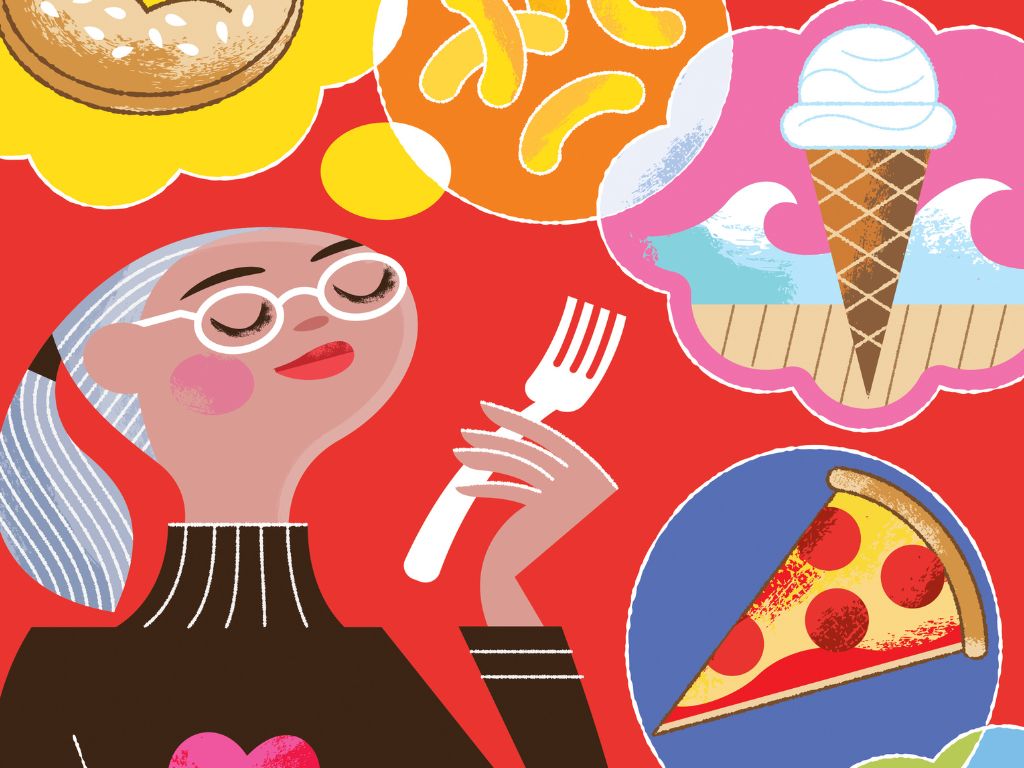
I spent years avoiding bread and pasta—now, I’m done with the carb guilt.
Carbohydrates: the nutritional villain of an entire generation and, for a while, my personal nemesis. For far too long, I lived in fear of bagels, avoided potatoes like they owed me money, and treated pasta as though it were illegal contraband. But before you judge (or start nodding in solidarity), you need to understand the times.
Carbs were public enemy number one, and I bought into the hype … hard.
It wasn’t just me. The late 1990s and early 2000s saw the rise of the Atkins and the South Beach Diets, and with it, a cultural obsession with low-carb living. Bread bowls became extinct, doughnuts were replaced with a sad pile of bacon, and the medical community didn’t just endorse it, they practically doubled down. Heroin chic was in (seriously, somebody named it that), and if you weren’t teetering on barely nourished, you weren’t paying attention. We’ve come a long way since then, but oh, the missteps we took.
I’m a registered dietitian who feared carbs.
This is my confession.
But I’ve since seen the light. And spoiler alert for anyone still stuck in the carb-fearing abyss: I actually lost weight when I reintroduced them. Here’s why I stopped running scared, started eating carbs, and haven’t regretted a piece of bread since.
The Atkins Era and Heroin Chic Fiasco
First, we need to set the scene. We just got over the paranoia that was associated with Y2K. Bread was evil. And as The Devil Wears Prada so gracefully put it:
“You don’t deserve them. I mean, you eat carbs, for Chrissake!”
We laughed—but we also nodded. Because yeah, that’s how it felt.
Fewer carbs meant fewer calories, and fewer calories got you … well, you probably remember the pictures from that time. Thinness wasn’t just a goal; it was an obsession.
Being skinny was in. As a result, that meant carbs were vilified, whether they came from a loaf of whole grain bread or (gasp) fruit. The message was clear: no spiking your blood sugar, no insulin surges, and definitely no “cheating” with spaghetti unless you wanted to balloon into oblivion. The media rolled with it, the medical community nodded along, and the rest of us ditched cupcakes faster than you could say “glycemic index.”
Why Avoiding Carbs Is a Terrible Idea (Especially for Women Over 50)
Fast-forward a couple of decades, and we now know better. Sure, cutting carbs works in the short term, but it’s unsustainable, miserable, and, honestly, pretty bad for your health, especially as we age. As a dietitian, I’m here to tell you why entirely avoiding carbs is the nutritional equivalent of texting your ex.
Goodbye Energy, Hello Fatigue
Carbs aren’t just there to sabotage your waistline. They provide your body with its most basic, preferred energy source, which is glucose. When you dramatically cut them out, your body has to scrape together whatever energy it can, leaving you feeling sluggish, cranky, and moments away from snapping at whoever left their dirty glass in the sink instead of in the dishwasher. Women over 50, whose energy levels naturally shift with age, need carbs even more to keep that pep in their step.
The Hormone Havoc
Low-carb diets can impact everything from insulin release to cortisol, potentially sending your hormones into chaos. For women navigating menopause or perimenopause, this becomes extra tricky. Your body’s already juggling so much hormone-wise. The last thing you need is a diet that makes things worse by stripping away vital nutrients.
Metabolism Meltdown
Muscle mass naturally declines as we age, and carbs are pretty great at helping us preserve it. When you go low carb, your body can start using protein (i.e., your muscles) for energy, which only slows your metabolism down further. Ironically, this makes weight loss harder in the long run.
Brain Fog, Anyone?
Here’s the thing about your brain: It loves carbs. Living in a low-carb fog isn’t sustainable because your brain literally runs on glucose. Cutting carbs can leave your mind feeling foggy and unfocused, which is a pretty steep price to pay for the privilege of skipping pasta night. Brain fog becomes more of a concern as we age, so the last thing we want to do is set ourselves up for even more reasons to feel fuzzy.
Bringing Carbs Back and Feeling Better Than Ever
Eventually, I hit a wall. The endless cycle of feeling deprived, fatigued, and defeated got old. I missed real mashed potatoes at Thanksgiving instead of telling myself that mashed cauliflower tasted “just like the real thing.” And sometimes, I simply wanted to enjoy a banana. A banana, folks!
One day, I did the unthinkable. I ate a sweet potato. Not just any sweet potato, either. This thing was roasted, caramelized, and topped with butter and a sprinkle of—gasp—brown sugar. And you know what? I didn’t instantly gain 10 pounds. I felt good.
It started slowly for me, a slice of toast here, a bowl of oatmeal there, but the impact was almost immediate. My energy skyrocketed, my mood improved, and (surprise!) my clothes actually fit better. Yep, it turns out that fueling your body properly doesn’t just keep you happy; it gets you healthy.
The best part? Carbs brought me freedom to eat, to enjoy, and to live without fear of sabotaging myself with a single bite.
Oh, and for the record? My weight didn’t balloon the way I’d feared. If anything, the scale became much kinder once I traded guilt for grains.
What Are We Missing on a Low-Carb Diet?
If you’re still clutching that cauliflower rice with white-knuckled fear, here’s a reality check for you. Low-carb diets aren’t just restrictive, they’re depriving you of some seriously important nutrients. Now, I’m not saying we should be downing copious amounts of regular soda and entire birthday cakes. I’m talking about carbs in the form of whole grains, fruit, and other nutrient-dense options. In reasonable portions and as a part of a balanced and healthy diet, of course.
Happy Hormones
Your body needs carbs to produce serotonin, aka the happiness hormone. Skip the carbs, and suddenly you’re tired, cranky, and glaring at everyone who crosses your path. Does that sound like someone living their best life? Nope.
Balanced Blood Sugar
Low-carb diets promise blood sugar balance, but the extremism often backfires. Healthy carbs (think whole grains and fruits, not ultra-processed choices) keep your blood sugar levels steady. No spikes, no crashes, no hangry-induced meltdowns.
Fiber for Days
Guess where most of your fiber comes from? Carbs! Whole grains, fruits, and veggies are all sources of fiber, which is essential for a happy gut, steady blood sugar, and avoiding … ahem, digestive drama.
Vitamins and Minerals
Banishing carbs often means saying goodbye to nutrient-dense choices like quinoa, sweet potatoes, and chickpeas. These foods are loaded with vitamins, minerals, and antioxidants that keep your skin glowing, your energy high, and your body functioning like the well-oiled machine it’s meant to be.
And let’s not forget that real milk—the quintessential bone health-supporting drink—contains carbs too. Skipping milk may mean skipping calcium, vitamin D, magnesium, and other key nutrients that help stave off osteoporosis.
The Verdict
Carbs aren’t the enemy. The fear, the demonization, the endless guilt trips? That’s the real problem. Women over 40, over 50, just over it in general—your body deserves better than keto cults and carb hysteria.
Next time someone tries to shame you for eating bread, serve yourself a second slice (preferably with butter) and enjoy every bite. After all, life’s too short to waste it worrying about a dinner roll.
******
MEDICAL ADVICE DISCLAIMER
DISCLAIMER: This website does not provide medical advice. For health or wellness-related content, SFD Media LLC emphasizes that information about medicines, treatments, and therapeutic goods (including text, graphics, and images) is provided for general information only. No material on this site is intended to substitute for professional medical advice, diagnosis, or treatment. Users are advised to independently evaluate and verify the accuracy, reliability, and suitability of the information before relying on it. You should not rely on the content as a substitute for professional medical advice. Consult with a physician or other health care professional for any health concerns or questions you may have. SFD Media LLC is not responsible for any action taken based on the information provided on this website. The use of any information provided on this website is solely at your own risk.



4 Responses
I appreciate your article and your candor about your own journey.
But if the assignment was to go deep and question the narrative, you needed to go deeper and I feel disappointed that you landed and stayed on our obsession with carbohydrates.
In MY mind, you needed to ask these questions:
Why have carbs been vilified to begin with?
What’s BENEATH this obsession with carbs or not-too-carb?
The scale. You said it yourself, “…the scale became kinder.”
Why does the scale rule the lives of even the most successful, accomplished, glamorous, glorious women? Why do I hear them reduce themselves to “…and I lost 6 pounds!”
Why? Why? Why do I give a rat’s ass about how much I weigh?
Yeah yeah yeah..it’s healthier.
I know better. At 69, I have also hidden behind that mask of declaring“I just want to be healthy.” It was less chic to be concerned about weight and more heroic to stand tall for “health.”
It was a false front for “I just want to be thinner.” No matter how I look, how I feel, if the number on the scale doesn’t match my (their/whose/someone’s) criteria, I am deeply chagrined, fighting demons that were put in place (and have devolved further since) when ancient Egyptians decided that jewelry was no longer sacred adornment, showing the sacred nature of the wearer, but worn, instead, as a reflection of wealth and status of the man involved.
I grew up with a mother who was on a diet my entire life. At 100 years old, she bemoaned her size (4’10” and 125 pounds of healthy, well-functioning muscle and brain) and would wonder out loud, “Should I have that brownie?”
My eldest sister (14 years old than I) once declared that she ate hard-boiled eggs because it took more calories to burn that egg than the egg held. She was my hero. I was an impressionable 11-year-old girl.
Is it a surprise that I (still) beat myself up over how much I eat, what I eat, when I eat…
Why? Why do we do these contortions?
BECAUSE OF HOW IT WILL SHOW UP ON THE SCALE…BECAUSE OF HOW MUCH I WEIGH. AND BECAUSE OF WHAT THIS WEIGHT MEANS TO ME AND THE WORLD AROUND ME.
Why weight? Why do we cede our sovereignty to an artificial image of a fantasy female figure created by some designer guy whose work promoted his own fantasies and reflected not a whit the real persons in living in the real world.
Botticelli’s Venus was neither Twiggy nor Kate Moss.
And even stating this, I arrive at a more unnerving place.
Carbs are a symptom of something further-reaching than what we eat and how it affects our metabolism, brain, muscle mass.
From your article:
“Cutting carbs works in the short term.” I’m wondering: Works for what (and whose) purpose?
“I actually lost weight when I re-introduced them (carbs).” My gut responds with Ahhhh…
These statements hint at what’s beneath the carbs war within ourself.
The tentacles of the carbs war reach from deeply seated roots: Our attractiveness as women is what matters and our thinness (in this culture) determines the degree of our attractiveness to men. No matter what form it takes, we feed this subservience.
THIS is what needs to be set on the table for all of us to look at and talk about and cry about…to acknowledge how our perspectives have been twisted and maligned yes, by our carb-fixation but more deeply than that by the shifting sands of the female figure as an ideal and by how our autonomy and self-love have been subjugated to the male member and its desire for control.
Here’s what I would love to see:
A movement of wholly, soulful, radical, militant ACKNOWLEDGEMENT and then REBELLION against this type of emprisonment, this sort of slavery.
Freeing ourselves to eat carbs is as good a place to begin as any. Freeing ourselves from the albatross of the scale and its potent symbolism of our addiction to our place in society.
I have no judgment about this. I’m as much a participant as the next woman. And the ones on either side of her.
But I see it. And I cringe. And I ache for something better for all of us, for our daughters, for our granddaughters, for our sons and our grandsons as well.
Because we truly are all in this together. And when we behave as such, we reap far greater rewards than when we are wedded to the weight we all bear of one being suppressed by the other.
Paula — I don’t know where to start, so I’ll start with your mother at 100, eyeing the brownie. That image is going to stay with me for a long time. Because it collapses the whole argument into one moment — a century of living, a lifetime of discipline, and still the brownie gets a vote.
You went somewhere the piece only began to point to, and you were right to. The hard-boiled egg story. The way “I just want to be healthy” became the polite version of something we’re still not allowed to say out loud.
Carbs are the surface. What you’re naming is underneath it — the scale, the inheritance, the quiet training in how to measure ourselves, and who we’re measuring for.
That’s the harder conversation. And the more honest one.
This is exactly the kind of expansion we hope for here.
Thank you for taking it further.—susan
Neither carbs nor humans are a monolith. I feel great on a grain-free diet, but quite enjoy starches in the form of tubers and all vegetables. This is what works for me at 50 and took years to figure out. I am grateful we live in a time of variety and that I can enjoy a healthy, delicious, and fun eating experiences while eating in ways that support *my* needs. Just because I appreciate a sweet potato does not mean a bowl of rice or a glutenous roll is going to be the same. The most important thing is to be connected enough to listen to our own bodies and to be willing to adapt our intake to its needs as opposed to being driven by what we think we “deserve”.
Exactly — food isn’t one-size-fits-all, and neither are we. Love how you’ve framed it: listening to your body instead of chasing diet dogma or “deserve” culture. Sweet potatoes for some, bread rolls for others — the freedom is in knowing what actually fuels you. —susan